
UK construction-site security arrangements sit within the Health and Safety at Work etc. Act 1974, and individual operatives carrying out licensable guarding activity must hold an SIA licence under the Private Security Industry Act 2001, according to The National Archives. A small site with a single entrance may require one security guard, while the site’s layout and exposure shape the practical arrangements. Construction site security services should therefore be assessed against both legal duties and operational risks.
Security means more than locking the gate at the end of the working day. Tools, materials, access points and periods without staff on site all affect a project’s exposure. Weak oversight can leave property vulnerable and disrupt work.
This guide explains the UK duties, why Birmingham sites can attract theft, and how to assess out-of-hours cover, practical site checks and provider comparisons. It also sets out what construction security can involve and how FMT Security’s construction security services fit into a considered site protection plan.
Key Takeaways
- Understand which UK legal duties shape site security and why guarding personnel must meet the required licensing rules.
- Assess exposure by considering site access, valuable materials, layout and work schedules, then prioritise practical prevention measures.
- Plan night and shutdown-period cover around changes in site activity, access control and the assets left on site.
- Use a consistent checklist to review boundaries, entry points, equipment storage and security procedures.
- Compare providers on the suitability of their guarding arrangements, operational oversight and ability to address your site’s risks.
What are the legal obligations for securing a construction site under UK law?
UK site security combines legal compliance with practical controls suited to each building site. The Private Security Industry Act 2001 requires individual security operatives carrying out licensable guarding activity in the UK to hold an SIA licence, according to The National Archives.
Manned guarding and site coverage
Manned guarding places a trained person at an agreed post to monitor access, observe activity and report incidents. Coverage may include a gate, delivery point or vulnerable storage area. For 24/7 site coverage, plan how guard duties continue across day, night and handover periods, with clear instructions for each shift.
The number of guards needed depends on the site layout, entrances, activity and risks. A small site with one entrance may need a single guard, while a larger or divided site may need separate posts or patrols to cover access points and valuable materials. Map the site first, then assign each post a clear task.
Training and licensing
The Private Security Industry Act 2001 sets the licensing requirement for individual operatives undertaking licensable guarding activity. Check that each guard assigned to that activity holds an SIA licence. Licensing establishes a formal threshold for the role; site-specific instructions then help guards apply access procedures, escalation routes and reporting requirements consistently.
Guard briefings should cover the specific site. Identify restricted areas, delivery arrangements, emergency contacts and incident-reporting procedures. For example, a guard at a vehicle entrance needs clear instructions on checking authorised access and raising concerns without obstructing routine operations.
Security services and SIA-licensed guards
Construction site security services can include manned guarding and static guards. The right arrangement depends on whether the priority is controlling an entrance, observing a particular area or maintaining a visible presence. The Private Security Industry Act 2001 requires individual security operatives carrying out licensable guarding activity in the UK to hold an SIA licence, according to The National Archives.
A guard can monitor activity, apply agreed procedures and report concerns, helping protect tools, materials and access points. The value of this cover depends on clear instructions and suitable positioning, not simply having a guard on site.
The cost of construction site security depends on the deployment, including the number and location of posts, coverage periods, site layout and identified risks. A clear risk assessment helps establish the level of guarding required.
Uniforms should make guards easy for workers and authorised visitors to identify. Clothing should suit site conditions and follow its access and safety procedures. For example, the site induction can specify suitable clothing before a guard takes up a post near active work areas.
A security contract and service-level agreement should define duties, locations, coverage periods, reporting and escalation contacts. They should also explain handovers, incident records and how changes to site access or activity are communicated. Clear terms help site managers check that the deployment matches the plan.
WHY ARE BIRMINGHAM CONSTRUCTION SITES TARGETED?
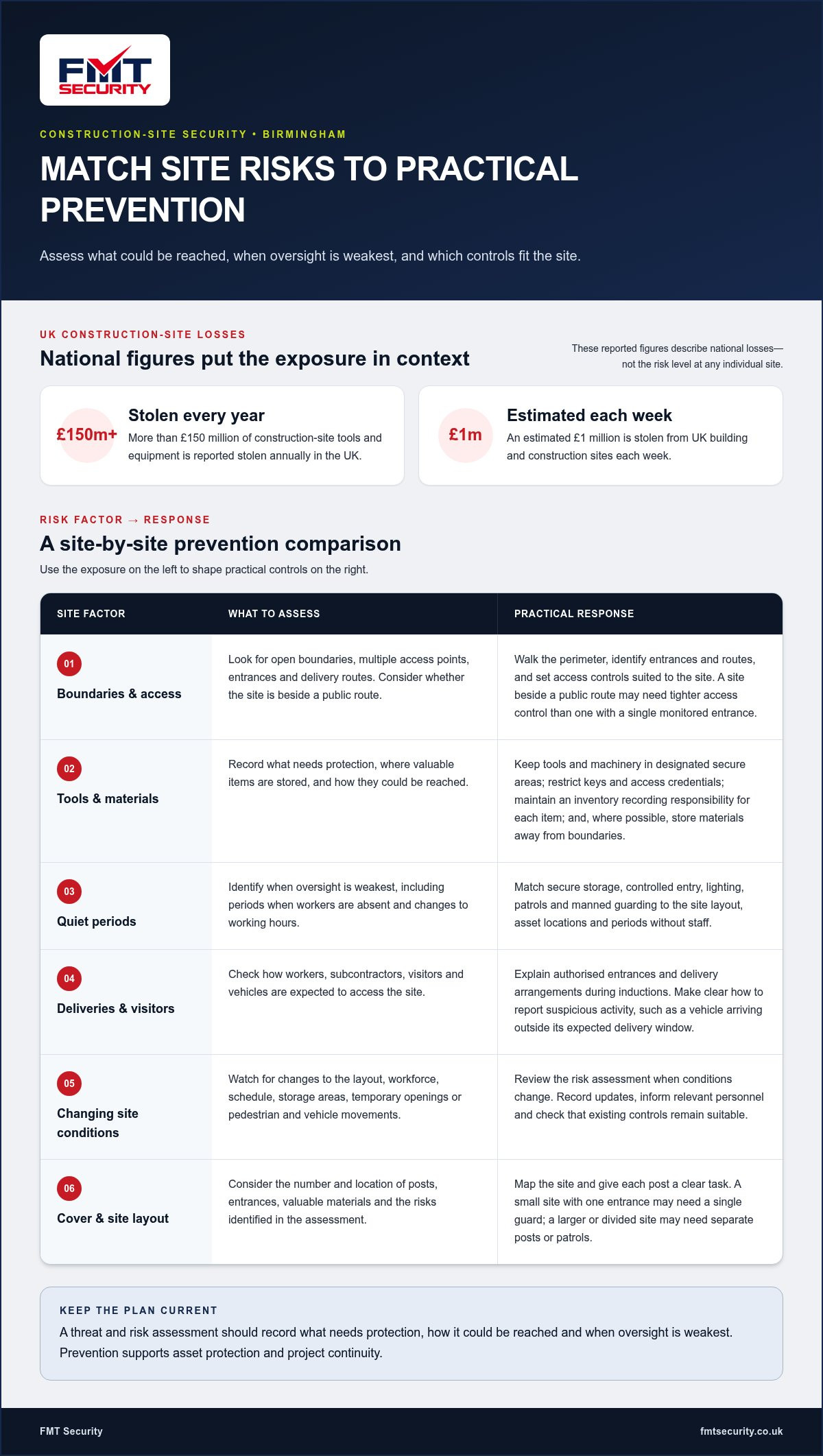
Construction sites hold tools, machinery and materials that can be removed, resold or used elsewhere. More than £150 million of construction-site tools and equipment is reported stolen every year in the UK. An estimated £1 million is stolen from UK building and construction sites each week. These figures describe national losses, not the risk level at any individual site.
Assess each project’s risks rather than assuming every site faces the same threats. An open boundary, multiple access points, high-value equipment or quiet periods can create specific vulnerabilities. Theft can also mean replacement purchases and disrupted work, so prevention supports both asset protection and project continuity.
Assess risks and plan prevention
Start with a threat and risk assessment that records what needs protection, how it could be reached and when oversight is weakest. Walk the perimeter, identify entrances and delivery routes, then note where valuable items are stored. A site beside a public route, for example, may need tighter access control than one with a single monitored entrance.
Turn the assessment into practical controls. Store tools and machinery in designated secure areas, restrict keys and access credentials, and keep an inventory that records responsibility for each item. Where possible, position materials away from boundaries. Review the plan when the layout, workforce or schedule changes.
Inductions and ongoing reviews
Site inductions help workers, subcontractors and visitors follow the agreed access process. Explain authorised entrances, delivery arrangements and how to report suspicious activity. A specific example, such as a vehicle arriving outside its expected delivery window, gives people a clear response to follow.
Review the risk assessment when project conditions change, such as when storage areas, temporary openings or working hours shift. Sites with changing pedestrian and vehicle movements may need different access arrangements from quieter sites. Record changes, inform relevant personnel and check that existing controls remain suitable.
Match guarding to the exposure
Prevention can combine secure storage, controlled entry, lighting, patrols and manned guarding. The appropriate mix depends on site layout, asset location and periods when workers are absent. Consider the full 24 hours, including delivery windows and quiet periods, rather than focusing only on the working day.
Where a guard forms part of the plan, define the post, patrol route and reporting procedure. Licensed personnel should know who receives an incident report and what action follows. A written response process reduces uncertainty when an alarm, attempted entry or missing item is discovered.
A structured assessment of site vulnerabilities can help identify suitable prevention and guarding arrangements. Construction site security planning should form part of a clear, site-specific risk control plan by FMT Security.
Night and shutdown-period cover
Construction sites often need different security arrangements after workers leave. At night, fewer people are present to notice an open gate, damaged boundary or unexpected vehicle. During a shutdown, lower activity can make normal access patterns harder to monitor. Set cover according to the risk assessment, operating hours and assets left on site.
Before a closure, record which entrances remain in use, who can authorise entry and how deliveries will be handled. Secure portable tools and machinery in designated storage, remove access credentials no longer needed and give security guards an updated contact list. For example, a planned maintenance visit should have an authorised contact, arrival window and agreed access route.
Where a site requires observation throughout 24 hours, plan how each period is covered and how responsibility passes between personnel. Written handover notes should record open incidents, expected visitors, access changes and areas needing attention. Define the response to an alarm or suspected entry, including who receives the report and how site management is contacted.
Construction security providers operate across the UK, but coverage near you depends on the site address and the deployment required. For a Birmingham project, specify the location, access arrangements, operating schedule and shutdown dates when comparing available cover. This gives providers a clear basis for explaining their local arrangements without assuming that every site needs the same deployment.
Regional planning should account for the construction sector’s changing work patterns. A site with regular deliveries needs different access instructions from a closed site holding machinery during a pause in work. Businesses should also identify whether guarding is required at fixed posts, along patrol routes or at both. Match the arrangement to the site plan rather than relying on a general description of coverage.
Before agreeing a deployment, document the practical requirements:
- Identify the dates and hours requiring cover, including night work and shutdown periods.
- Mark entrances, boundary sections, storage areas and any restricted zones on a site plan.
- Set out visitor authorisation, delivery handling, incident reporting and escalation contacts.
- Record how guard attendance, patrol activity and shift handovers will be communicated.
When a provider refers to accreditation, establish which activities it covers and how it relates to the proposed assignment. Confirm that personnel undertaking licensable guarding activity hold the required SIA licences. Clear instructions help guards follow site procedures consistently, while documented handovers support continuity between shifts.
For Birmingham construction sites, connect the shutdown plan to the site’s actual access points and working calendar. Night-time construction site security should be considered alongside storage controls, reporting routes and management contacts.
Construction site security checklist
A consistent checklist turns site security into repeatable actions for supervisors and personnel. Use it at opening and closing, and whenever a change affects access, equipment or the boundary. A clear checklist helps teams apply construction site security services consistently instead of relying on memory.
Visitor credential checks
Set a clear entry process for visitors, delivery drivers and contractors. Record each person’s name, organisation, reason for attending and site contact, then compare those details with the expected visit. Issue a visitor credential and record arrival and departure. If a visitor cannot be authorised, restrict access and contact the named site representative before admitting them.
Keep visitor records accessible to the person managing the entrance, and collect temporary credentials when visitors leave. For example, a delivery driver should use the agreed delivery point rather than entering storage or work areas. Explain restricted zones before granting access, and ensure escorts know they are responsible for accompanying visitors.
Physical security checks
Walk the perimeter and inspect gates, fencing, locks and other access points. Look for gaps, damage, unsecured doors or signs of attempted entry. Record the location and report defects for action. Check that lighting covers entrances and routes used after working hours. A damaged fence beside equipment storage needs prompt attention and a recorded follow-up.
Inspect storage areas for exposed tools, machinery and materials. Confirm that keys are controlled, containers are secured and equipment is returned to its designated location. Check that vehicles and plant are immobilised according to site procedures. Clearly record vandalism, missing items or damage, including the affected area and the person notified.
Use this practical checklist during routine site inspections:
- Confirm gates and doors close securely, and note any faults or forced-entry marks.
- Check that visitor credentials are issued, recorded and returned at departure.
- Verify that tools and equipment are stored in their assigned secure areas.
- Inspect boundary lighting, access routes and signs for damage or obstruction.
- Record concerns, identify the responsible person and track the response to completion.
Each entry should state what was checked, where an issue occurred and what action followed. A note such as “rear gate latch damaged, reported to the site manager” gives personnel a usable record. Avoid vague entries such as “site checked”, which do not identify a defect or show whether anyone addressed it. These records also help construction site security services respond to recurring weaknesses with clearer site instructions.
When a concern needs immediate attention, follow the site’s escalation procedure and notify the designated contact. For example, record the time, location and observed details of suspected unauthorised access. Avoid disturbing a potentially relevant area unnecessarily, and preserve information for the appropriate manager or response personnel.
Review the checklist when site access, storage arrangements or work activities change. A new delivery entrance or relocated equipment store can make an existing inspection route incomplete. Assign responsibility for each check, retain completed records and resolve reported defects. This makes security part of daily site control, not an occasional inspection.
Comparing construction security providers
Compare providers against the site’s documented risks, not broad claims about protection. A useful proposal explains how specific posts, patrols or monitoring arrangements address each exposure. A site with valuable plant near an open boundary, for example, needs a different deployment from one requiring controlled entry at a single gate. Assess the proposed duties and supervision, not just the visible presence of officers.
Start with the service scope. Check the locations to be guarded, coverage periods, assigned duties and handover arrangements. Ask how the deployment will adapt if site access changes or work moves to another area. A proposal for construction site security services should link its measures to defined risks, rather than rely on a standard package or broad assurances.
Assess operational oversight as well as staffing. The proposal should explain who receives incident reports, how concerns are escalated and how attendance or patrol activity can be reviewed. For mobile patrols, look for defined routes, site access instructions and visit records. These details help show how the service is supervised.
Review the service terms before deciding. The agreement should define duties, locations, coverage periods, reporting, escalation contacts and procedures for changing requirements. Check how missed attendance, incidents and complaints are handled. Review relevant insurance documentation and confirm that the stated cover applies to the contracted work. Clear terms make responsibilities easier to manage.
Use consistent criteria to compare each proposal:
- Match each identified risk to a named post, patrol or monitoring task.
- Compare officer duties, site instructions, handovers and management oversight.
- Review incident reporting, escalation routes and record-keeping arrangements.
- Assess contract scope, insurance documentation and procedures for changes.
- Consider how the proposed response would address suspected criminal activity.
Do not use the headline price as the only measure of value. Compare coverage, included tasks and the management time needed to oversee the service. A fixed post and mobile patrols are not equivalent unless both address the same risks and operating periods. Compare construction site security proposals on a like-for-like basis against the site’s requirements.
Finally, assess whether the provider understands construction operations. A new delivery entrance, changing work zone or shutdown can alter security requirements. The provider should explain how changes become updated instructions and how those instructions reach the relevant officers. This helps maintain consistent procedures as the project develops.
Use these criteria to identify gaps before agreeing terms for your project. Discuss construction site guarding requirements in relation to your site’s risks, coverage and reporting needs.
FMT Security: Construction Security
FMT Security provides construction security for sites requiring professional manned guarding and security oversight. Its SIA-licensed officers help businesses protect building sites, valuable materials and access points through a defined guarding arrangement.
Consider construction security when a site risk assessment identifies a need for a visible guard presence, controlled entry or ongoing oversight. The deployment can be tailored to the project’s layout and operational requirements. FMT Security also provides corporate, industrial and event security for other commercial environments.
Share your site requirements and the security concerns you need addressed. Contact FMT Security about construction security.
Make security part of project planning
Security arrangements should develop alongside the build. As contractors, access routes and storage areas change, assign responsibility for updating site instructions and communicating revisions. This keeps construction site security services aligned with the project instead of relying on procedures designed for an earlier phase.
For Birmingham businesses, the next step is to translate identified risks into a clear guarding requirement: define the areas needing attention, expected duties and reporting arrangements. FMT Security provides Construction Security, alongside Corporate Security and Industrial Security, for organisations with different operational needs.
A considered discussion can help establish whether manned guarding is appropriate for your site and what its role should cover. Contact FMT Security to discuss your construction security requirements and the next steps for your site. A clear plan gives your project team a practical basis for maintaining security as work progresses.
Frequently Asked Questions
Do individual guards need an SIA licence, or does the company need accreditation?
Individual operatives carrying out licensable guarding activity in the UK must hold an SIA licence under the Private Security Industry Act 2001, according to The National Archives. This is a requirement for the operative, not a substitute for assessing the security company’s processes. When reviewing a provider, distinguish each guard’s licence status from any company-level accreditations or quality procedures, which relate to different aspects of service delivery.
How quickly can a new site get security in place?
The time needed to prepare a deployment depends on how quickly the site requirements can be defined and arrangements prepared. A site plan, access instructions, coverage schedule and named escalation contacts help establish the scope. For example, a project with separate contractor and delivery entrances needs those arrangements documented so personnel can follow them consistently. Include planned work changes so the deployment reflects actual operating conditions.
How quickly can manned guarding be deployed?
Deployment planning depends on the required post, coverage pattern, site access and instructions for guards. A straightforward entrance post differs from a site needing several locations, detailed delivery procedures or restricted-zone controls. Prepare the site address, operating schedule, duties and emergency contacts together. This allows the deployment to reflect practical requirements rather than an assumed start time or incomplete description.
What threats do construction sites face?
Common site risks include theft of tools, machinery and materials, unauthorised entry, trespass and vandalism. The likely risks vary with the project’s location, boundary condition, storage arrangements and activity levels. Materials stored beside an accessible perimeter, for instance, present a different concern from equipment kept in a locked compound. Assess the site and identify which assets, entrances and periods need the closest attention.
What track record indicates a security provider is reliable for construction sites?
Look for evidence that a provider can turn site requirements into consistent guarding procedures. Useful indicators include clear post instructions, documented handovers, structured incident reporting and defined oversight responsibilities. For example, a written process should explain how to record an access concern and notify the correct site contact. Assess whether the service addresses construction activity, rather than relying on broad claims about security experience.
Why does access control matter on a construction site?
Access control helps distinguish authorised workers, contractors, visitors and deliveries from unplanned arrivals. Without a consistent process, a delivery vehicle may enter the wrong area or a visitor may reach a restricted zone. Specify who can approve entry, which routes different users should follow and how exceptions are recorded. These procedures also give site managers a clearer record of who entered and why.
How do mobile patrols, CCTV and monitored alarms compare for construction site security?
Mobile patrols involve physical visits to designated areas, while CCTV records activity within camera coverage and monitored alarms signal an activation. Each serves a different role: patrols can observe site conditions, cameras can provide recorded visual information, and alarms can draw attention to a trigger. Choose based on the site layout and response procedures. These methods can complement one another, but none replaces clear access arrangements.
What are the legal requirements for security guards and CCTV on UK construction sites?
Individual operatives carrying out licensable guarding activity in the UK must hold an SIA licence under the Private Security Industry Act 2001. CCTV is a separate consideration from guard licensing. Establish who can view footage, why it is being used, how recordings are managed and who handles requests or incidents. These practical controls support accountable operation; CCTV does not replace the licensing requirement for guards performing licensable activity.


