A visible guard is effective when presence is matched by clear procedures. Security guards for business premises should be alert to access and activity, able to follow site instructions, and appropriately licensed for the work they perform. Licensable guarding work requires an SIA licence under the Private Security Industry Act 2001, according to the UK legislation portal. Static cover places a guard at a defined point, such as an entrance, where they can monitor arrivals and respond to concerns.
It’s reasonable to expect security to do more than provide a visible presence. Guards can work alongside alarms and CCTV, helping identify unusual activity and manage access without replacing those systems.
This article explains what to look for in security guards for business premises, how SIA licensing applies and how static guarding can support deterrence and site protection. It also explains when a fixed post is useful and how it can fit into a wider security plan.
Key Takeaways
- Assess a guard’s suitability by their training, experience, reporting approach and ability to follow site procedures.
- Understand when SIA licensing applies to guarding work and why valid licensing matters for compliance.
- Use visible presence and consistent patrols to deter unauthorised access and support a timely response to suspicious activity.
- Consider static cover where a fixed post can control entry, check permissions and maintain oversight of a specific area.
What to look for in a modern business security guard?
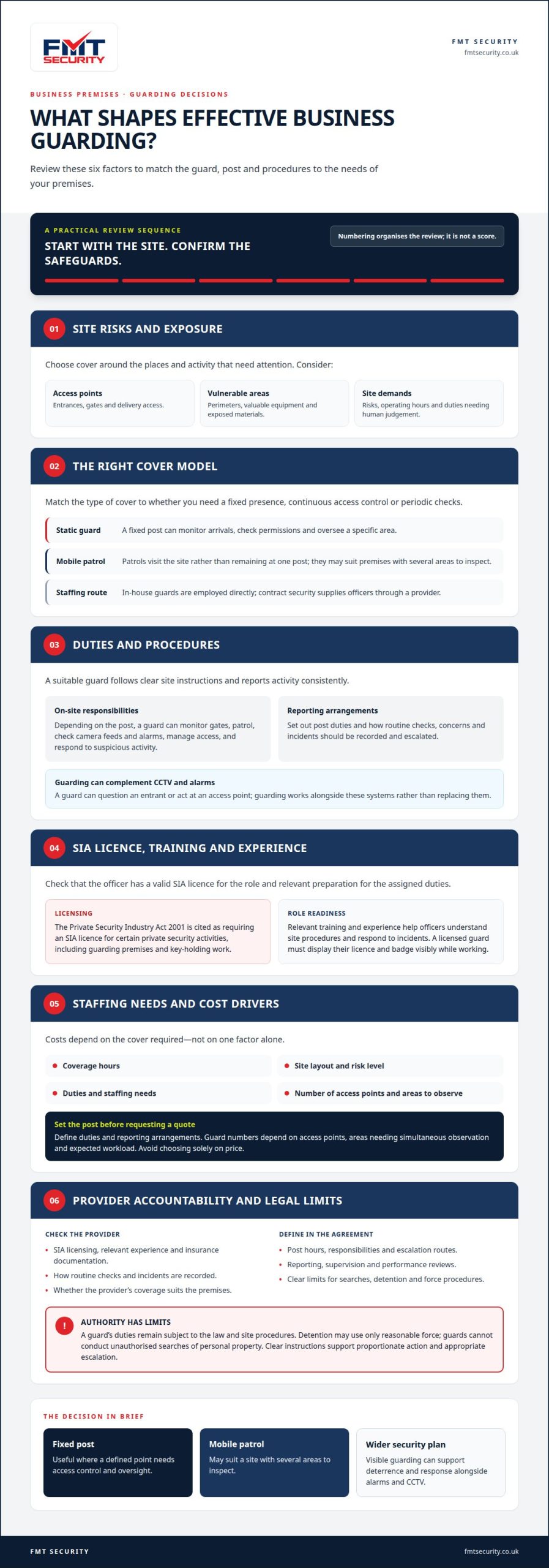
Choose cover according to the site’s risks, operating hours and duties that require human judgement. A suitable guard follows clear procedures and reports activity consistently.
Manned guarding and CCTV
Manned guarding places an officer on site, while CCTV records or displays activity for monitoring. A guard can check camera feeds, patrol, monitor gates and alarms, then respond to suspicious activity. This matters where footage alone cannot question an entrant or act at an access point. The UK legislation portal cites the Police and Criminal Evidence Act 1984 as the UK legal basis for anyone making a citizen’s arrest.
Business security staffing options
In-house guards are employed directly, while contract security supplies officers through a provider. Mobile patrols visit sites rather than remaining at one post. The right model depends on whether you need continuous access control, a fixed presence or periodic checks. At a retail entrance, for example, a stationed guard can manage arrivals, while mobile patrols may suit a site with several areas to inspect.
Hiring costs and guard numbers
Commercial guarding costs depend on coverage hours, site layout, risk level, duties and staffing needs. The number of guards depends on access points, areas requiring simultaneous observation and the expected workload. A single entrance with limited activity differs from a warehouse with separate gates and loading areas. Set out the post duties and reporting arrangements before requesting a quote, and avoid choosing solely on price.
Provider credentials and local searches
Assess a provider’s SIA licensing, relevant experience and insurance documentation, then establish how incidents and routine checks are recorded. Search by your location and required service, and assess whether the provider’s coverage suits the premises. A contract and service-level agreement should define post hours, responsibilities, escalation routes, reporting, supervision and performance reviews. Clear limits on search, detention and force procedures help manage operational and liability risks for the business and guard.
SIA licensing for UK security guards
SIA licensing applies to certain private security activities in the UK. Understanding its scope helps businesses distinguish licensed guarding from other site duties.
Licensing requirements and training
The Private Security Industry Act 2001 is the legislation cited for requiring an SIA licence for certain private security activities, according to the UK legislation portal. Licensable work includes guarding premises against damage, theft, unauthorised access or disorderly behaviour. Keeping or controlling access to keys or devices that operate locks is also a licensable key-holding activity. Businesses should ensure the assigned officer holds a valid licence for their role. Relevant training and experience also matter, because officers must understand site procedures and how to respond to incidents.
Licence display and legal limits
An SIA-licensed guard must display their licence and badge visibly to the public while working. This helps visitors and employees identify the officer performing a regulated activity. A guard’s presence does not grant unrestricted powers: duties remain subject to the law and site procedures. Clear instructions help officers manage access, identify concerns and escalate incidents appropriately, without acting beyond their authority.
Guards may detain someone only using reasonable force. A citizen’s arrest is subject to specific conditions, including the circumstances of the suspected crime and whether a police arrest is practical or necessary to prevent harm. Officers cannot conduct unauthorised searches of personal property. Businesses should make these limits clear in post instructions, particularly when staff handle suspected theft or confrontations.
Licensing does not replace suitable preparation. Training should relate to the assigned duties, while site briefings should cover entry rules, incident reporting and escalation contacts. For example, an officer controlling a delivery gate needs clear procedures for checking permission and recording concerns. These measures help keep security activity proportionate and accountable.
For businesses assessing on-site cover, business security guard services can form part of a considered premises security plan.
Crime deterrence
Visible on-site guarding can deter offending and support a timely response to suspicious activity. Its value depends on positioning the guard where people, property or access points are exposed.
Deterring crime and protecting property
A guard’s visible presence can discourage vandalism, theft, trespassing and unauthorised access. At a building entrance, for example, checking who enters can make unauthorised access more difficult. On construction sites, patrols can draw attention to exposed materials and vulnerable areas. Patrols may follow regular intervals or vary their timing, helping officers notice changes in site activity. The aim is prevention and early detection, not a guarantee that crime will stop.
Security works best when patrol routes reflect the property’s layout. An officer can check perimeter gates, entrances and areas where valuable equipment is stored. If they notice damage or suspicious behaviour, they can record the incident and alert the relevant people. This supports a clear response process as well as the deterrent effect of visible cover.
Safety through visible guarding
On-site guarding can support staff and customer safety by providing a visible point of contact during incidents. In a retail environment, an officer can monitor public areas and respond to disputes or suspected theft. Their presence may deter shoplifting and employee theft, while a measured response can help de-escalate aggression. Staff can also report concerns directly instead of relying only on recorded footage.
During an incident, a guard can act as the first line of defence by following site procedures and seeking appropriate assistance. For example, an officer who sees a conflict near an entrance can alert the relevant people and help keep others clear. This is particularly useful where employees, visitors and customers share busy access areas.
Deterrence depends on suitable positioning and consistent vigilance. A guard near a public entrance can monitor arrivals, while patrols cover less visible parts of the property. CCTV and alarms can support this work by drawing attention to activity, but they do not replace a guard’s ability to observe conditions directly and respond on site.
Static guarding at business premises
Static guarding assigns an officer to a defined post, such as reception, a gate or a loading entrance. This fixed deployment suits locations that need a consistent presence to manage access and observe activity.
Static guard arrangements
For businesses assessing security guards for business premises, a fixed post can provide direct oversight of a specific access point. An officer can check permissions, monitor people entering and leaving, and provide a point of contact for employees, visitors and delivery drivers. At a warehouse, for example, post instructions might cover supplier access, vehicle movements and incident recording. These procedures keep the guard’s duties clear.
Static cover is most useful where one location needs ongoing attention. A guard can assess whether someone has permission to enter at the gate, rather than relying only on footage after an incident. Records can also help management identify recurring issues, such as attempts to use an unattended entrance. Position the post so the officer has an appropriate view of the area they are assigned to monitor.
Types of business security guards
Businesses can choose fixed-post guards or mobile patrol officers who visit premises to inspect areas. The decision depends on whether the priority is continuous access control or checks across multiple locations. Retail premises may need an officer at a public entrance, while a larger site may require patrols between separate areas. The right deployment of security guards for business premises depends on the environment and the duties required.
Static guarding can work alongside surveillance. CCTV may draw attention to activity, while an officer at the gate assesses the situation and follows site procedures. Cameras record events; guards observe conditions directly. Identify which assets need protection, which entrances require control and how staff can report concerns.
For a fixed post focused on access and site oversight, explore static guarding arrangements as part of your premises security planning.
FMT Security: Static Guards
FMT Security provides static guards for businesses that need a visible presence at a defined post. This can suit premises where access control, visitor oversight or protection of a particular area forms part of the security plan.
FMT Security provides tailored security guard services for commercial environments. Its fully trained, vetted and SIA-licensed officers can support corporate premises and construction sites where entry points, people or assets need on-site attention. Post duties depend on the site layout, operating environment and identified risks. Clear instructions align the guard’s role with daily operations and incident reporting.
For fixed guarding at your premises, contact FMT Security to discuss your requirements.
Set the right level of cover for your next stage
Security arrangements should reflect how your premises operate and adapt as access patterns and business activity change. When planning future occupancy, deliveries or site use, consider whether the guard’s location and responsibilities still match the risks. This makes security guards for business premises part of operational planning, rather than a measure reviewed only after an incident.
FMT Security provides Construction Security, Corporate Security and Industrial Security. These services give businesses guarding suited to their environment and site requirements. Discussing your premises with FMT Security can help define the purpose of the cover and the operational details that should shape it.
Take the next step by contacting FMT Security about your security requirements. A clear assessment of your priorities can help you move towards a more considered guarding plan.
Frequently Asked Questions
Are security guards a legal requirement in the UK?
A guard is not necessary at every UK business premises. The decision depends on the site’s exposure, operations and risks, including access arrangements and valuable assets. Assess whether guarding is a proportionate measure alongside existing controls. Where a business uses guards for licensable security activities, the relevant SIA licensing requirements apply.
Can security guards undertake unauthorised searches of personal property?
No. Security guards cannot conduct unauthorised searches of personal property. A limited exception applies where the apparent owner is incapacitated and a search is needed to identify or assist them. For example, suspected theft does not itself authorise an officer to search someone’s bag. Site procedures should direct officers to record concerns and escalate them through appropriate channels.
Can security guards use handcuffs or weapons?
UK security guards may carry handcuffs, but not weapons. This does not give an officer unrestricted authority to restrain someone: any detention must remain within legal limits, including the use of reasonable force. Businesses should set clear incident procedures that prioritise de-escalation and appropriate escalation, rather than treating equipment as a substitute for judgement or training.
Can security guards use surveillance equipment?
Guards can monitor CCTV footage on site and use camera views to identify suspicious activity. CCTV can support an officer’s observations, for example by drawing attention to movement near a restricted entrance. It does not replace the officer’s role in assessing the situation and following site procedures. Businesses using biometric surveillance must ensure collection is informed and proportionate to its purpose.
What SIA licences and qualifications must UK security guards have?
Guards need a valid SIA licence for the licensable activity they perform. The Private Security Industry Act 2001 is the legislation cited for requiring licences for certain private security activities, according to the UK legislation portal. For example, guarding premises and controlling access to keys are licensable activities. Training and experience should also be relevant to the guard’s assigned duties and site procedures.
How should businesses assess premises security risks before hiring guards?
Assess the premises by considering its size, industry, access points, operating patterns and specific risks. A warehouse may need attention to vehicle movements and loading access, while an office may prioritise visitor entry. Map the areas requiring observation, identify likely incidents, and decide what response and reporting procedures are needed. This provides a practical basis for deciding whether guarding is suitable.