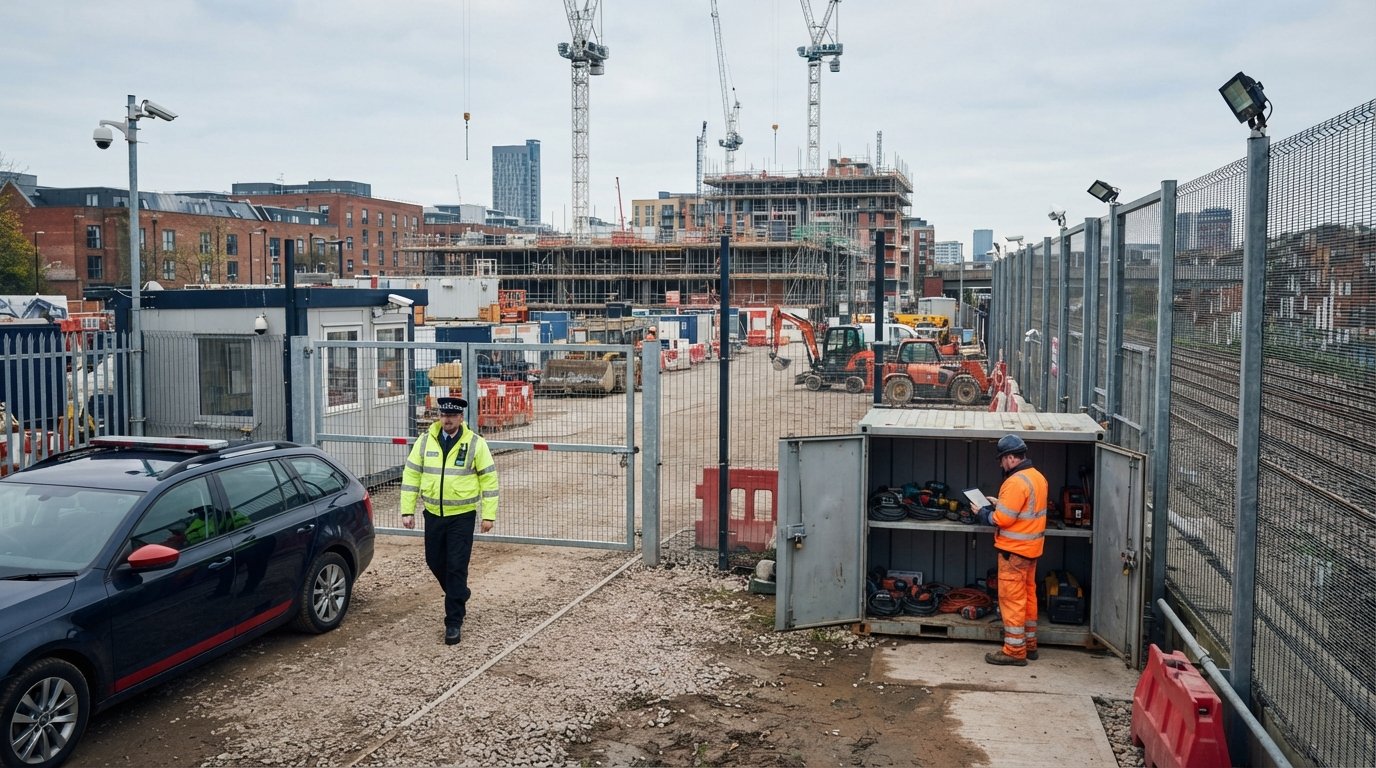
UK construction theft losses reach £800 million per year, according to Allianz Cornhill. To prevent construction site theft, combine practical controls rather than relying on a single measure. Secure tools and plant, manage site access, and use visible deterrents to reduce opportunities for theft and support a prompt response if something goes wrong.
Keeping a site secure can be challenging when a small team is balancing deliveries, equipment and daily work. A consistent routine makes protection more manageable. This guide sets out practical steps for small teams and lone contractors, including tool sign-in and sign-out, equipment records and tracking, and the role of cameras, alarms and lighting. It also includes a checklist for storage, access, deliveries and site reviews, helping you identify gaps and organise safeguards around the risks at your site.
Key Takeaways
- Build consistent end-of-day routines for securing tools, plant and materials, even when a small team is responsible for the whole site.
- After suspected theft or unauthorised entry, preserve CCTV, photographs, access logs and asset records, then report the incident to the police.
- Keep clear equipment records and consider marking or tracking valuable assets to support identification and recovery.
- Use lighting, alarms and carefully positioned CCTV as complementary deterrents, with cameras operated in line with UK data-protection requirements.
- Use a practical site checklist to review access, storage, deliveries and vulnerable periods, then address the gaps that expose assets to risk.
1. Security options for small teams and lone contractors
Small teams can improve site security by assigning clear responsibility for closing, storing and recording equipment. A daily routine helps prevent construction site theft without requiring a large workforce. For example, the last worker to leave can check storage locks, gates and plant keys against a short closing checklist. Lone contractors should complete the same checks before leaving equipment unattended.
Start with the boundary. Keep gates closed unless deliveries or authorised site movements require them to remain open, and repair damaged fencing promptly. Position equipment away from safety fences and public view, rather than beside a perimeter where it may be easier to reach. If one entrance serves the project, direct workers and deliveries through it so arrivals can be monitored. Fencing and security personnel can provide additional deterrence where the site layout or asset exposure warrants it.
After each shift, return power tools, hand tools and lifting tackle to lockable tool chests or steel storage containers. Keep storage buildings locked, and secure items inside containers with heavy-duty padlocks or chains. Store valuable materials in locked compounds or buildings away from the perimeter. A sign-in and sign-out record for small tools makes it easier to identify missing equipment and establish who last used it.
Unattended plant needs separate controls. Remove ignition keys and keep them in a controlled location, rather than leaving them in the cab or nearby. Park machinery in a lit, monitored compound where possible. Larger plant can be positioned to restrict access to smaller equipment. Secure fuel tanks with secure caps or anti-siphon devices, and limit access to fuel storage.
Contractors can reduce theft risks when hiring or receiving equipment by recording each item’s arrival, condition and authorised recipient. Schedule deliveries for a specific time when a worker can supervise unloading, and record materials moving onto or off the site. Do not release an unexpected collection without authorisation. When vehicles must be parked in public, leave only the tools needed for that day, secure them in a locked steel chest fixed to the vehicle, and remove them overnight.
Security procedures work best when workers know them before handling equipment. Include site rules in inductions, then reinforce them through toolbox talks. Explain where tools belong, how to complete sign-out records, and whom to notify about a damaged lock or suspicious activity. Keep instructions practical: a worker using a disc cutter should know where it is stored and who records its return.
For a small crew, a brief end-of-day check can cover the gate, storage, keys and equipment register. Workers should not leave small tools unattended while working elsewhere on site. Limit information about valuable equipment and materials to people who need it, and make sure each worker understands the agreed reporting route. Repeating these steps supports consistent site security across changing shifts and deliveries.
2. What is the best way to prevent theft on a construction site?
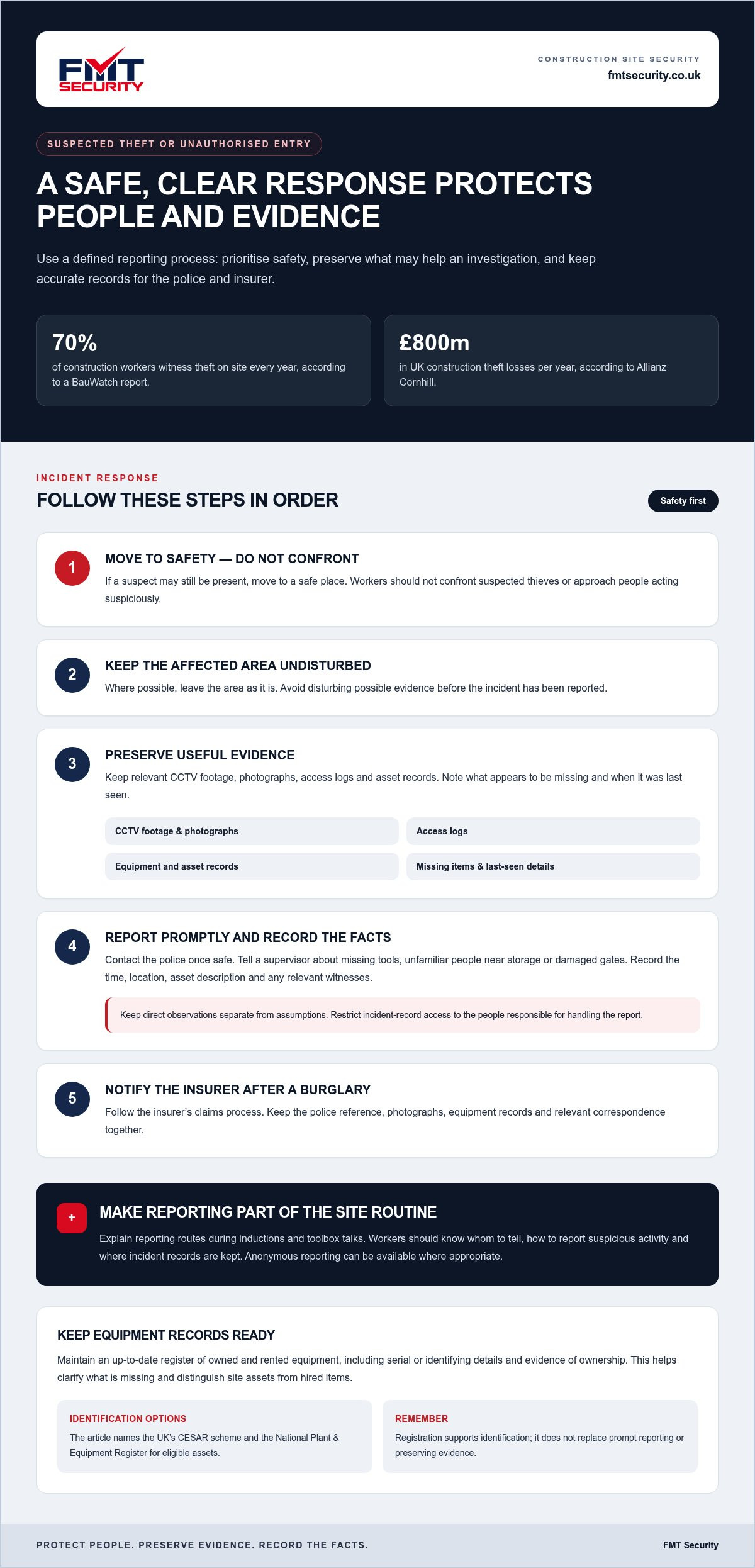
The best approach combines preventive measures with a clear incident response: report theft to police, notify your insurer after a burglary, and preserve evidence. For equipment identification, use the UK’s CESAR scheme or the National Plant & Equipment Register to register eligible assets.
If someone suspects a break-in, workers should prioritise safety and avoid confronting thieves. Leave the affected area undisturbed where possible, then preserve CCTV footage, photographs, access logs and asset records. Record what appears to be missing and when it was last seen. These details can help police investigate and support an insurance claim.
Make reporting responsibilities clear before an incident occurs. During inductions and toolbox talks, explain whom workers should tell, how to report suspicious activity and where incident records are kept. A worker who notices a missing tool, an unfamiliar person near storage or a damaged gate should report it promptly to a supervisor. Do not confront anyone over suspected employee theft. Report concerns through the supervisor, with anonymous reporting available where appropriate.
A BauWatch report found that 70% of construction workers witness theft on site every year. A defined reporting process helps turn observations into usable information, rather than leaving concerns unrecorded. Supervisors should note the time, location, asset description and any relevant witnesses. Separate direct observations from assumptions, and restrict access to incident records to people responsible for handling the report.
Neighbours and nearby businesses may notice activity outside normal site hours. Give them a site contact and clear instructions to report suspicious activity to police, rather than approaching people themselves. Workers who discover a burglary should move to a safe place if a suspect may still be present. They should avoid disturbing possible evidence and contact police once safe.
After reporting the incident, notify the insurer and follow its claims process. Keep copies of the police reference, photographs, equipment records and relevant correspondence together. An up-to-date register should identify owned and rented equipment, serial or identifying details, and evidence of ownership. These records can clarify what is missing and distinguish site assets from hired items.
Registration supports identification, but it does not replace prompt reporting or evidence preservation. Keep workers informed about reporting routes, including how to raise concerns anonymously, and review the procedure after any incident. A consistent process helps contractors respond in a controlled way, protect remaining assets and provide police and insurers with accurate information.
3. Tracking devices for tools and heavy equipment
Tracking devices can help locate construction tools and heavy equipment if they are stolen. They work best alongside physical security, clear asset records and a defined reporting process. Prioritise high-value or operationally critical items, such as a breaker or excavator, so the project team knows which assets need closer oversight. Record which device is associated with each asset and keep that information accessible to authorised staff.
A tracker is not a substitute for securing equipment overnight. Remove ignition keys from unattended plant and store them separately in a controlled location. Put smaller tools in locked chests or containers, and secure equipment inside containers with heavy-duty padlocks or chains. Where the site has a lit, monitored compound, park plant there. Larger machinery can also be positioned to restrict access to smaller assets.
Maintain a register covering owned and rented tools, equipment and materials. Include descriptions, identifying details, ownership status and each item’s usual storage location. Update the record when equipment arrives, moves between work areas, is returned or leaves the site. A current inventory helps supervisors identify what is missing and gives police and insurers useful evidence of ownership.
Mark tools with company details so they can be linked to their owner if recovered. Forensic marking or registration can provide another means of identification. Keep a record of the markings and the asset they belong to; otherwise, a mark may be difficult to connect with the correct entry. Apply the same approach to hired items, while clearly recording their ownership and hire status.
In the UK, the Construction Equipment Security and Registration scheme, known as CESAR, and the National Plant & Equipment Register are programmes for registering construction equipment. Registration details should match the site’s asset records. Keep relevant information available to the person responsible for reporting theft, so it can be supplied accurately if an item goes missing.
If equipment is stolen, report the incident to police and provide its description, identifying details, photographs and tracker information. Preserve relevant records and CCTV footage rather than altering or deleting them. Share tracker information through the appropriate reporting process; workers should not attempt to confront a suspect or recover an asset themselves. Notify the insurer and retain copies of the incident details and asset records.
Limit information about onsite assets to people who need it for their work. Avoid unnecessary public discussion of valuable equipment, storage locations or site routines. Keep the asset register and tracking access under controlled management, and update them whenever equipment changes hands. These measures help contractors protect equipment and provide a clearer record if recovery or an insurance claim follows.
4. CCTV, alarms and lighting
UK construction-site CCTV should be operated in line with UK data-protection requirements. Plan its purpose, coverage and footage handling as part of site security. Cameras should focus on relevant areas, such as equipment storage, site entrances and vehicle access points. Do not treat recording as a standalone measure: its value depends on suitable placement and a clear process for reviewing footage.
Position cameras to view tools, plant and material storage, including the routes leading to those areas. Review each camera’s view after dark and during normal site activity. A stack of materials, parked vehicle or temporary structure can create a blind spot. Adjust coverage when the project layout changes, so equipment does not become a new target outside the recorded view.
Some cameras use motion detection and can send automatic notifications when movement occurs. When configured, these alerts can help staff identify activity outside working hours. Set monitored areas around access routes and valuable assets, then decide who receives and reviews alerts. A notification is useful only when someone has a defined response and can assess the event safely.
Lighting supports both deterrence and visibility. Illuminate entrances, routes around storage areas and compounds holding plant, rather than leaving dark gaps beside fencing. Check these areas after dusk, since a light that covers the gate may not reach a container entrance. Well-lit surroundings can discourage theft and make people or vehicles easier to identify in recorded footage.
An audible alarm can alert people to unauthorised entry and draw attention to a vulnerable area. Consider which access points or storage locations need alarm coverage, then set a clear procedure for responding to activation. Staff should know how to report an alarm event and preserve relevant footage. Do not rely on sound alone to identify what triggered it.
These measures work best as a coordinated system. For example, lighting can improve the view captured by a camera, while an alarm draws attention to activity near a locked compound. Tracking may help locate missing equipment, while CCTV can provide context about when and where it disappeared. Keep camera coverage, alarm settings and asset records aligned as site conditions change.
Include a regular condition check in the site security routine. Inspect cameras, lights and alarms for visible damage, obstruction or wear, and record faults for follow-up. Test the view across access points and storage areas, not only at the main gate. If a camera has moved or a light has failed, address the gap before it leaves valuable equipment exposed.
Finally, make access to footage controlled and purposeful. Identify who is responsible for reviewing relevant recordings after suspicious activity, and preserve footage when an incident occurs. Keep the process consistent with UK data-protection requirements. This gives site managers a practical way to use CCTV for prevention and incident evidence, without relying on recording alone to protect assets.
UK construction-site CCTV should be operated in line with UK data-protection requirements. Plan its purpose, camera coverage and footage handling, and focus cameras on relevant areas such as entrances, vehicle access points and equipment storage.
5. Construction site theft prevention checklist
A useful checklist turns a site risk assessment into tasks workers can complete and supervisors can monitor. Review access roads, blind spots, working hours and previous incidents in the area. Then identify which valuable assets are closest to those risks. For example, machinery beside an unlit access road may need different controls from tools stored inside a locked building.
Check how people and deliveries enter and leave. Limit access to people who need to be onsite, and make sure the person responsible can recognise authorised visitors. Store equipment away from safety fences, where it is less accessible from outside. Revisit the layout when a new work area opens or storage moves, as changes can create fresh blind spots.
Plan for periods when the site is unattended. Weekends, night-time and holidays can leave equipment and materials more exposed. Before each closure, check that storage is locked, plant keys are removed and gates are secured. Confirm that lights, alarms, cameras and tracking devices show no signs of damage or wear.
- Review roads, blind spots, working hours and previous local incidents in the site risk assessment.
- Control entry and exit, and keep valuable equipment away from perimeter fencing.
- Secure plant and materials before weekends, night-time and holiday periods.
- Inspect alarms, CCTV, lighting, trackers and immobilisers for damage or wear.
- Schedule deliveries for times when a worker can supervise unloading.
- Verify each delivery and refuse unexpected collections without authorisation.
- Record materials moving onto and off the site, including the responsible person.
Delivery controls deserve particular attention. Items left onsite when nobody is present can be taken before staff discover their arrival. Agree delivery days and times, assign someone to supervise unloading, then compare the items received with the order. Keep a record of materials entering and leaving, and do not release an unexpected collection without authorisation.
Police guidance recommends trackers, alarms, immobilisers and CCTV to help protect heavy machinery. The CESAR Registration Scheme also provides relevant guidance on construction equipment theft prevention. Include these controls in the site review, and confirm that each device works and covers the intended equipment or access point.
Use the checklist when opening the site, before unattended periods and whenever the project layout changes. Assign each action to a named role, record faults and follow up until they are addressed. This makes omissions visible and gives contractors a consistent way to monitor exposure, protect valuable assets and reduce the risk of theft-related delays.
FMT Security: Construction Security
FMT Security provides construction security for projects where equipment, materials and site access need professional oversight. Its security officers deliver manned guarding tailored to the site, supporting controlled access and a visible on-site presence. This can complement the practical measures in this guide, particularly where a team needs dedicated oversight of entry points or valuable assets.
For commercial or industrial sites, FMT Security also provides Corporate Security and Industrial Security. The appropriate approach depends on the site’s layout, working arrangements and security requirements. Contact FMT Security to discuss construction site security for your project.
Make site protection part of project planning
Construction site security should adapt as a project changes. New access routes, temporary storage areas and incoming subcontractors can alter which parts of a site are most exposed. Build a regular security review into project planning, especially when work moves into a new phase or the site layout changes. This keeps responsibilities clear and helps controls remain relevant to current conditions.
To prevent construction site theft, treat security as an operational responsibility rather than a one-off setup task. Decide who monitors changes, records emerging risks and coordinates the response when existing arrangements need adjustment. Where a site needs dedicated professional oversight, contact FMT Security to discuss an approach to site protection.
Contact FMT Security to discuss site protection for your project. A considered next step can help you set clear priorities and maintain a disciplined approach as work progresses.
Frequently Asked Questions
What is the best way to prevent theft on a construction site?
Use layered controls and assign a named person to oversee each shift’s security handover. Prioritise assets that are portable, valuable or essential to the next stage of work, then match safeguards to their exposure. For example, secure a compact generator separately from materials stored in a locked building. Review near misses and access changes during project meetings, so controls respond to actual site conditions rather than remaining static.
How should tools be stored overnight?
Before leaving, return each tool to its designated secure location and record any item that remains in use. Keep storage keys separate from equipment, and avoid leaving them in vehicles or unattended site cabins. A lone contractor can prepare a simple inventory before departure, then compare it with the morning’s equipment allocation. This makes an overnight discrepancy easier to identify before tools are moved around the site.
Why do thieves steal from construction sites?
Construction sites can contain portable tools, plant, fuel and materials that may be attractive for resale or personal use. An open access route, poor visibility or unsecured storage can make them easier to take. Thieves may also exploit busy delivery periods, when staff attention is divided. Understanding these opportunities helps managers focus on exposure and site routines, rather than assuming every theft involves a planned or organised operation.
What are the most effective ways to prevent theft on UK construction sites?
The most effective approach combines physical protection, accurate asset control and clear worker reporting. To prevent construction site theft, make security part of daily project management: assign responsibility, review changes to the site layout and act on reported weaknesses. A useful test is whether a supervisor can identify who controls a gate, where a particular asset belongs and how staff should respond to an unexplained absence.
How should construction sites control access and secure perimeters?
Set a clear entry point and make the site’s access procedure known to workers, subcontractors and delivery drivers. Keep a current record of expected visitors, and direct them to a responsible site contact rather than allowing them to move freely. During shift handovers, note any gate or fence damage and restrict access to affected areas until it is addressed. This helps distinguish authorised movement from unfamiliar activity.
What CCTV, alarms and lighting deter construction site theft?
Use CCTV to provide useful views of entrances and exposed work areas, and limit footage access to responsible personnel. Arrange lighting to reduce dark approaches and improve visibility around access routes. Alarms can draw attention to an intrusion, but staff need a defined procedure for responding safely. Review camera coverage after temporary buildings, scaffolding or stored materials change sightlines, and manage recordings in line with data-protection requirements.
How can tools, plant and machinery be marked and tracked to prevent theft?
Give each asset a traceable identity by recording its description, ownership and identifying marks alongside photographs. Company details or forensic marking can help connect recovered equipment with its owner. For tracked plant, record which device is linked to each asset and ensure authorised staff know where to find that information. If an item is stolen, provide identifying details and tracker information to police, while keeping the corresponding ownership record available for the insurer.
What are the best practices for securing materials and equipment overnight?
Organise the site so high-value materials are held in a secured area, rather than left in delivery positions or beside public access points. Separate fuel from general stores and restrict access to its container. Before closing, confirm that outstanding deliveries have been accounted for and that no collection is authorised without approval. Keep the closing record with the project’s site documentation, so the next shift can investigate any discrepancy promptly.