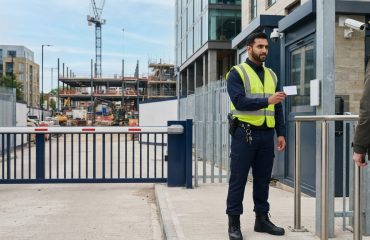
The lowest quote is not necessarily the safest choice for a site. To decide how to choose a security guard company, compare its sector experience, reputation, staff qualifications, service fit and the scope of each quotation. In the UK, security operatives need an SIA licence when their work is part of a contract for services and involves a licensable activity, according to the UK Government.
A lower quote can reflect differences in coverage, supervision, absence cover, reporting or support. Compare like with like rather than price alone. This guide explains how to assess a provider’s reputation and experience, check qualifications, match guarding services to your site, and review costs and contract terms. Consider whether the proposed arrangements address the risks that matter to your operation. The right service should support safe access, consistent site procedures and continuity without including provision you do not need.
Key Takeaways
- Assess reputation by reviewing client feedback and checking whether the provider has experience in environments similar to your site.
- Verify that officers hold an SIA licence where their duties require one, and review the company’s insurance and relevant staff training.
- Match the guarding approach to your site’s risks, access requirements and operating patterns before comparing providers.
- Compare quotations by examining coverage, supervision, reporting, support and contract terms, not price alone.
1. Company reputation and sector experience
A security company’s track record can indicate how well its procedures suit your operating environment. Look for relevant experience, not simply a long list of sectors. A provider familiar with construction may understand changing access points, deliveries and unattended equipment. Offices, industrial facilities and events have different access patterns and operational pressures. Ask for examples of comparable assignments and the safeguards used. The answer should explain how officers’ duties were tailored to the site, rather than relying on broad claims about experience.
Assess reputation through practical evidence. Read recent feedback on Google Reviews and Trustpilot, then compare it with testimonials on the company’s website. Look for specific comments about communication, reliability and issue handling, rather than relying on a rating alone. Ask how the provider assesses risks at a site like yours and communicates incidents, updates and routine observations. Discuss incident response arrangements and, where possible, meet the proposed guards. A clear account of responsibilities is more useful than a general assurance.
For example, a retail business may prioritise customer interaction and clear reporting, while a building site may focus on access control and protecting materials. Ask how procedures adapt to these different conditions and how arrangements can change as site activity evolves. Reputation is most convincing when client feedback, relevant sector experience and the proposed operating approach align.
For CCTV, ask how footage and personal data will be handled under the company’s GDPR procedures. Agree the purpose of recording, who can access footage, how it will be stored and shared, and how long it will be retained. Set out each party’s responsibilities in writing, particularly if the provider’s officers may view or report incidents captured on camera.
2. Employee certifications, licences and qualifications
In the UK, an operative needs an SIA licence when their work forms part of a contract for services and involves a licensable activity, according to the UK Government. Check that each proposed officer’s licence is current and appropriate to their duties. A company’s general assurance is not a substitute for checking the individuals assigned to your site. Match the role described in the contract with the work officers will actually perform, including any access control or patrol responsibilities.
Hiring an unlicensed operative for work requiring an SIA licence creates a compliance risk and may assign duties to someone without the required authorisation. Gaps in relevant training can also affect incident handling, compliance with site rules and report quality. Ask how credentials are verified and how replacements are checked against the same requirements. An officer covering a site unexpectedly should still hold the appropriate licence and be prepared for the assignment.
Review insurance before agreeing terms. Ask for evidence of public liability insurance and check that the policy details relate to the contracting company and the work being arranged. Keep a record of what you reviewed alongside the contract documents. This provides a clear reference if responsibilities or site arrangements change.
Qualifications should match the duties. Ask about training in safety, first aid and emergency response, then discuss how officers handle disputes, communicate with visitors, follow site rules and complete incident reports. These are practical competencies, not interchangeable credentials. A busy reception requires controlled visitor communication, while an industrial setting may place greater emphasis on following site procedures. Ask how personnel are selected and prepared for your environment. Clear, role-specific evidence helps distinguish a documented process from a broad claim of competence.
3. Guarding options and specialist services
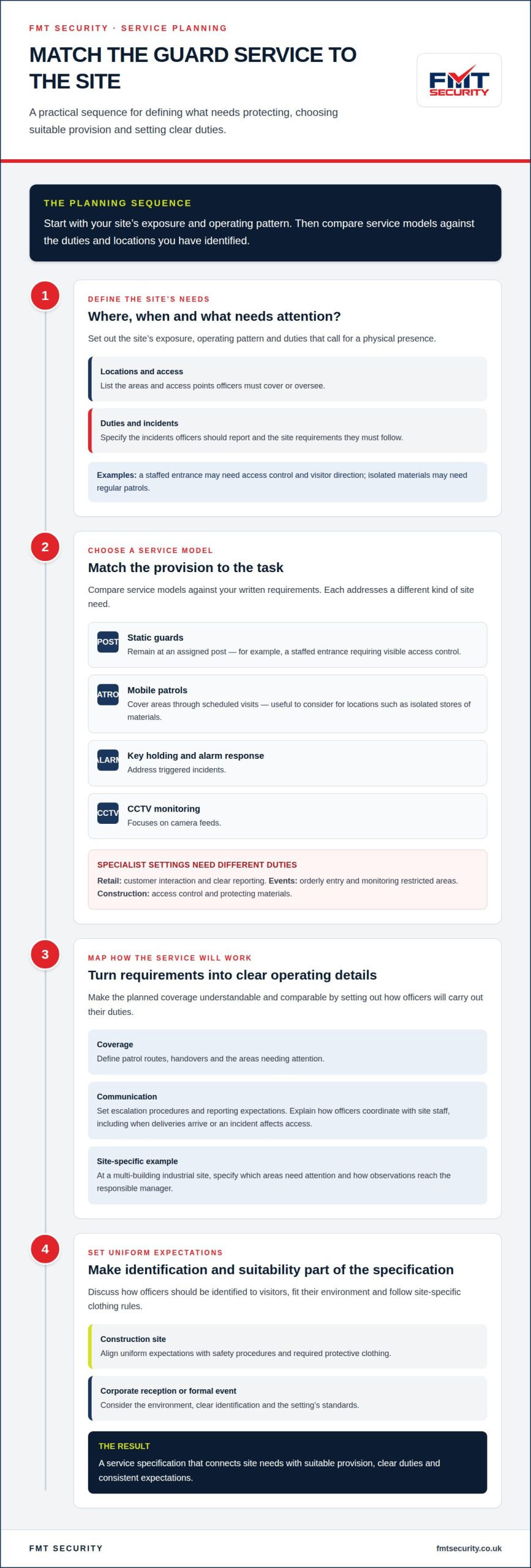
Start by defining the site’s exposure, operating pattern and duties that require a physical presence. A staffed entrance may need access control and visitor direction, while an isolated store of materials may need regular patrols. Events bring different demands, such as orderly entry and monitoring restricted areas. List the locations officers must cover, the access points they must oversee and the incidents they should report. Matching these requirements to suitable provision is a practical part of how to choose a security guard company.
Compare service models against your written requirements. Static guards remain at an assigned post, while mobile patrols cover areas through scheduled visits. Key holding and alarm response address triggered incidents, while CCTV monitoring focuses on camera feeds. Retail, event and construction security each involve distinct settings and tasks. A warehouse with vulnerable stock may need visible access control, whereas a public event may prioritise managing entry and orderly movement. Understanding these differences helps you choose a security guard company suited to your site.
Clarify how the service will operate. Define patrol routes, handovers, escalation procedures and reporting expectations. Ask how officers coordinate with site staff when deliveries arrive or an incident affects access. At a multi-building industrial site, specify which areas need attention and how observations reach the responsible manager. Clear duties make proposals easier to compare and help reveal gaps between planned coverage and actual requirements.
Uniforms affect how officers function and are perceived. Discuss whether staff should be readily identifiable to visitors, fit into a corporate reception environment or follow site-specific clothing rules. On a construction site, align uniform expectations with safety procedures and required protective clothing. At a formal event, consider whether the appearance supports clear identification and the event’s standards. Set expectations for consistency, identification and suitability in the service specification. Uniform choice does not replace defined duties, competent conduct or effective supervision.
4. Comparing service costs and value
A low quotation may cover fewer areas, offer less support or set out different contract terms. Compare proposals against the same written brief, including site areas, operating hours, duties, reporting and absence cover. The price depends on the assignment and is provided after a quote request. Relevant cost factors include coverage, staffing, duties and contract duration. This helps explain differences without relying on an industry average that may not reflect your site.
Ask what each quotation includes, how supervision is arranged and what management or out-of-hours support applies. Clarify whether officer training, reporting, proposed technology and absence cover are included. Ask how the plan addresses the risks identified for your premises. For example, a quote covering one entrance is not directly comparable with one covering several buildings and patrols. Record exclusions and additional charges before assessing the full scope.
A UK service agreement should set out duties, coverage, contract duration, reporting arrangements and each party’s responsibilities. The quotation should explain the price and included services, with exclusions and additional fees made clear. Ask whether the agreement is short or long term, how changes are handled, and what notice or cancellation terms apply. These details clarify your commitment, not just the initial cost.
When comparing security guard companies, ask what coverage and staffing are proposed, what support and absence arrangements apply, and how the plan addresses site risks. Compare the answers line by line. The strongest value comes from a clear match between identified risks, specified duties and documented support, not the lowest figure in isolation.
For a site-specific comparison, request a security services quotation based on your required coverage and duties.
FMT Security: Construction Security
FMT Security provides Construction Security for businesses managing building sites. Manned guarding can support site access control and help protect facilities, equipment and materials from unauthorised access. The right arrangements depend on the site layout, operating activity and identified risks.
For construction environments, FMT Security provides security guard services, including static guards staffed by SIA-licensed officers. This provides a visible on-site presence as part of wider site security arrangements. FMT Security also provides Corporate Security, Industrial Security and Event Security for organisations in those settings.
Contact FMT Security to discuss Construction Security for your site.
Put your site security decision into practice
Security arrangements should keep pace with how your site operates. When access patterns, staffing or site activity change, revisit duties and reporting so responsibilities remain clear. Assign an internal contact to oversee the arrangement and record operational changes that may affect coverage. This keeps security planning connected to business continuity rather than treating the appointment as a one-off procurement decision.
Choosing how to choose a security guard company means finding provision that fits your site’s actual requirements and can adapt as they evolve. FMT Security provides Construction Security, Corporate Security and Industrial Security for businesses seeking manned guarding in these environments. Discuss your site, its operating conditions and the security support you need with FMT Security.
Contact FMT Security today to discuss your requirements and take a considered next step towards site security.
Frequently Asked Questions
How do I check a UK security guard company’s SIA licence and approved contractor status?
Check an operative’s licence on the Security Industry Authority (SIA) register, using their details to confirm it matches the duties they will perform. According to the UK Government, an operative needs an SIA licence when their work is part of a contract for services and involves a licensable activity. To check approved contractor status, search the SIA register and ensure the listed company name matches the business you would contract.
What insurance should a security guard company in the UK have?
Ask for evidence of public liability insurance and review the policy schedule before signing. Check that the named insured is the company entering the agreement and that the cover relates to the security work and premises involved. Clarify the policy period, relevant exclusions and how changes to the assignment affect the documentation. Keep a copy with the signed agreement for easy reference.
How much does it cost to hire security guards in the UK per hour?
The price depends on the assignment and is provided after a quote request. Cost factors include the number of officers, coverage hours and days, duties, site conditions, supervision and contract duration. A quotation should show what the price covers, including any specified absence cover or management support. Compare proposals for the same working pattern and scope, rather than treating an hourly figure as directly comparable on its own.
How can I assess a security company’s staff training, vetting and experience?
Ask the provider to describe its screening process and explain how officers are matched to assignments. Request examples of relevant experience, such as managing access at an active building project or receiving visitors at a corporate office. Ask how training covers site instructions, incident reporting and emergency response. Discussing a sample shift can show whether officers understand the duties, escalation routes and records expected at your premises.
How do I check reviews, references and complaints for a UK security company?
Look for specific details in reviews about attendance, communication and issue resolution, then compare themes across different sources. Request a relevant client reference and ask about the assignment, service continuity and how concerns were addressed. Ask the company to explain its complaints process, including how concerns are recorded, investigated and communicated. Compare that explanation with the feedback you have read instead of relying on a single comment.