A guarding quotation is only useful if it covers the risks and duties your premises actually face. For offices and headquarters, corporate security services can include static guarding, mobile patrols, key holding and alarm response, tailored to the building and its operating requirements. The right combination supports access control, site security and business continuity without treating every workplace alike.
Comparing quotations can be difficult when providers describe their services differently. Look beyond the headline rate and compare the duties, coverage, supervision and response arrangements included. This guide explains the options used in corporate settings, how guarding and monitoring can work together, and what to assess in a proposal. It also explains how FMT Security’s Corporate Security service can meet office and headquarters needs.
Key Takeaways
- Match access control and visitor procedures to the building’s entrances, operating patterns and expected visitors.
- Assess office and headquarters risks by considering staff access, sensitive areas, assets and continuity needs.
- Clarify how officers, call handling and CCTV monitoring coordinate when an incident or alarm requires attention.
- Compare guarding quotations by checking the duties, coverage, supervision and response arrangements each one includes.
What corporate security services do you offer?
Office security combines controlled entry, a visible staff presence and clear incident procedures. The right mix depends on the entrances, visitor activity and operating pattern of the premises.
Compare security solutions by the duties they cover, not just by the service name.
Access control and visitor management
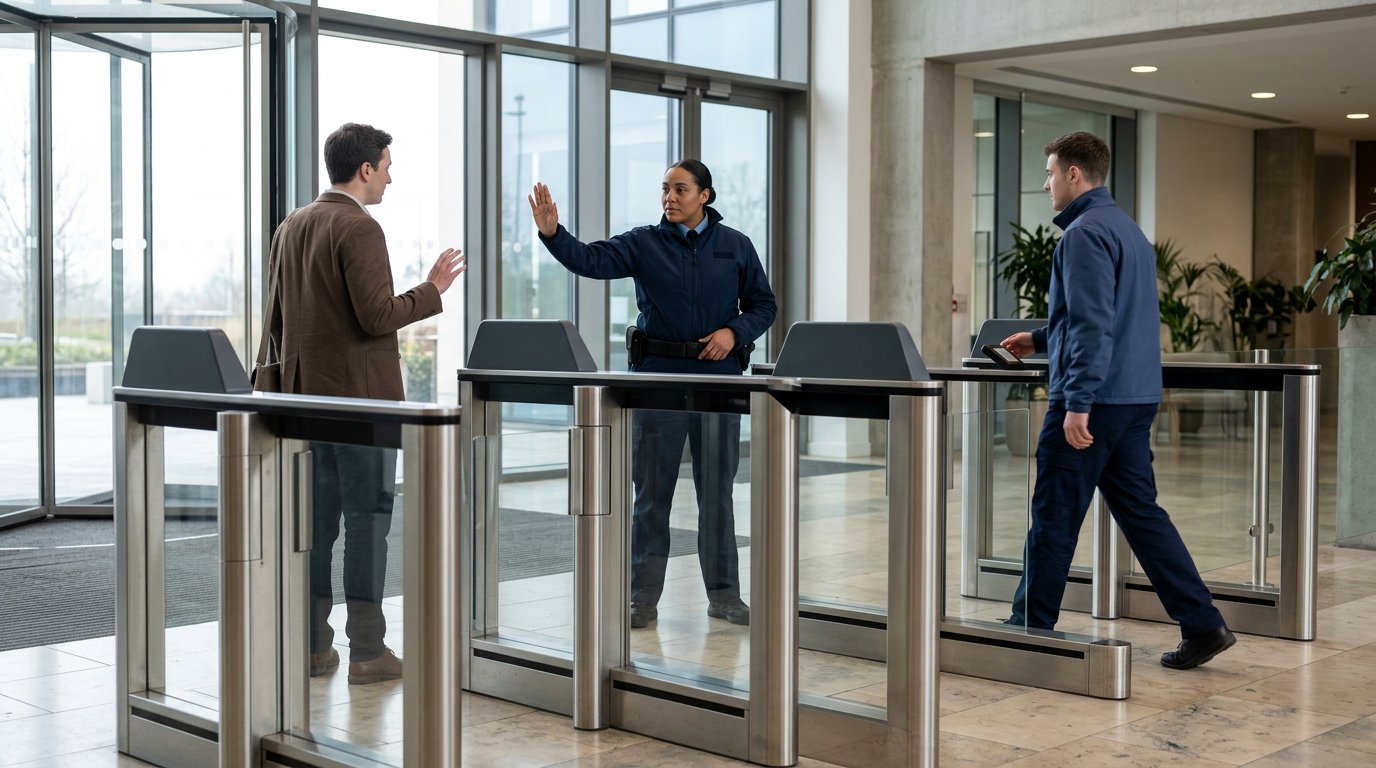
At reception, a security officer can greet visitors, establish their purpose and direct them to the right department. Procedures should distinguish staff, expected guests, contractors and unannounced callers. Visitor records, temporary passes and a clear process for contacting hosts help keep track of who entered and why.
Review how the front-of-house post handles deliveries, busy arrival periods and restricted areas. For example, visitors waiting for a host should remain in an approved reception area rather than enter the office unescorted.
Regional differences usually reflect the premises and its surroundings, rather than a single UK-wide operating pattern. A city-centre headquarters may prioritise reception flow and deliveries, whilst a standalone office may focus on perimeter access and vehicle arrivals.
Preventing unauthorised access and internal theft
Unauthorised access can happen when doors are left unsecured, passes are shared or visitors move beyond reception. Procedures should explain how officers challenge unfamiliar people, report damaged entry points and escalate repeated access concerns. Tracing a visitor’s route from the entrance to the meeting room can help identify where oversight is needed.
Managing internal theft risks calls for consistent controls, not assumptions about individuals. Officers can monitor access to designated areas, record incidents and follow agreed reporting procedures. Outsourced security can fall short if responsibilities, escalation routes or site instructions are unclear. Written post orders and a named reporting contact help establish accountability.
Guarding, patrols and CCTV options
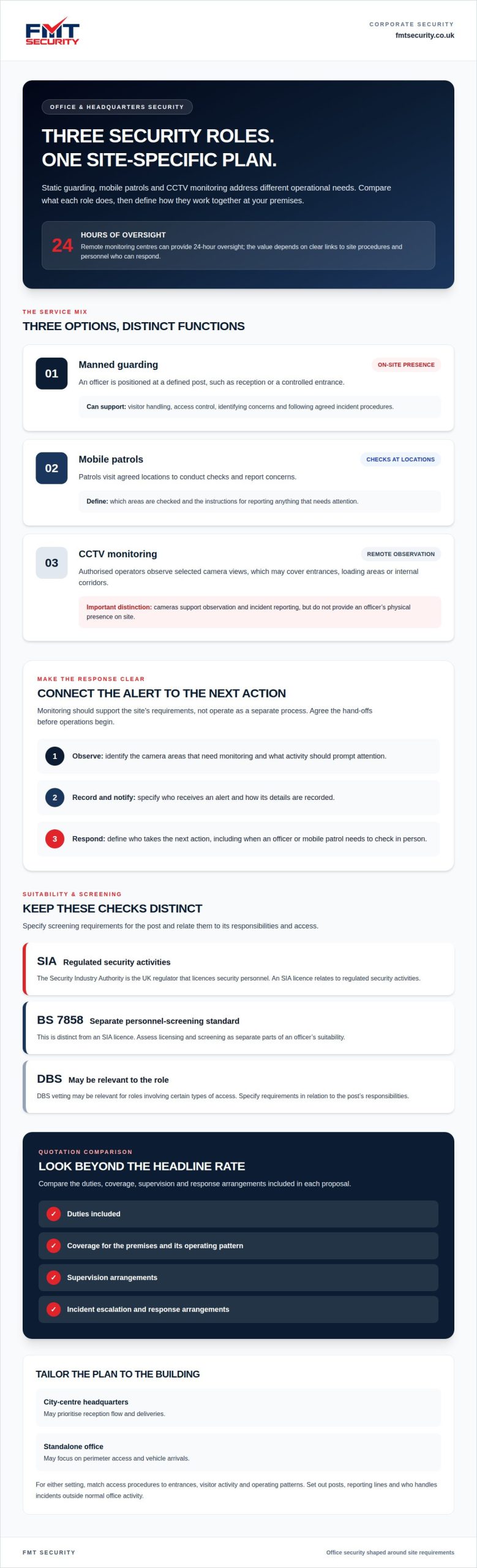
Manned guarding places an officer at a defined post, such as reception or a controlled entrance. Mobile patrols visit locations to conduct checks and report concerns. CCTV monitoring provides remote observation of camera feeds, but not the physical presence of an officer on site.
These methods serve different operational needs. A security officer can manage a visitor interaction in person, mobile patrols can check agreed areas, and CCTV can support observation and incident reporting. The Security Industry Authority (SIA) licenses security personnel in the UK. Emergency procedures should specify who receives an alert and how a response is initiated.
Corporate office and headquarters security
Protecting an office depends on trained officers, clear procedures and coverage suited to the premises. Security staff can help protect employees and visitors by managing access, identifying concerns and following agreed response arrangements.
Officer licensing and vetting
The Security Industry Authority (SIA) is the UK regulator that licences security personnel. An SIA licence relates to regulated security activities; BS 7858 is a separate personnel-screening standard. These are distinct checks, so assess licensing and screening as separate parts of an officer’s suitability.
DBS vetting may also be relevant for roles involving certain types of access. Specify the screening requirements for the post and consider how they relate to its responsibilities, such as reception duties or access to restricted office areas.
Protecting staff and visitors
At a headquarters, an officer can oversee reception, monitor entry points and follow procedures when someone needs assistance. Agree how officers contact the relevant manager, report incidents and guide visitors during an emergency. Clear arrangements support orderly movement and give staff a straightforward way to raise concerns.
First aid capability can also be included in the post specification. Define whether the role requires a first aid-trained officer and how that person should coordinate with the organisation’s emergency procedures.
Coverage should reflect how the building is used, its access points and its hours of operation. A tailored plan identifies the posts officers cover, the reporting chain and who handles incidents outside normal office activity. This gives the organisation a practical framework for assigning duties across the premises.
Reputation depends partly on consistent conduct at the entrance. Include visitor interaction, confidentiality expectations and escalation steps in the post instructions. For example, an officer who receives an unexpected delivery should follow the site’s procedure rather than direct the visitor into staff areas. Office security arrangements can be shaped around these operational requirements.
Operations room, call handling and CCTV monitoring
Remote monitoring centres provide 24-hour oversight for modern corporate security in London. Their value depends on clear links between camera coverage, call handling, site procedures and personnel who can respond. Define those links before operations begin, including who receives an alert and how its details are recorded. A monitoring plan should support the site’s specific requirement, not operate as a separate process.
CCTV allows authorised operators to observe activity in selected areas. Depending on the site layout, camera views may cover entrances, loading areas or internal corridors. Identify the areas that need observation and what should happen when activity appears unusual. For example, an operator might follow an agreed escalation procedure after spotting an unattended delivery near a restricted entrance.
Monitoring is not a substitute for physical guarding. Cameras show selected areas, but cannot provide an officer’s presence on site. Security personnel can assess a situation in person, while mobile patrols can check locations according to agreed instructions. Define each role clearly so an alert reaches the person responsible for the next action.
Call-handling procedures should distinguish routine requests from urgent incidents. A useful process records the caller’s location, the nature of the concern and any immediate access issue. The call handler can then follow the site’s escalation route and pass the relevant information to the appropriate contact. If an alarm relates to a secured door, for example, the procedure should state who reviews the event and who attends.
Assess whether monitoring supports continuity during routine operations and unexpected events. Set out camera responsibilities, alert routes, incident records and handovers between the operations room and on-site teams. Test the procedure against a realistic scenario, such as a camera outage or an out-of-hours alarm. This can reveal unclear responsibilities before they affect the premises.
Comparing guarding quotations
A useful comparison starts with the work each quotation commits to deliver. Assess every proposal against the same site duties, operating hours and reporting expectations.
Assessing guarding quotations
Compare the specified post, coverage periods and responsibilities before assessing the overall proposal. For reception, check whether the officer manages entry, records incidents and follows agreed access control procedures. The quotation should also explain how supervision and monitoring support the post, including how concerns reach the responsible manager.
Use the same checklist for every proposal. Record what each includes for site instructions, handovers, incident reports and contingency arrangements. A quotation covering patrols is not equivalent to one covering reception only. Identify the difference in scope, then assess which arrangement fits the premises and its risks.
Choosing a reputable security company
For UK businesses, reputation should be assessed alongside clear procedures and accountable service delivery. Check whether the provider holds Security Industry Authority Approved Contractor Scheme status, and confirm that security officers assigned to regulated duties hold the relevant SIA licence. Review how the provider sets site instructions and supervises their delivery.
Ask how the proposed duties would work in a realistic scenario, such as an employee reporting an unfamiliar visitor after reception closes. A clear proposal should explain the reporting route, escalation responsibility and response procedure. Compare those commitments with your organisation’s operating requirements rather than relying on broad assurances.
Before choosing a quotation, make sure its scope reflects your premises, including entrances, sensitive areas and expected visitor activity. Clarify exclusions and confirm who is responsible for each stated task. This makes differences between proposals visible and supports a decision based on operational fit, not presentation alone.
Discuss your office guarding requirements and the duties your quotation needs to address.
FMT Security: Construction Security
FMT Security provides Construction Security for businesses managing active building sites and exposed premises. Site guarding helps oversee access, deter unauthorised entry and protect materials and property during operations.
For an office or headquarters, FMT Security’s Corporate Security service provides professional manned guarding tailored to the premises and its operating requirements. Duties can be shaped around the location, access arrangements and risks the business needs to manage. FMT Security also provides Industrial Security and Event Security for those settings.
When discussing your requirements, describe the site, key access concerns and guarding duties needed. Contact FMT Security to discuss security for your premises.
Set a clear direction for your security plan
Define the outcome your business needs, the duties involved and how performance should be reviewed. A concise service brief gives you a practical basis for discussing corporate security services and assessing a quotation in context.
FMT Security provides Corporate Security for offices, Construction Security for building sites and Industrial Security for operational premises. These services can help protect a workplace, site or facility through professional guarding. To discuss the right operational fit, set out your premises, key concerns and required duties.
Contact FMT Security to discuss your needs and the security arrangements relevant to your premises. A clear brief is a constructive start towards a disciplined, workable plan.
Frequently Asked Questions
How do you respond to security breaches?
A breach should be handled under the agreed incident procedure, with information passed to the responsible contact. FMT Security’s Key Holding Service includes alarm response to investigate trigger events and secure client facilities. An alarm activation can prompt an investigation at the premises, followed by a report describing the trigger and actions taken. Clear access instructions and escalation contacts help ensure the relevant details are available.
Mobilisation: What should be agreed before the first shift?
Before the first shift, agree the post instructions, reporting contacts and site-specific access arrangements. Confirm which entrances officers cover, how they receive keys or credentials, and who authorises entry outside routine operations. Specify how handovers, incident records and urgent notifications are handled. A pre-start briefing can run through a typical arrival, delivery and escalation scenario so officers understand their duties from the outset.
What sectors do you provide commercial security for?
FMT Security provides guarding for corporate offices, industrial premises, construction sites, retail environments and events. Officers can support different operational needs, from overseeing a workplace entrance to maintaining a visible presence at an event. For an industrial facility, the brief might focus on site access and protecting operational areas; for an event, it may define perimeter duties and crowd-related responsibilities.
What corporate security services are available in the UK?
FMT Security’s services include Corporate Security, Static Guards, Mobile Patrol, Key Holding, Construction Security, Industrial Security, Retail Security and Event Security. The right arrangement depends on the premises and duties required. A business managing several sites, for example, may combine patrols with a fixed guard post. FMT Security provides services for commercial premises and operational sites across the UK.
How much do security services cost in the UK?
FMT Security provides a quotation based on the assignment’s requirements. The proposal reflects the service requested, the premises and the duties involved, rather than a universal rate. To support an accurate quotation, describe the site, required coverage and responsibilities expected of security personnel. This gives you a defined operational basis for comparison.
What factors affect corporate security service pricing?
The scope of duties, the premises’ operating pattern and the coverage required all affect a corporate security services proposal. A reception post, for example, involves different responsibilities from guarding an industrial site or arranging patrols across locations. The number and timing of posts, access arrangements, reporting requirements and any specialist role requirements also shape the proposal. Setting out these details makes clear what the quotation covers.