A factory’s security plan must protect more than its entrance. Industrial security services for UK factories and warehouses can combine manned guarding, access control, perimeter patrols and incident procedures, delivered by fully trained, vetted, SIA-licensed officers. The right measures depend on the property, its operations and the risks it faces.
For industrial operators, controlling entry and responding consistently to incidents are practical priorities, particularly where staff, stock, machinery and production schedules share the same site. This guide explains what industrial security involves, how guards and site-specific training contribute, and what to consider when planning protection for a factory or warehouse in London. It also outlines how an industrial security arrangement can be shaped around a site’s day-to-day requirements.
Key Takeaways
- Match guard duties to the site’s layout and operating routines, from entry control to patrols and incident reporting.
- Understand how SIA licensing and site-specific instruction support compliant, prepared guarding.
- Plan London warehouse protection around access points, perimeter exposure and the movement of vehicles and goods.
- Assess production areas, critical assets and operational risks to shape safeguards that support business continuity.
Industrial security guards for factories and warehouses
For factories and warehouses, guarding combines a visible presence with defined access, patrol and incident procedures. The deployment should reflect the premises, operating hours and vulnerable points.
Industrial estate and plant guarding
Industrial estate guarding can cover perimeter checks, gatehouse duties, vehicle access control and patrols across shared roads or plant boundaries. When comparing security arrangements, consider the proposed duties, reporting and response procedures, and how well they fit site operations, rather than focusing on guard numbers alone. A depot with several vehicle entrances, for example, needs clear checks at each access point.
Armed and unarmed manned guarding
Unarmed guards can monitor entrances, check authorised access, patrol designated areas and report incidents under agreed procedures. Armed guarding is a distinct option that requires a clear operational rationale and careful consideration of applicable UK requirements. The decision should follow a documented assessment of the threat, assets and site conditions, not a general assumption that armed deployment offers better protection.
SIA-certified security guards
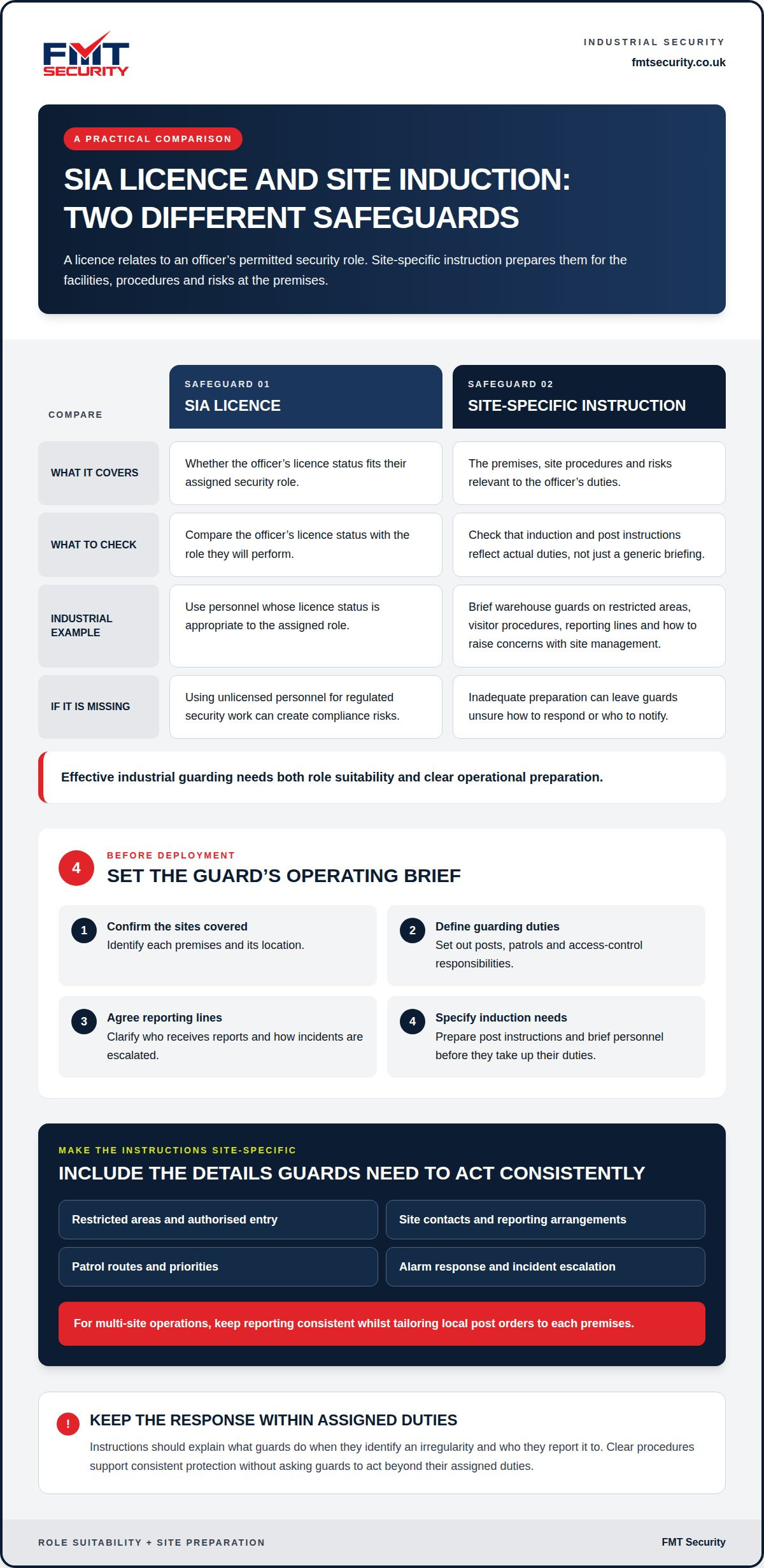
In the UK, the relevant description is generally SIA-licensed guards, rather than SIA-certified guards. For a provider comparison, look for officers whose licence status fits their assigned role, alongside site-specific induction and clear post instructions. A warehouse induction, for example, should explain restricted areas, visitor procedures, reporting lines and how guards communicate concerns to site management.
Arranging industrial site security
Arranging site security starts by defining the premises and its operational risks. Map entrances, vulnerable boundaries, vehicle routes and priority assets, then set out static posts, patrols and access-control duties. Agree on reporting and escalation procedures, and brief guards on site rules and daily activity. These steps clarify what the service covers and how it supports operations.
SIA licensing and site-specific training
SIA licensing and site induction address different parts of industrial protection. A licence relates to an officer’s permitted security role, while site-specific instruction covers the facilities, procedures and risks at the assigned premises. Effective security requires both role suitability and clear operational preparation. Training should reflect actual duties, rather than relying on a generic briefing alone.
Using unlicensed personnel for regulated security work can create compliance risks, while inadequate preparation can leave guards unsure how to respond. At a waste facility, for example, officers need clear instructions about restricted areas, site contacts and incident escalation. Defined patrol routes and alarm-response procedures help ensure concerns reach the appropriate person promptly.
Utility and energy sites may contain sensitive infrastructure, controlled access points and areas with specific hazards. A site induction should explain boundaries, authorised entry, reporting arrangements and the steps guards follow when they identify an irregularity. Waste facilities also need procedures suited to vehicle movements and restricted work areas. Clear instructions support consistent protection without asking guards to act beyond their assigned duties.
Multi-site security needs consistent oversight alongside instructions tailored to each location. A shared reporting format can help managers review incidents across facilities, while local post orders identify each site’s entrances, contacts and patrol priorities. Guards moving between a depot and a production site, for example, need separate briefings for each premises, even if both use the same escalation process.
Before deployment, establish the sites covered, guarding duties, reporting lines and induction requirements. The security provider can use these details to prepare post instructions and brief trained personnel before they take up their duties. For organisations reviewing industrial security arrangements, aligning licence suitability with site procedures is a practical starting point.
Industrial and warehouse security in London
Across the UK, industrial premises range from distribution warehouses to manufacturing facilities, each with different access patterns. A site beside a busy freight route may need closer vehicle-entry oversight than a compact production unit. Planning should map perimeter access, delivery points, staff entrances and priority assets. These details help determine whether static guards, mobile patrols or combined cover best fit the premises.
Industrial CCTV monitoring can support perimeter surveillance, remote verification of breaches, alarm integration and secure incident recording. It can complement an on-site guard: a camera may identify a perimeter alert, while the guard follows the agreed response procedure. A security plan should define how monitoring, access control and patrols work together, rather than treating each measure as a separate task.
Industrial protection can include static guarding, mobile patrols, gatehouse duties and access-point monitoring. The appropriate combination depends on the site’s layout, operating pattern and identified risks. For example, a depot with separate staff and delivery entrances may need distinct controls for each. Highly trained guards should also understand the correct reporting route for each type of incident.
Planning for an industrial facility should account for perimeter exposure, vehicle movements, vulnerable assets and local risk patterns. Identify entrances and priority areas, then define patrol coverage and incident escalation. CCTV can help record an event, but response procedures should specify who receives the report and what guards do next. Clear responsibilities make security easier to manage.
Industrial security arrangements should reflect the site’s requirements and the measures needed there. An assessment can record the location, access points, operating hours, asset priorities and existing arrangements. These details help shape suitable guarding and monitoring. The plan should connect each measure to a specific exposure, such as an unobserved gate or vulnerable loading area.
Security for factories, manufacturers and production lines
Factory protection should reflect how people, materials and equipment move through the premises. A practical plan considers asset criticality, hazardous zones and operational continuity.
UK businesses with production equipment, valuable stock or critical infrastructure may need industrial security services. This can include manufacturers, logistics operators, utilities and waste facilities, where unauthorised access may disrupt work or expose assets.
Factory and manufacturing security
Planning starts with assessing perimeter length and exposure, infrastructure criticality, hazardous zones and local risk patterns. These factors help determine officer deployment and priority duties. A manufacturer with a vulnerable loading area, for example, may need focused oversight there, coordinated with site personnel and operating routines.
Production line security
Production-area controls should protect equipment without obstructing authorised work. Define who may enter restricted zones, how visitors are escorted and how concerns are escalated. Officers should understand the production layout and site instructions before deployment. Monitoring can then focus on vulnerable access points and align with operational procedures.
A site security plan should align personnel, patrols and monitoring with the factory’s operating requirements. Identify exposed boundaries, critical assets and hazardous areas, then establish duties and incident-escalation procedures. This gives officers a clear framework and helps managers understand how security supports continuity.
Set out your production layout and security priorities to discuss guarding for industrial sites and how it can support your operation.
Industrial-site security can include gatehouse control, vehicle management, perimeter patrols, access-point monitoring and incident-escalation procedures. ProFM Group advises industrial sites to prioritise physical security, such as mobile patrols, gatehouse coverage or canine handlers, and then build out security technology such as access control, CCTV and intruder alarms.
Industrial Security Services offers analogue and digital CCTV, alarm systems, GSM, GPRS and radio communication systems, access control systems and electronic fencing.
FMT Security: Industrial Security
FMT Security provides industrial security for factories, warehouses and logistics depots that need a professional guarding presence. Its security guard service uses fully trained, vetted, SIA-licensed officers, with duties shaped around the site’s layout, access points and operating requirements. This is a practical option when a business needs structured on-site protection for staff, premises or assets.
For sites undergoing construction, FMT Security also provides Construction Security, while Corporate Security supports relevant commercial environments. The right arrangement depends on the property and identified risks, including where guarding is needed and which procedures officers must follow. Contact FMT Security to discuss security requirements for your industrial site.
Keep your site security aligned with operations
Security arrangements should stay aligned with the way a site operates. Changes to delivery routes, stored materials, production schedules or access arrangements can alter where protection is most needed. Reviewing these changes helps businesses keep industrial security services relevant to current operational risks, rather than relying on procedures that no longer fit the premises.
FMT Security provides Industrial Security, Construction Security and Corporate Security for commercial environments. The right service depends on the site and its operational requirements. A clear discussion of your premises, current procedures and priorities provides a practical basis for planning suitable security.
Contact FMT Security to discuss your site’s security requirements and identify a considered next step. A measured review can help your organisation plan with greater clarity.
Frequently Asked Questions
What is industrial security?
Industrial security services protect commercial premises, people and operational assets through planned guarding and security procedures. At a logistics depot, this could mean monitoring goods-in access, checking visitor authorisation and recording unusual activity for management. The approach should support normal operations and make responsibilities clear, helping reduce exposure to unauthorised access, theft, disruption and damage.
Can security operate in hazardous or regulated environments?
Yes, security duties can be arranged for sites with controlled or hazardous areas, provided officers follow defined site procedures. For example, a guard can monitor an authorised access point without entering a restricted work zone. The site’s operating team should set out boundaries, emergency instructions and reporting contacts so security activity complements operational controls rather than interfering with specialist work.
Do you provide security for energy, utility and waste management sites?
FMT Security provides Industrial Security for industrial premises, including energy, utility and waste-management settings. Deployment should reflect each facility’s access arrangements, operating procedures and controlled-entry areas. At a waste facility, for example, security duties may focus on authorised vehicle access and reporting activity near restricted areas. Site-specific instructions establish how officers carry out their duties.
How can security help?
Security helps by making access and incident procedures part of daily operations. At a distribution facility, officers can identify visitors, guide them through the correct entry process and report unexpected activity to the designated manager. Clear incident records also help management understand what happened and when. These measures support accountability and can help limit disruption when an issue arises.
What are the advantages of having security guards?
Security guards provide an accountable human presence, able to observe changing conditions and apply site procedures. An officer at a staff entrance, for instance, can manage visitor arrivals while alerting the relevant contact to an unexpected delivery. Guards can also record observations for management review. Their presence supports consistent control where access arrangements involve employees, contractors and visitors.
What licences and regulations apply to industrial security guards in the UK?
Industrial security officers should hold an SIA licence appropriate to their duties. FMT Security’s officers are SIA-licensed, fully trained and vetted. Industrial sites also have their own access, safety and emergency procedures, which officers need to follow. The specific instructions depend on the facility and the officer’s assigned role.