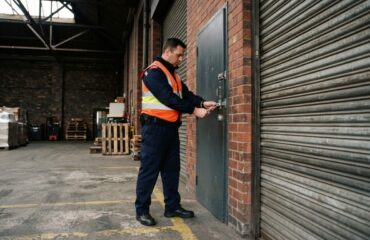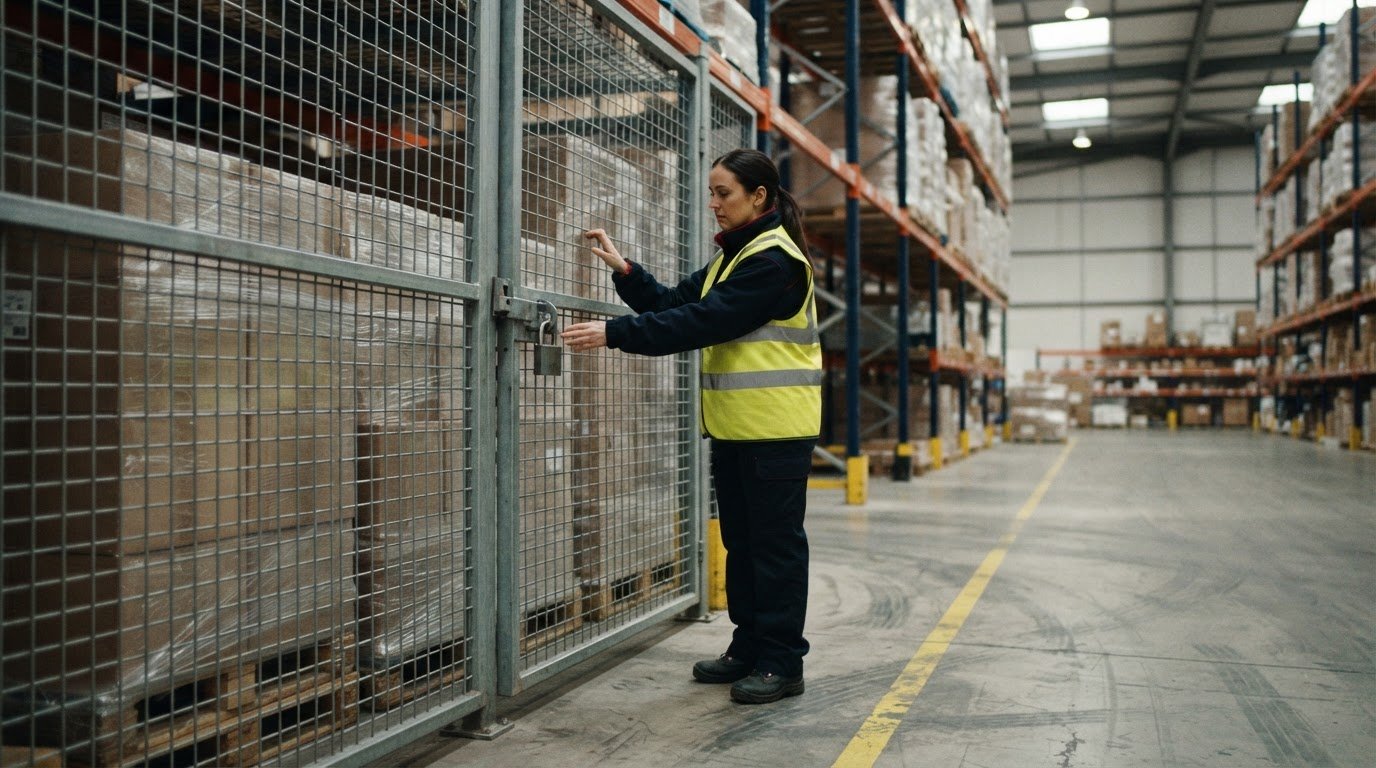
A warehouse security guard’s role extends beyond watching the entrance. Warehouse security guards can patrol the site, monitor CCTV, respond to alarms and de-escalate conflicts, helping protect stock, people and operations. Duties should reflect the warehouse layout, access points and identified risks.
Inventory, vehicles and busy loading areas all create security considerations, particularly when staff, contractors and deliveries move through the site. A visible guarding presence and a clear response to concerns can help maintain a more controlled environment.
This article explains warehouse guards’ main responsibilities, how they can help reduce theft and assess site risks, and what to consider when arranging security in the UK. It also explains how FMT Security’s manned guarding can support businesses seeking a practical approach to protecting stock and premises.
Key Takeaways
- Understand how patrols, CCTV monitoring and alarm response contribute to warehouse security.
- Identify how access points, stock movement and site layout shape inventory protection measures.
- Learn which operational requirements influence the cost of a guarding service, without relying on a flat hourly figure.
- See when FMT Security’s Static Guards may support a more controlled warehouse environment.
What Is The Responsibility Of A Warehouse Security Guard?
A warehouse guard deters unauthorised access, observes site activity and reports incidents. Patrols should reflect the building’s layout, stock movement and identified risks.
On-site Guarding and Patrols
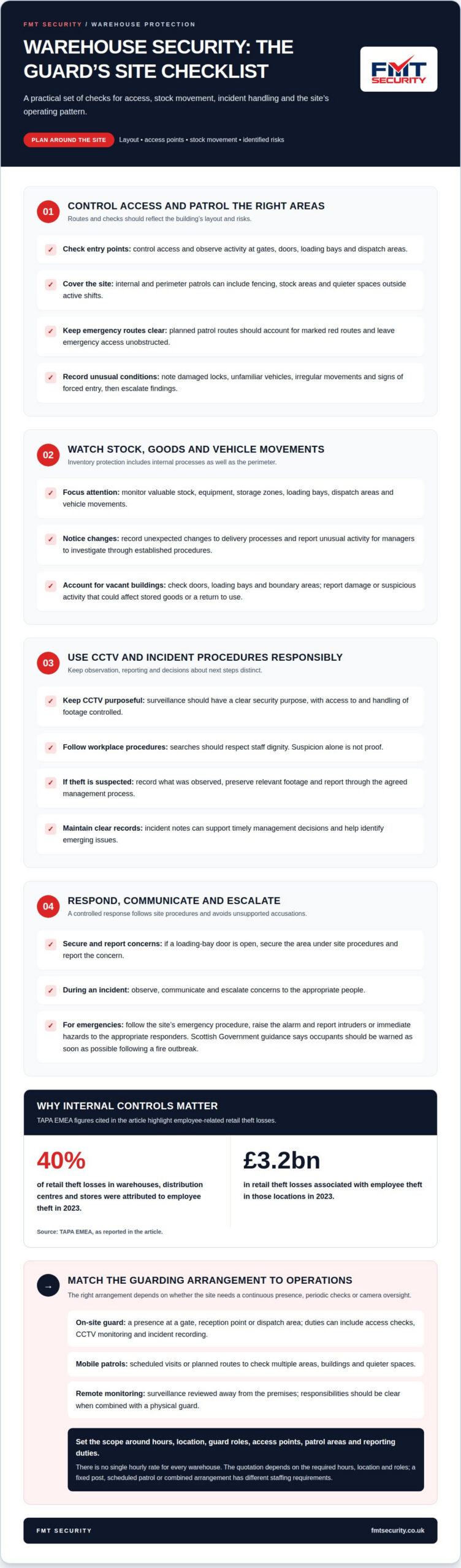
An on-site guard remains at the warehouse, controlling entry and observing activity. Mobile patrols visit sites or follow planned routes; remote monitoring reviews surveillance away from the premises. The right arrangement depends on whether risks call for a continuous presence, periodic checks or camera oversight. Internal and perimeter patrols can cover loading bays, doors, fencing and stock areas. A tailored route should include red routes, keeping marked emergency access clear. At an industrial site, security personnel can record damaged locks, unfamiliar vehicles and irregular movements, then escalate findings. UK Government says many security guard jobs legally require a front-line SIA licence, which requires an approved licence-linked qualification.
Legal Rules for CCTV, Searches and Suspected Theft
CCTV should have a clear security purpose, with access to and handling of footage controlled. Searches should follow workplace procedures and respect staff dignity; suspicion alone is not proof. If theft is suspected, guards can record what they observe, preserve relevant footage and report through the agreed management process. This keeps surveillance, incident reporting and decisions about next steps distinct.
Preventing Theft and Responding to Emergencies
Visible patrols can deter theft and trespass by checking access points, stock areas and vehicle movements. If a guard finds an open loading-bay door, they can secure the area under site procedures and report the concern. During an incident, professional security means observing, communicating and escalating concerns rather than making unsupported accusations. For fire, Scottish Government guidance says occupants should be warned as soon as possible following an outbreak. Guards should follow the site’s emergency procedure, raise the alarm and report intruders or other immediate hazards to the appropriate responders.
Duties may also include regular property patrols or CCTV monitoring to deter theft and protect inventory, alongside measures to address vandalism, unlawful entry and sabotage.
Warehouse theft and inventory protection
Protecting stock involves more than securing the perimeter. Understanding how goods move, where staff work and when the site is occupied helps shape practical security measures.
Inventory, Asset and Goods Protection
A visible presence and focused monitoring can help deter theft, vandalism and unauthorised entry. Guards can observe risks around loading bays, dispatch areas, storage zones and vehicle movements. For example, recording an unexpected change to a delivery process gives managers information to investigate through established procedures.
The scale of employee-related losses is also relevant. According to TAPA EMEA, employee theft in warehouses, distribution centres and stores accounted for 40% of retail theft losses in 2023. Retail theft losses associated with employee theft in those locations totalled £3.2 billion in 2023, according to TAPA EMEA. These figures underline why controls should consider internal processes as well as external access.
A tailored approach can focus patrols on valuable stock, equipment and other business assets. Guards can note unusual activity, report damaged security points and maintain incident records. This supports timely management decisions while helping protect staff from confrontations and the business from preventable disruption.
Protection for Vacant Warehouses
An unoccupied warehouse may still contain stock, machinery, fixtures or sensitive business materials. With less day-to-day activity, unauthorised entry or damage may also be harder to spot. Security planning should account for the building’s contents, access points and condition, rather than treating vacancy as an absence of risk.
Patrols can check doors, loading bays, boundary areas and signs of forced entry, then report concerns for action. Monitoring can also help identify damage or suspicious activity before it affects stored goods or delays a return to use. For a site between tenants or awaiting refurbishment, tailored security can support asset protection and preserve a clear record of emerging issues.
Warehouse security guard services
Warehouse security should match the site’s operating pattern, access points and exposure. The agreed scope sets out where guards remain on post and when they patrol other areas.
Warehouse Guard Service Options
Warehouse security guards can provide an on-site presence at a gate, reception point or dispatch area. Duties may include checking authorised access, monitoring CCTV and recording incidents. Mobile patrols can check multiple areas of a site, including quieter spaces outside active shifts. Some warehouses combine a guard’s physical presence with surveillance monitoring, with clear responsibilities for each measure.
For example, a distribution warehouse with separate vehicle and staff entrances may need distinct access procedures. A site with several buildings may need patrol routes that cover each building and the connecting boundary. Security plans should be tailored to the layout and operating schedule, not applied as a standard template. The site’s risks determine the appropriate arrangement.
Hourly Service Costs
There is no single hourly rate for every warehouse. The cost depends on the required hours, location and guard roles, and is set out in a quotation. A fixed post, scheduled patrol and combined arrangement each have different staffing requirements.
Operational details also shape the scope. A warehouse requiring overnight cover has different scheduling needs from one active only during daytime dispatch. The number and type of access points, patrol areas and reporting duties also affect the proposed service. A clear brief helps define which duties the quotation covers and how they fit site operations.
Hiring a Warehouse Security Company
Start by setting out the site’s operating hours, entrances, goods movement and main security concerns. Specify whether a guard must remain at a post, conduct patrols or monitor CCTV. These details provide a practical basis for assessing the premises and proposing an appropriate service.
Next, define the required duties, reporting process and response arrangements for incidents. For a warehouse with multiple areas, identify the locations that need attention and how patrol coverage should work. A quote request can then address hours, location and roles, helping align the proposed service with the warehouse’s operating needs.
Warehouse security guard hourly rates in the UK
The hourly charge reflects the security service required, not simply the time spent on site. Hours, location and guard roles all affect the quotation. A fixed entrance post requires a different staffing arrangement from regular patrols across several buildings. The proposed duties and operating pattern therefore matter as much as shift length.
Coverage hours shape the overall requirement. A site needing a guard during overnight goods movement, for example, has different scheduling needs from a warehouse active during daytime dispatch. Location also affects the service arrangement. The deployment should reflect the premises and the cover needed, rather than use one figure for every UK warehouse.
Roles also affect the scope. A post focused on authorised access differs from one combining access oversight, incident reporting and patrols. The quotation should make responsibilities clear, including the areas covered and how the guard’s time is allocated. This helps the business understand what the proposed hourly charge includes and assess it against operational requirements.
Assess value against the risks the service is intended to address. A lower charge may not meet the need if key access points or stock areas fall outside the agreed duties. Equally, broad coverage may be unnecessary if the main concern is one entrance or operating period. Define the required hours, site location and guard responsibilities first, then use those details to request a quote and review the proposed scope against warehouse operations.
FMT Security: Static Guards
FMT Security provides Static Guards for businesses seeking a consistent on-site presence. At a warehouse, a guard can observe activity and follow agreed procedures for access and incident reporting. This can suit premises where regular human oversight is more appropriate than patrols alone.
FMT Security also provides Construction Security and Corporate Security. The right arrangement depends on the site’s operating pattern, access points and principal concerns. Clear duties help align a guard’s presence with the warehouse’s day-to-day requirements and its identified risks.
For a warehouse assessment or to discuss a suitable guarding arrangement, contact FMT Security.
Build security into your warehouse operations
Treat site security as part of operational planning, not a fixed arrangement. Changes to stock profile, shift patterns, access routes or building use can alter a warehouse’s exposure. A planned deployment of warehouse security guards should have clear responsibilities, reporting lines and escalation procedures that fit daily activity. This gives site teams a practical basis for consistent oversight as operations develop.
FMT Security provides Static Guards and security guard services, alongside Construction Security, Corporate Security and Industrial Security. Its commercial and industrial security work can inform a guarding arrangement suited to a warehouse’s operational requirements, with duties shaped around the site.
Set out your priorities and discuss a suitable next step with FMT Security. Contact FMT Security about warehouse security to begin a practical conversation about protecting your operation.
Frequently Asked Questions
What are the advantages of having security guards?
Security guards provide direct oversight that can help businesses manage disruption and protect their working environment. For example, a guard can observe a dispute near a loading area and alert the appropriate manager before it interrupts dispatch. Their presence also gives staff a clear point of contact for reporting concerns, supporting orderly operations, incident awareness and an accountable response to emerging problems.
How can security help?
Security helps make risks visible and supports a consistent response. If a delivery arrives outside its planned schedule, for example, a guard can record the event and report it to the responsible manager under site procedures. This gives the business information to review what happened and decide whether further action is needed. Clear reporting also supports operational decisions.
What do warehouse security guards do in the UK?
In the UK, warehouse guards carry out duties agreed for the particular site. These may include welcoming expected visitors, directing drivers to the correct point and documenting unusual incidents. If a stock discrepancy is reported, a guard can record relevant observations and notify management, rather than make assumptions about its cause. The role is practical and procedural, supporting staff and site operations.
What should warehouse security guard duties and shift coverage include?
Duties and coverage should reflect the warehouse’s timetable and handover needs. If a morning team starts before the previous shift leaves, for example, the plan should specify who receives incident updates and outstanding instructions. It should also identify the contact for escalation and set task priorities during busy periods. Written arrangements help each shift maintain continuity without relying on informal messages.
What qualifications and SIA licence do warehouse security guards need?
Many warehouse security guard roles legally require a front-line SIA licence, which requires an approved licence-linked qualification.