
An alarm sounding is only the start of the security response. Key holding and alarm response gives an authorised keyholder access to business premises to investigate an activation, take appropriate action and secure the site. Businesses use the service to avoid relying on an employee to attend an uncertain incident and to maintain a clear response when usual staff are absent.
The cost depends on the scope of the arrangement, including the site’s location, access requirements, alarm arrangements and the level of response needed. A callout may involve checking the premises, identifying the cause of the activation and reporting any damage or security concern; emergency services may be contacted if the circumstances require their attendance.
This article explains what the service includes, how an alarm callout is handled and when escalation may be appropriate. It also outlines the factors that influence costs, helping you understand what a suitable response arrangement needs to cover for your business.
Key Takeaways
- Professional keyholding gives an authorised responder access to investigate alarm activations and help secure business premises.
- A clear callout procedure helps establish what happened, what action is needed and when an incident should be escalated.
- Costs are shaped by factors such as site access, alarm arrangements and the level of response required.
- FMT Security’s keyholding service can support businesses seeking a structured response for their premises.
What Is Key Holding and Alarm Response?
Keyholding gives an authorised person access to business premises when an alarm activates or an incident needs attention. The response can include checking the site, addressing faults and recording the outcome.
Key and access code management
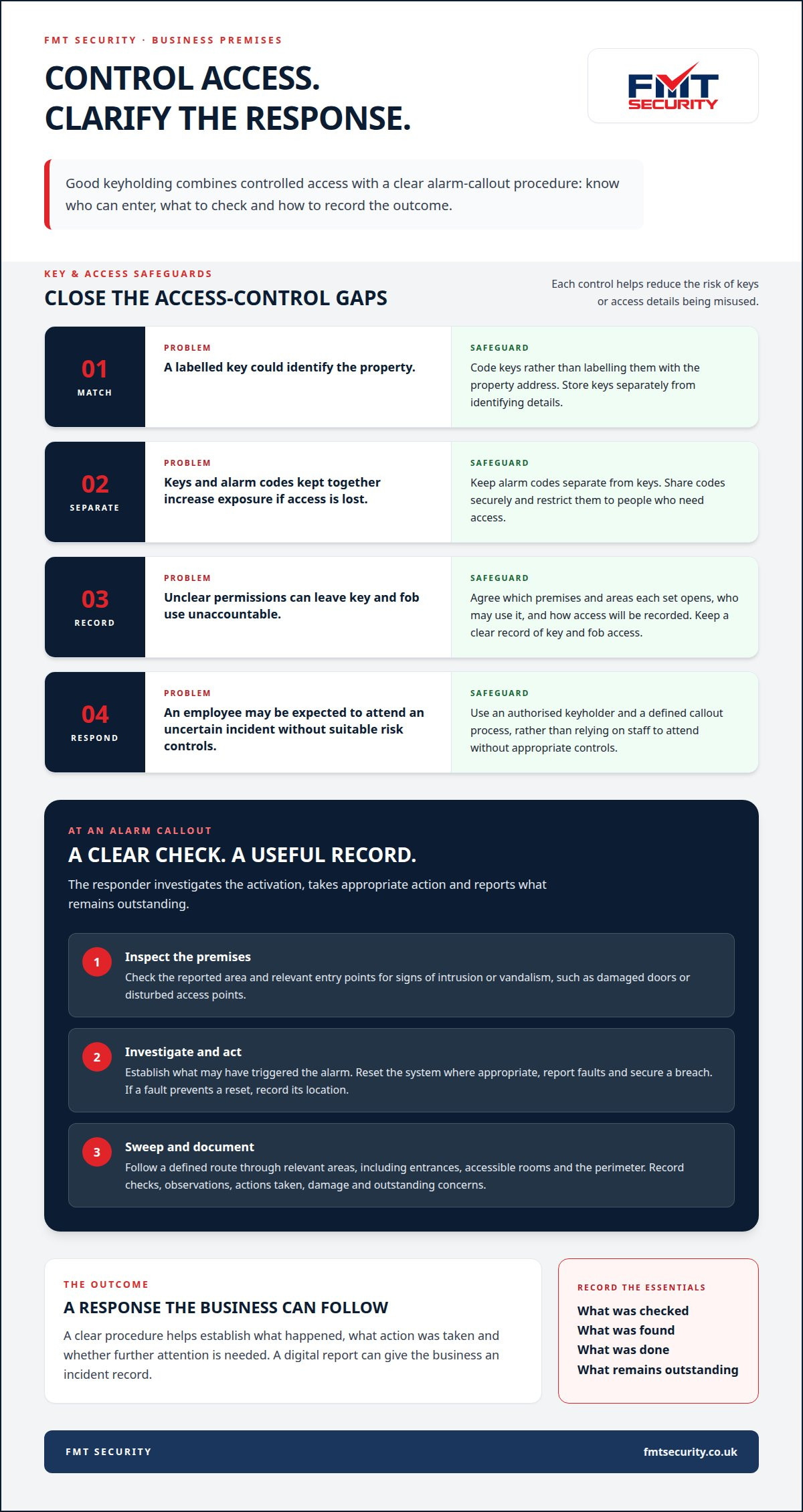
Key and access code management means controlling how keys, alarm codes and entry fobs are stored, issued and used. Poorly controlled access can expose premises to unauthorised entry. Keys should be coded rather than labelled with the property address, and stored separately from identifying details. Share access codes securely, restrict them to people who need them, and keep a clear record of key and fob access for accountability.
Safeguards for sharing keys
Safeguards are procedures that reduce the risk of keys or access details being misused. Before issuing a set, agree which premises and areas it opens, who may use it, and how access is recorded. Keep alarm codes separate from keys and avoid labels that identify the site. These controls reduce exposure if a key is lost or an access detail is disclosed. Employees should not be expected to attend an incident without suitable risk controls.
During a callout, an officer can inspect the premises for signs of intrusion or vandalism, such as damaged doors or disturbed entry points. The officer can investigate the alarm trigger, reset the system where appropriate, report faults and secure a breach. If a fault prevents the alarm from being reset, recording its location helps guide the next response.
A security sweep should follow a defined route through relevant areas, including entrances, accessible rooms and the perimeter. A checklist helps document what was inspected and any damage found. Digital reporting can record observations, actions taken and outstanding concerns, giving the business a clear incident record.
The Health and Safety at Work etc. Act 1974 places a duty on UK employers to protect staff from foreseeable harm, according to the UK legislation register. That duty is relevant when assigning employees to attend incidents.
Keyholding services are available for commercial premises in the UK, while local coverage depends on the provider’s operating area and the site’s location. A mobile response can be arranged for a business site, with the callout process shaped by its access points and security procedures.
Alarm activation response
An alarm response begins when a monitoring centre or direct notification reports an activation. A defined procedure helps distinguish a fault from a security incident and directs the next action.
Alarm response procedures
Alarm response procedures set out who receives an alert, how the premises are assessed and what happens next. The monitoring centre can notify a keyholder after an initial activation, then escalate a further activation according to the agreed process. Clear instructions help the responder identify the site, access arrangements and relevant contact details. Recording each action also creates an account of the incident for the business.
Investigating alarm activations
Investigating an activation means attending the premises, checking the reported area and establishing what may have triggered the alarm. An officer can examine entry points for damage, look for signs of disturbance and compare observations with the reported zone. If there is no visible breach, the activation may relate to a fault that needs reporting. This distinction helps the business respond to a real security concern without treating every signal as a confirmed intrusion.
Intruder and fire alarm activations
Intruder and fire alarm activations require attention to the type of signal and conditions at the site. For a URN-registered intruder alarm, two separate detectors must activate before the signal counts as a confirmed activation. An Alarm Receiving Centre may notify the keyholder after the first activation and the police after a second. A fire alarm should be treated as a potential emergency. Signs of smoke or fire require prompt escalation rather than a routine system reset.
False activations also affect response demand. The Home Office reports that 43% of incidents attended by fire and rescue services in England in the year ending June 2024 were unwanted alarms. A contractor investigating a repeated activation can report a fault, helping the business arrange attention to the alarm system and enhance the reliability of its response procedures.
For commercial premises, keyholding arrangements can provide a designated response when an alarm activation needs investigation.
Contacting emergency services when needed
A key holding and alarm response plan should define when an incident requires emergency services rather than routine site checks. A responder may find a forced entrance, visible fire, flooding or signs that someone needs urgent help. These observations guide the next action. The keyholder should clearly communicate the location, incident type and immediate hazards, helping emergency personnel understand the situation and access requirements.
At the premises, the responder assesses conditions without entering an area that appears unsafe. Smoke behind a locked door, for example, calls for escalation rather than an attempt to investigate alone. If there is evidence of a break-in, the officer can report the breach and seek police assistance where appropriate. Damage or signs of an intruder should be recorded without disturbing potential evidence.
For suspected fire, the responder should prioritise life safety and contact the fire and rescue service when circumstances indicate an active emergency. With flooding, water near electrical or operational areas creates a hazard that should be reported, with access restricted where necessary. Emergency personnel need accurate details, including the site entrance and known access constraints. The responder should follow their instructions and stay clear of unsafe areas.
Once help has been requested, the keyholder can notify the business’s designated contact and record observations and actions. This creates a factual incident record for management and insurance discussions. Some insurance policies require a formal alarm response plan, so clear escalation criteria support consistent handling. Effective key holding and alarm response also depends on defined responsibilities for updates, access authorisation and entry for emergency personnel.
After the immediate incident, the premises may need to remain secure until the hazard has been addressed. The responder can document damage, report outstanding risks and help maintain controlled access. A clear record of who attended, what they observed and what actions followed gives the business a practical basis for reviewing procedures and managing the site’s return to normal operations.
Key holding and alarm response costs
The cost of a commercial arrangement depends on the premises, access requirements and response duties. A quote should distinguish key custody from attending an alarm, investigating an incident and securing the site afterwards. Each activity affects the resources needed. A single office with straightforward access has different operational requirements from an industrial site with several buildings and restricted entry points.
Location and layout influence how a responder reaches the premises, checks relevant areas and records findings. Multiple buildings, controlled entrances or sensitive operating spaces may require detailed instructions. The agreed scope should identify which areas are covered, who receives incident reports and how damage is handled. These details define the work expected and help prevent gaps between the required response and the service.
Alarm arrangements also shape the cost. A site connected to an Alarm Receiving Centre may need a specific notification and escalation process, while a business may use direct contact arrangements. The agreed key holding and alarm response scope should state whether attendance, investigation, system resetting where appropriate, breach security and reporting are included. Each duty affects the staffing and procedures required, even if no callout takes place during a particular period.
Standards can help clarify service expectations. The British Standards Institution identifies BS 7984-1 as the standard addressing keyholding services in the UK. Businesses assessing key holding and alarm response should therefore consider the agreed duties and reporting process, not just key storage. Regular patrols, where part of the required arrangement, are a separate activity from responding to an alarm activation.
The service price depends on the premises and response requirements, and is provided after a quote request. FMT Security can prepare a tailored quotation based on access arrangements, alarm procedures and reporting needs. Request a keyholding quote to discuss the scope required for your business.
FMT Security: Key Holding
FMT Security provides key holding for businesses that need controlled access and a response when an alarm activates. The service includes 24/7 key holding and immediate alarm response to investigate trigger events and secure client facilities.
This service can support corporate offices, construction sites and industrial premises where relying on an employee to attend may complicate incident management. The response focuses on the reported activation, site conditions and steps needed to secure the facility. For businesses with wider operational security requirements, key holding can sit alongside construction, corporate or industrial security.
Contact FMT Security to discuss key holding for your premises and response requirements.
Make your security arrangements fit your operation
Consider how your site operates when normal staffing changes, access needs shift or responsibilities are divided across teams. A clear brief about these conditions helps shape key holding and alarm response around practical business requirements, rather than treating every premises as identical. It also gives decision-makers a sound basis for reviewing responsibilities as operations develop.
FMT Security provides Construction Security, Corporate Security and Industrial Security. These services can support businesses considering site security as part of wider operational planning, alongside keyholding requirements. The appropriate arrangement depends on the premises and the security challenges it presents.
Discuss your operational requirements directly with FMT Security to identify a suitable next step. Contact FMT Security to discuss your needs and move towards a more considered security plan.
Frequently Asked Questions
Why use a keyholding service?
A keyholding service gives a business an authorised person to attend when usual staff cannot respond. This can be useful if a manager is travelling, the premises are closed for a holiday period or employees should not be asked to attend alone. A key holding and alarm response arrangement also establishes who can access the site and report an incident, helping maintain continuity when normal contacts are unavailable.
What standards and regulations govern key holding in the UK?
UK keyholding is addressed by BS 7984-1, while workplace safety, data handling and private security regulation are covered by separate legislation. According to the UK legislation register, the Health and Safety at Work etc. Act 1974 places a duty on employers to protect staff from foreseeable harm. The Information Commissioner’s Office states that the Data Protection Act 2018 and UK GDPR apply to professional key storage.
Why use an NSI-approved keyholding company?
NSI approval indicates that a provider has undergone independent assessment against relevant requirements. The National Security Inspectorate is an independent certification body accredited by UKAS for the UK security and fire safety sectors. NSI Gold approval involves operating a Quality Management System to ISO 9001. For a business, this offers a basis for considering how procedures, records and service controls are managed.
How does a key holding and alarm response service work in the UK?
A monitoring centre or direct notification alerts the nominated responder when an alarm activates. The responder attends, follows the site’s access and escalation procedures, investigates the signal and records relevant findings. The agreed key holding and alarm response process should also define who receives updates and how faults or damage are reported. For a URN-registered alarm, nominated keyholders must be contactable 24 hours a day.
What legal obligations apply to commercial keyholding providers in the UK?
Providers must operate within the laws relevant to their security activities and handle stored access information responsibly. The Private Security Industry Act 2001 is the legislation under which the Security Industry Authority regulates the UK private security industry. Businesses can also set out responsibilities, contact arrangements and reporting expectations in their service agreement, so operational duties are understood by all parties.
Do UK key holders need an SIA licence?
The need for an SIA licence depends on the duties performed, not simply on holding a set of keys. The Security Industry Authority regulates the UK private security industry under the Private Security Industry Act 2001. FMT Security provides SIA-licensed security officers. This distinction matters where key custody forms part of a wider security role at commercial premises, rather than being limited to access arrangements.