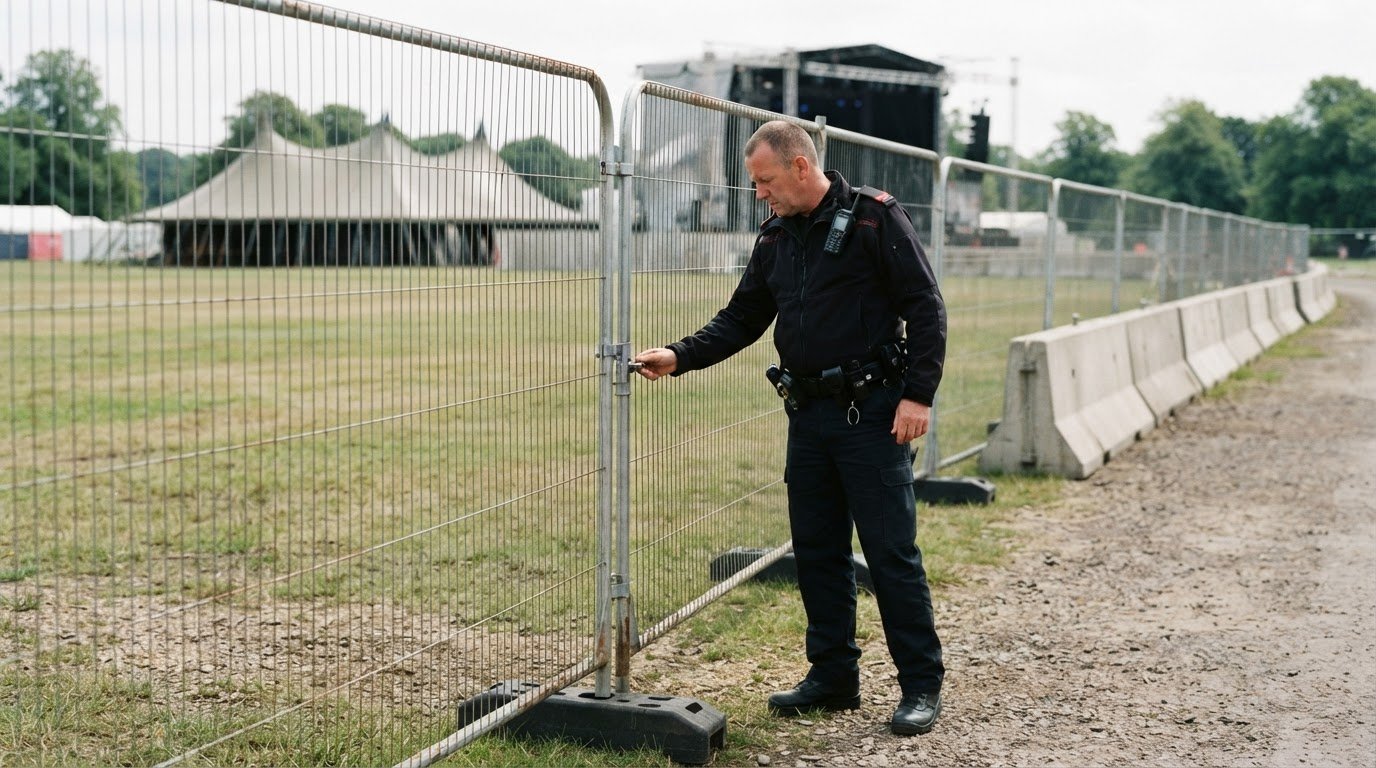
A well-planned event perimeter security arrangement combines temporary fencing with monitored detection, clear alert procedures and vehicle barriers positioned to protect exposed approaches. For short-term or one-off events, temporary perimeter protection can establish a controlled boundary, while CCTV, suitable lighting and detection can help identify attempts to enter restricted areas. Reusable equipment should be assessed against each site, since gates, fence lines and vehicle access points differ.
Large gatherings concentrate people within a defined space, so the boundary must do more than mark the event footprint. It needs to guide entry, discourage opportunist intrusion and give security personnel time to respond to an incident. This article explains how temporary fencing, detection and alerting, reusable equipment and vehicle defences work together. It also covers the site factors that shape a proportionate plan and how professional event security can support its delivery.
Key Takeaways
- Learn how temporary fencing can define event boundaries and why reused equipment needs a fresh site assessment.
- See how detection, lighting and clear alert procedures can help security teams identify and respond to perimeter incidents.
- Understand why vehicle access points need specific consideration when planning protection around an event.
- Find out how a professional risk assessment can identify vulnerable fence lines, gates and barriers before the event.
Temporary fencing for major events
Outdoor events bring large crowds into a defined space, making a clear, controlled boundary important. Temporary perimeter protection can suit short-term or one-off events, with the layout tailored to the site and its access needs.
Choosing professional perimeter protection
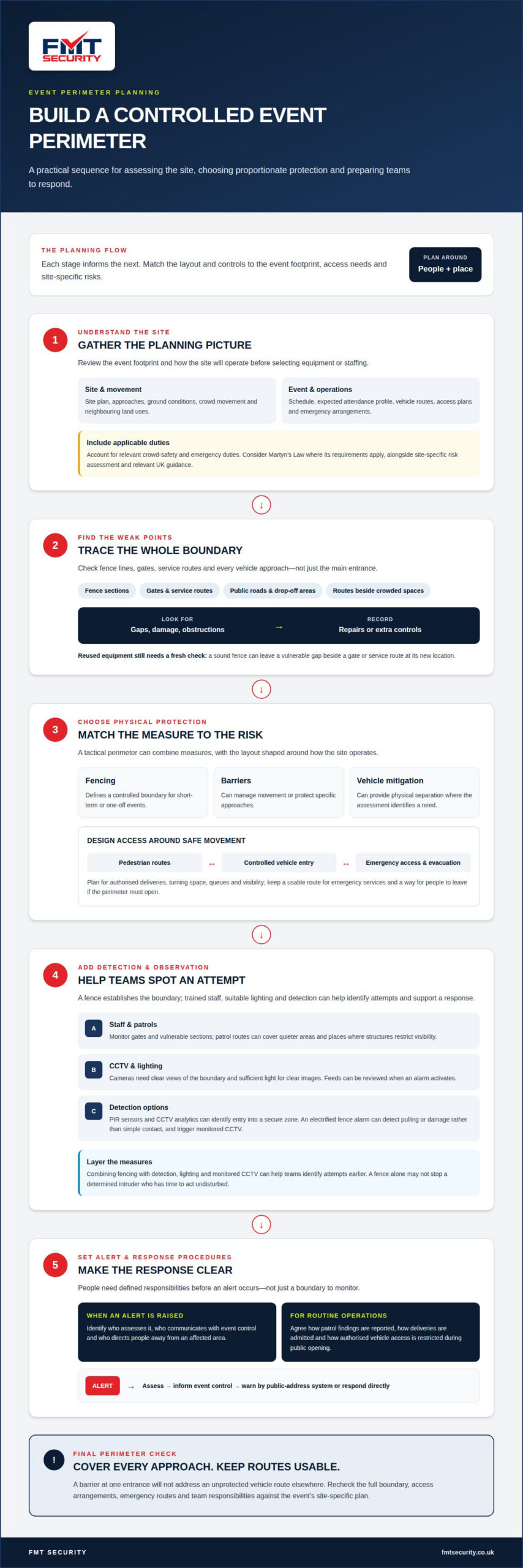
A professional provider assesses the event footprint, approaches, ground conditions and likely crowd movement before recommending temporary fencing, barriers or hostile vehicle mitigation. The choice depends on the risk being addressed: fencing defines a boundary, while barriers can manage movement or protect specific approaches. A tactical perimeter may combine measures, with the physical layout matched to how the site operates.
Legal and Martyn’s Law requirements
UK event planning should account for applicable legal duties covering crowd safety, emergency arrangements and the safe operation of the venue. Martyn’s Law is relevant to protective security planning where its requirements apply; the event’s circumstances determine which measures to consider. Guidance from UK authorities and industry bodies can inform decisions on crowd management, emergency planning and protective security, alongside a site-specific risk assessment.
Assessing event perimeter security risks with a professional provider
A provider reviews the site plan, event schedule, expected attendance profile, vehicle routes and existing barriers. Organisers should provide access plans, emergency arrangements, details of neighbouring land uses and information about equipment intended for reuse. The assessment identifies weak points in fences, gates and barriers, then records repairs or additional controls. Assess each reused item at its new location: even a sound fence can leave a vulnerable gap beside a gate or service route.
Securing event access points
Access points need controls that support entry management without obstructing emergency access or evacuation. A professional provider can position staff and barriers at gates, separate pedestrian and vehicle routes, and set procedures for deliveries and authorised vehicles. The plan should show how emergency services can reach the site and how people can leave if the perimeter needs to open. Clear roles and opening procedures help teams respond consistently during an incident.
Perimeter detection, alerting and defence
A fence establishes a boundary, but detection and response procedures help security teams act when someone tests it. A layered plan combines physical measures, trained staff and clear alerts around critical areas.
Staffing the event perimeter
Professional security staff can monitor gates, observe vulnerable sections and coordinate responses to alerts. Deployment depends on the site layout, entry arrangements and the visibility of each boundary section. Staff need clear responsibilities: who assesses an alert, who communicates with event control and who directs people away from an affected area.
Perimeter patrols
Patrols provide direct observation between fixed positions and can identify damage, obstructions or unusual activity along the boundary. A provider plans routes around access points, quieter sections and areas where buildings or temporary structures restrict visibility. Patrol findings should follow an agreed reporting procedure, so event control can assess concerns and direct an appropriate response.
Surveillance for perimeter security
CCTV can strengthen a fence line when cameras provide clear views of the boundary. Lighting matters because cameras need sufficient light to capture clear images. Where cameras are used, feeds can be set up for review when an alarm activates. Detection options include PIR sensors and CCTV analytics that identify entry into a secure zone.
A fence alone may not stop a determined intruder who has time to act undisturbed. Combining fencing with detection, lighting and monitored CCTV can help teams identify attempts earlier. Remote camera monitoring can reduce the time available for an intrusion; staff may issue a warning through a public-address system or respond directly. An electrified fence alarm can detect pulling or damage, rather than simple contact, and trigger monitored CCTV. Cameras can also support other types of perimeter.
For coordinated staffing and surveillance at an event boundary, consider professional event security.
Vehicle-borne attacks at events
Vehicle approaches need deliberate controls in event perimeter planning. A risk assessment considers public roads, drop-off areas, service entrances and routes beside crowded spaces. The number of vehicle attacks rose in 2016, and a vehicle attack took place in Westminster in 2017. These events underline why organisers assess vehicle access separately from pedestrian entry.
For UK events, public access, nearby traffic and the site layout affect exposure. A town-centre event may have roads close to pedestrian areas, while a rural venue may have service routes crossing its grounds. A barrier at one entrance will not address an unprotected vehicle route elsewhere, so the assessment needs to cover every approach.
Professional planning maps vehicle routes and identifies where physical separation is needed. Barriers can restrict unauthorised access to pedestrian areas, while controlled vehicle entrances allow authorised deliveries and emergency access. The layout should account for turning space, queues and visibility to avoid blind corners or bottlenecks. Positioning depends on the site, anticipated vehicle movements and required protection.
Operational procedures are just as important. Security staff can monitor vehicle entrances, manage authorised access and report suspicious activity to event control. The plan should define how delivery vehicles are admitted, where they may travel and how access is restricted during public opening. Emergency services must retain a usable route, with procedures for managing barriers during an evacuation.
- Map every vehicle approach, including service roads and drop-off points.
- Separate pedestrian areas from vehicle routes wherever the site permits.
- Assign staff to entrance controls and set clear reporting procedures.
- Include emergency access and evacuation arrangements in the barrier plan.
At a public event, measures must reflect surrounding roads and crowd movement. A site-specific plan connects barriers with staff oversight and access procedures, rather than relying on a single obstacle to manage vehicle risk.
How does a professional security provider assess perimeter security risks for an event?
A professional assessment starts with the event site plan and a physical inspection. The provider reviews fence lines, gates, barriers, vehicle routes and nearby public access. Opportunist intrusion is more common than a pre-planned attack involving tools, climbing equipment or vehicles. The assessment therefore considers everyday weak points as well as more deliberate threats.
Organisers should provide the event layout, access arrangements, operating schedule and details of equipment intended for reuse. The provider checks each reused item at its new location, since a fence suitable for one site may leave gaps elsewhere. Gates and barriers are assessed for damage, reliable closure and exposure to unauthorised access.
- Map the boundary, entrances, service routes and neighbouring public areas.
- Inspect fence sections, gates and barriers for damage or gaps.
- Identify pedestrian approaches and vehicle access routes.
- Record repairs, additional controls and monitoring responsibilities.
Physical perimeter security is typically a high priority in a site security risk assessment. A provider considers how site conditions affect protection, including restricted sightlines, nearby buildings and sections with heavy pedestrian footfall. Lighting can act as a deterrent, particularly alongside physical security and monitored CCTV. Where cameras are used, their position and available light affect the clarity of images along the fence line.
The assessment should produce a clear operational plan. It connects identified weaknesses with practical controls, such as securing a damaged gate or improving observation around a concealed boundary. It also explains how staff report concerns and how event control responds. Reassess the plan if the site layout, access routes or reused equipment changes before the event.
Arrange a professional event perimeter risk assessment to identify vulnerabilities and establish suitable controls.
FMT Security: Event Security
FMT Security provides Event Security for organisers who need professional officers to support perimeter arrangements. Its manned guarding service can provide a visible presence at designated boundary positions and access points, with responsibilities aligned to the event’s operational plan. This is useful when fencing and barriers need consistent oversight during event activity.
Organisers can share the site layout, access arrangements and identified risks so security provision can be planned around the event. Officers can help monitor assigned areas and report concerns through agreed procedures. The physical perimeter remains part of a wider plan, with roles and response arrangements set out before operations begin.
Contact FMT Security to discuss Event Security for your event.
Set the perimeter plan in motion
The next step is to turn event perimeter security decisions into an operational brief that reflects the site, event programme and each team’s responsibilities. Early coordination gives organisers time to align security arrangements with venue operations, contractors and emergency planning before event activity begins.
FMT Security provides Event Security, Construction Security, Corporate Security and Industrial Security. This breadth is relevant when event planning involves temporary venues, business premises or industrial locations, where site operations may affect security arrangements. A clear discussion can establish the event context, the areas requiring attention and how professional officers can support the plan.
Share the event’s operating requirements and the perimeter concerns that need attention. Contact FMT Security to discuss your event and take the next step towards a considered security plan.
Frequently Asked Questions
What can be done?
Organisers can create a boundary plan that assigns each entrance a purpose, such as public entry, staff access or deliveries. A professional security team can align those access categories with physical controls and monitoring responsibilities. If event operations change, the plan should specify who can authorise adjustments and how staff communicate them, so the boundary remains consistently managed.
Why does it matter?
A defined perimeter distinguishes public event space from restricted areas, including back-of-house locations and service routes. That clarity supports orderly access and helps staff recognise when a person or item is outside its intended area. It also gives organisers a framework for coordinating security with venue operations, contractors and emergency arrangements, rather than leaving separate teams to interpret access informally.
What is event perimeter security and what does it include?
Event perimeter security is the planned protection and management of an event’s outer boundary. It can include temporary fencing, gates, barriers, controlled access procedures, security personnel, lighting, CCTV and detection measures. The arrangement depends on the venue and the event’s operational needs. For example, a public entrance, a staff-only route and a delivery point each need clear access arrangements.
What types of barriers and fencing are used for event perimeter security?
Temporary fencing can mark an event boundary, while barriers can guide movement or restrict access to specific areas. Vehicle mitigation measures address exposed approaches where vehicles could reach crowded spaces. These are categories, not a universal specification: selection depends on the location, access requirements and intended function. A pedestrian entrance, for instance, needs controls suited to people entering on foot.
What are common event perimeter security risks and how can they be reduced?
Common concerns include opportunist entry, gaps or damage in a boundary, poorly observed approaches and unauthorised vehicle access. A weak gate can undermine an otherwise continuous fence, while inadequate lighting can limit the usefulness of CCTV images. Reduce risk by inspecting the whole boundary, addressing defects, assigning staff to key locations and linking detection alerts to clear reporting and response procedures.