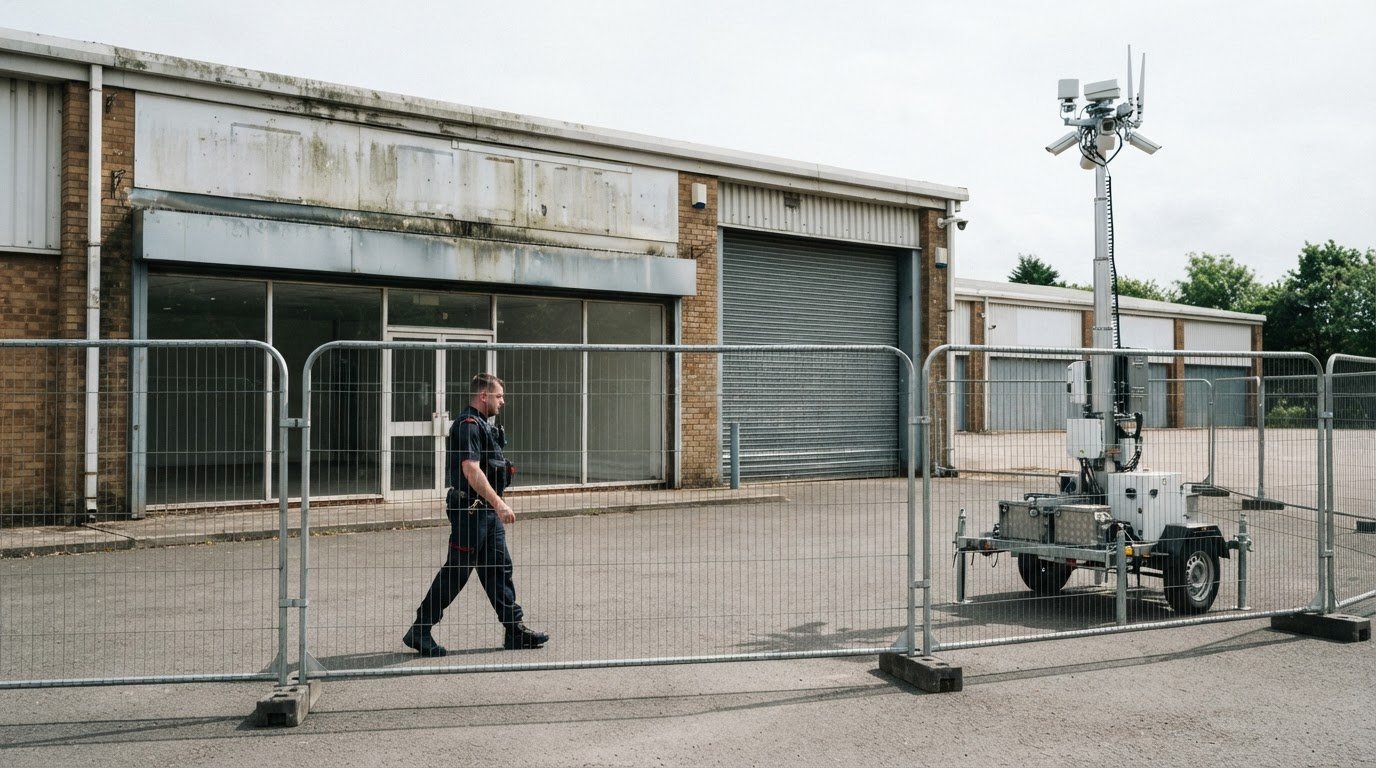
A CCTV tower can deter and record activity, but it doesn’t secure an empty site by itself. A plan for vacant commercial property security should combine CCTV and wireless alarms with suitable perimeter measures, patrols or guarding, and a clear response to alerts. Under the Occupier’s Liability Act 1984, an occupier must take reasonable care in all circumstances to prevent injury to a non-visitor from a danger on the premises, according to the UK Government.
Empty commercial buildings can face different risks depending on their location, condition, contents and how long they will remain vacant. The right safeguards should reflect those conditions rather than rely on one measure alone. This article explains how CCTV towers and wireless alarms can support site security, when static guards, K9 and mobile patrols may be appropriate, and how perimeter protection contributes to a layered approach. It also outlines how inspections and a planned response help keep security arrangements aligned with the property’s changing needs.
Key Takeaways
- Match CCTV towers and wireless alarms to the site’s layout and exposure, and plan how alerts will be handled.
- Use regular inspections to identify attempted entry, damage or developing problems, then record actions and the next visit.
- Choose static guarding, K9 or mobile patrols according to the property’s risks, and avoid sending employees into a potentially compromised building.
- Strengthen visible deterrence with appropriate perimeter measures as part of a layered security plan, rather than relying on cameras alone.
Temporary CCTV towers and wireless intruder alarms
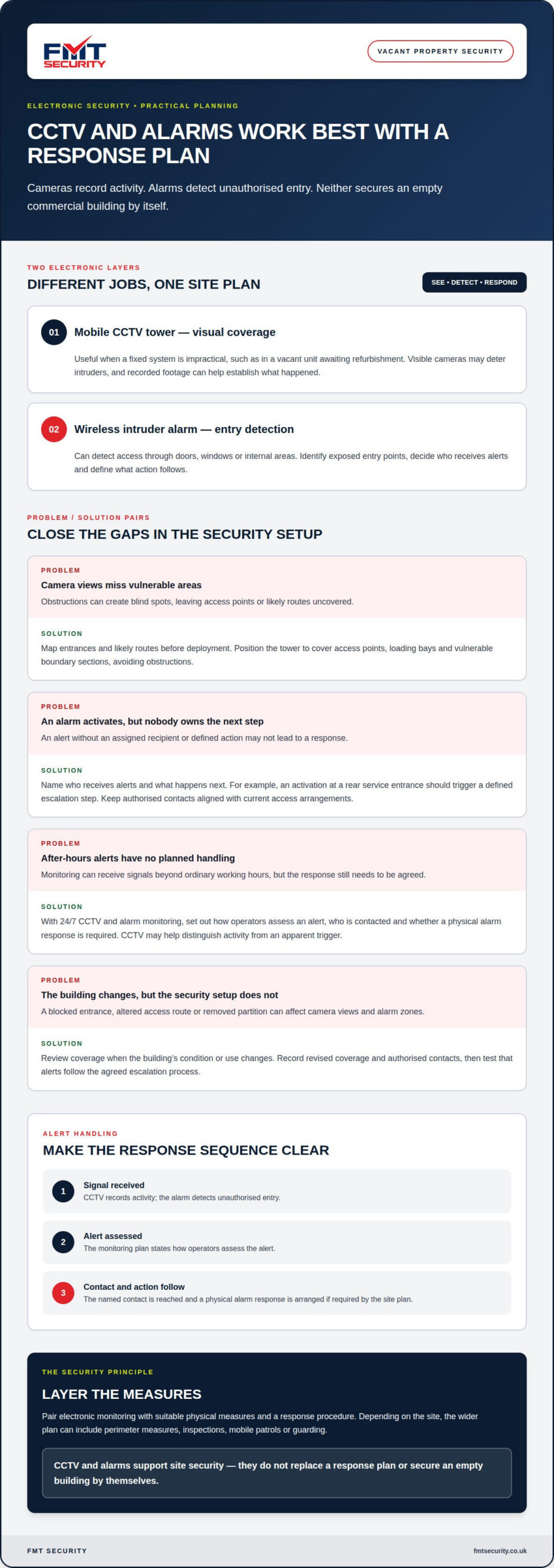
For vacant commercial property security, a strong electronic setup combines visible CCTV, intrusion detection and a clear alarm response. Options include a mobile CCTV tower, wireless intruder alarms, or both, with monitoring suited to the site’s exposure. Cameras record activity; alarms detect unauthorised entry. Neither replaces a response plan.
A mobile CCTV tower can provide temporary camera coverage when a fixed system is impractical, such as in a vacant unit awaiting refurbishment. Position it to cover access points, loading bays and vulnerable boundary sections, avoiding obstructions that create blind spots. Map entrances and likely routes across the site before deployment. Visible cameras may deter intruders, while recorded footage can help establish what happened.
Wireless alarms can detect access through doors, windows or internal areas. Start by identifying the most exposed entry points, then decide who receives alerts and what action follows. For example, an activation at a rear service entrance should prompt a defined escalation step, not an alert with no assigned recipient. Keep the authorised contact list aligned with current access arrangements.
With 24/7 CCTV and alarm monitoring, a monitoring team can receive signals beyond ordinary working hours. The site plan should state how operators assess an alert, who is contacted and whether a physical alarm response is required. CCTV can help distinguish activity from an apparent trigger, but it cannot secure an empty commercial building by itself. Pair electronic monitoring with suitable physical measures and a response procedure.
Review coverage whenever the building’s condition or use changes. A blocked entrance, altered access route or removed partition may affect camera views and alarm zones. Record the revised coverage and authorised contacts, then test that alerts follow the agreed escalation process. This keeps temporary security measures aligned with the property, rather than relying on equipment placement alone.
How Vacant Property Security Works in Practice?
Effective arrangements combine scheduled inspections, controlled access and recorded actions. Set inspection frequency and physical measures according to the building’s use, condition and exposure.
Property Inspections and Lock-Up Services
Inspections should start on day one of vacancy, with findings recorded after each visit. An opening or lock-up service can document access, check doors and windows, and confirm the building is left secure. Contractors and inspectors should have authorised access for a defined purpose, with keys or codes controlled and returned. A patrol can check fencing, damage, leaks and signs of entry, then record actions and the next visit. Planned mobile patrols can add physical checks between inspections.
Security Needs by Property Type
A vacant shop may need attention to street-facing glazing, rear access and valuable stock or fixtures. Offices often need controls for shared entrances and internal rooms, as well as documents or equipment left behind. Warehouses and industrial buildings may have larger yards, loading bays, plant or exposed boundaries. An assessment should consider the layout, remaining assets, condition, vacancy duration and incident history. These factors inform inspections, access controls, alarms and perimeter measures, including any fence repairs.
Owner Duties and Insurer Conditions
UK Government, legislation.gov.uk, states that where the Act imposes a duty to a non-visitor, an occupier must take reasonable care in all the circumstances to prevent injury on the premises from the danger. Insurance conditions also shape the inspection schedule and required security measures. Many UK commercial property insurance policies tighten their conditions after a property has been vacant for 30 days, and requirements vary. Review the policy wording for inspection frequency, isolated services and approved precautions, then record how each condition is addressed.
Fire, Utility and Incident Precautions
When a building’s use or occupancy changes, review its fire safety arrangements and maintain appropriate precautions. Isolate or remove power and drain water from systems where required by the property’s arrangements and insurer expectations. After a break-in or discovery of unauthorised occupants, avoid entering a potentially compromised building. Record visible damage from a safe position, arrange appropriate assistance, secure affected access points and reassess the site’s measures. The review should log findings, assign actions and set the next inspection or patrol.
Manned guarding, K9 patrols and mobile patrols
Choose a security presence based on the site’s exposure, access points and operating risks. Static guards provide a visible presence at a vacant entrance or reception, control authorised access and report damage or attempted trespass. This may suit a property with valuable equipment, repeated vandalism or contractors arriving at set times. Clear instructions should define permitted visitors, access records and escalation steps.
Mobile patrols provide scheduled visits without a continuously staffed post. Patrols can check gates, doors and perimeter fencing, and look for signs of fly-tipping, recording findings for follow-up. Set the route and visit timing according to vulnerable areas, recent incidents and the property’s layout. A warehouse with a rear service yard, for example, may need specific checks there, not just a brief inspection of its main entrance.
K9 patrols may add a visible deterrent at a larger or more exposed site. Their use should fit the property layout, public access and required patrol tasks. A site plan can identify boundary routes, restricted areas and safe access points, helping personnel conduct a controlled patrol. K9 activity is not a substitute for clear access rules or a defined response to an incident.
For an alarm activation, agree who attends, what they inspect and how they report the outcome. Employees should not be expected to enter a dark, potentially compromised building after a late-night alert. Key holding can give authorised responders access under an agreed procedure. The response plan should distinguish alarms requiring physical inspection from signals that need escalation to a responsible contact.
Use patrol and guard reports to identify patterns, such as repeated perimeter damage or attempted entry at the same door. Assign each issue for action, then adjust patrol focus or guarding arrangements. Consistent records of attendance, observations and escalation support continuity between visits. This helps align the physical response with changing risks, whether the concern is trespass, vandalism or fly-tipping.
Perimeter security and visible deterrence
Start perimeter planning with a walk-around assessment. Identify public entrances, service gates, loading bays and places where fencing is damaged or obstructed. A vacant retail unit with street-facing doors needs different access controls from a warehouse with a wide vehicle entrance. Mark vulnerable points on a site plan, then assign a suitable physical measure, such as a repaired fence, locked gate or controlled entrance.
Commercial sites may need more robust barriers than residential properties, including steel security and concrete blocks. Concrete barriers used to restrict vehicle access to larger compounds can weigh 4-6 tonnes. Their placement should address vehicle approaches without blocking authorised access or creating new hazards. Review barriers after changes to the site layout, construction work or vehicle routes, and record their condition during regular inspections.
Visible measures work best in layers. CCTV can help monitor access points, while fencing and secured gates make entry more difficult. A monitored alarm, key holding and patrols add further measures if someone attempts unauthorised entry. For example, a warehouse perimeter can combine clear boundary demarcation, a secured vehicle gate, camera coverage and an agreed alarm response. Cameras alone are not a substitute for physical security or a response plan.
Keyholding supports the perimeter plan by giving an authorised responder access when an alarm requires investigation. Access instructions should identify the relevant gate, safe entry route and any restricted areas. Regular inspections can then record fence damage, gate condition, signs of trespass and any required repairs. If a site’s exposure changes, update the assessment and adjust the physical measures accordingly. Discuss perimeter security arrangements for an empty commercial site and its access requirements.
FMT Security
FMT Security helps businesses plan a practical guarding response for vacant commercial premises. The right approach depends on the building’s use, access points, condition and exposure. A vacant construction site, corporate office or industrial property may require different deployment and oversight.
Where a human presence is needed, FMT Security provides Construction Security, Corporate Security and Industrial Security. Guarding arrangements are matched to the site’s operational risks, with clear procedures for access, observations and escalation. This can support businesses managing an empty property alongside wider site or business security responsibilities.
If your vacant premises needs a considered guarding plan, contact FMT Security to discuss the site and its security requirements.
Set clear ownership for the next stage
An empty site should not be treated as a static risk. Exposure can change as access arrangements, contractors, contents or the building’s condition change. Assign a named person to oversee the security plan and record who can authorise adjustments. This supports continuity when responsibility passes between property, facilities and security teams.
Use significant site changes as review points instead of waiting for a routine renewal. A tenant handover, redevelopment decision or reported incident can prompt a fresh assessment of deployment and escalation procedures. Keep the resulting decisions accessible to those responsible for the premises, so agreed measures remain workable as the site evolves.
FMT Security provides Construction Security, Corporate Security and Industrial Security for organisations requiring a structured guarding response. A considered vacant commercial property security plan begins with the site’s operational needs and clear allocation of responsibility. Contact FMT Security to discuss your site and identify a practical next step. With ownership and procedures established, you can manage the vacancy with greater operational clarity.
Frequently Asked Questions
Is CCTV enough on its own to protect a vacant site?
No. CCTV can record activity and provide visible deterrence, but it cannot physically prevent entry or manage an incident on its own. Footage of someone forcing a side door has limited practical value if nobody is responsible for assessing the alert. Pair camera coverage with intrusion detection, a named escalation contact and a defined response for checking and securing the affected area.
What are the biggest security threats to void properties?
Common risks include trespass, theft, vandalism, arson, unauthorised occupation and fly-tipping. Leaks or other damage can also go unnoticed without inspections. Exposure varies by property: a retail unit may have accessible glazing, while an industrial site may contain machinery or have less visible entrances. Consider both criminal activity and deterioration.
What is the most cost-effective way to secure an empty building?
The most proportionate approach is to address the site’s highest risks first, rather than apply the same package to every building. Identify exposed entrances, remaining valuable assets, site condition and vacancy duration, then prioritise suitable physical security and oversight. The cost depends on the case and is given after a quote request; relevant factors include the site, risk profile and required security arrangements.
What should the security approach be?
Start with a site-specific assessment: identify what needs protection, who requires access and how incidents will be escalated. Set out responsibilities for property management, authorised visitors and security personnel so access decisions are clear. Review the plan when occupancy, building condition or site activity changes. This keeps arrangements relevant throughout the vacancy rather than treating them as fixed.
How much does vacant commercial property security cost in the UK?
There is no single price for every vacant property. Cost depends on the premises, level of exposure, required security presence and duration or pattern of cover. A compact office with limited access differs from a large industrial site with multiple entry points. Request a quote so the arrangements can be considered for the specific property.
How can vacant commercial buildings be protected against trespass, theft, vandalism and arson?
Use complementary controls: secure access points, remove or protect attractive assets, maintain visible boundaries and arrange checks to identify damage or attempted entry. For fire risk, review the building’s fire safety arrangements when its use or occupancy changes, and address utility precautions. Record incidents and resulting actions so repeated vulnerabilities can inform future security decisions.