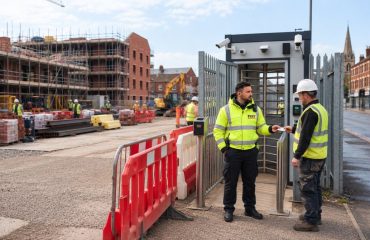
A turnstile is only effective when it forms part of a controlled entry process. Construction site access control should combine identity checks, structured sign-in and clear procedures for responding to access concerns. Under Regulation 13(4)(b) of the Construction (Design and Management) Regulations 2015, the principal contractor must take necessary steps to prevent unauthorised people from accessing a construction site.
Turnstiles can regulate movement through an entry point, whilst facial recognition can support identity checks. Neither removes the need to manage visitors, deliveries and site records consistently. Biometric data used to uniquely identify workers is special category data under Article 9 of the UK GDPR, according to the UK legislation register, so its use must be considered alongside the wider access process.
This guide explains how to coordinate turnstiles and facial recognition with sign-in procedures, inductions and connected systems. It also covers practical safeguards to keep access arrangements aligned with site operations and emergency procedures. The aim is a consistent process that helps site teams understand who is entering, why they are there and how to respond when someone does not follow the agreed procedure.
Key Takeaways
- Match turnstiles and identity checks to the site layout, entry points and fire-safety arrangements.
- Set a consistent sign-in and sign-out process for workers, contractors and visitors, with clear steps for exceptions.
- Link induction completion, attendance records and CCTV procedures so site teams can make informed access decisions.
- Review access arrangements as the project, site layout and delivery patterns change, and record incidents to identify weaknesses.
- Use professional construction security support when site operations need disciplined oversight of personnel and access procedures.
Which Access Control Technologies Suit a Construction Site?
Choose technology to suit the entry point, workforce movement and site risks. A PIN keypad may suit a controlled gate with limited users, but codes can be shared. Keycards provide individual credentials, although lost cards need prompt cancellation. A biometric reader can identify personnel through facial recognition or fingerprints, reducing reliance on shared passes. Each option needs a clear procedure for failed checks and authorised exceptions.
Costs depend on the number of entry points, site layout, selected technology, integration requirements and ongoing support. Request a quote based on the project, and compare equipment and operational requirements rather than focusing only on the reader at the gate.
Gates and fencing should direct people to a controlled entry point, without informal gaps. HSE public-protection guidance says a two-metre hoarding and controlled entry point typically provide access control on construction sites in populated areas. Keep the gate secured when unattended, route visitors through the designated entrance, and display signs outlining site rules, hazards and emergency procedures.
Turnstiles can regulate pedestrian access, while a staffed gatehouse can check identity, record arrivals and challenge unauthorised entry. Match the turnstile to expected footfall and delivery arrangements. A vehicle gate and pedestrian turnstile may need separate checks, preventing delivery traffic from bypassing the personnel process.
Fire safety must shape turnstile design and operating procedures. The UK legislation register identifies the Regulatory Reform (Fire Safety) Order 2005 as one of the rules shaping fire-safety design for construction-site turnstiles. Coordinate access controls with evacuation procedures, keep muster points accessible, and establish how personnel can leave safely if a system loses power.
Security awareness training should cover the entry routine, pass handling and escalation steps. During induction, show personnel where to report a damaged fence, an unknown visitor or a lost card. Keep instructions visible at the gatehouse and communicate changes when the site layout or access route changes.
For a security breach, define who receives the report, who controls the gate and how the site team raises an emergency. Test communication systems regularly, record incidents and review the response with site management. Integrate these steps with fire safety and evacuation procedures, rather than treating access control as a separate process.
Assess risks by reviewing the perimeter, lighting, access points, vulnerable assets, delivery patterns and incident history. Audit controls against those risks, record weaknesses and assign corrective actions. Repeat the review when project phases or site layouts change, so outdated credentials and entry procedures do not undermine security.
Electronic access control and sign-in procedures
A reliable process links each entry decision to a person, purpose and site record. Construction sites need consistent checks, clear staff responsibilities and controlled closing procedures.
Construction site access procedures
At each entry point, confirm the person’s identity, reason for attending and authorisation before granting access. Record workers, contractors and visitors on arrival and departure, including any change in the purpose of a visit. Pre-register visitors where practicable and arrange for authorised personnel to accompany them. Choose checks that fit the site assessment, workforce movement and entry systems.
Access control plan contents
A construction site access control plan should set out entry points, credential checks, sign-in and sign-out steps, visitor arrangements and responsibility for exceptions. Explain how personnel should report a lost pass, failed check or suspected unauthorised entry. Include rules for protecting access records and handling biometric information, then review the measures when site operations change.
Electronic records support a consistent sign-in process, but staff still need to resolve mismatches. If a worker’s card fails, do not wave them through on recognition alone. Direct them to the designated supervisor, establish their identity and authorisation, then record the decision. Apply the same procedure to delivery drivers and visitors, asking the relevant site contact to validate their purpose.
Facial recognition can link an identity check to an access decision, but its use requires careful data handling. Biometric data used to uniquely identify workers is special category data under Article 9 of the UK GDPR, according to the UK legislation register. Restrict access to records, explain the process to personnel and retain only information required for defined site purposes.
Training should turn written rules into repeatable actions. During induction, show personnel how to present credentials, sign in, report access concerns and respond if a system fails. Supervisors should reinforce the procedure when contractors change or an entry point moves. Use a short gatehouse briefing to communicate revised routes or temporary restrictions.
Closing procedures need a named person responsible and a recorded handover. Before the site becomes quiet, confirm who remains on site, secure entry points and report any unresolved access issue to the responsible supervisor. A final walk-through can identify an unsecured gate, an unattended pass or an open delivery entrance. Record completion so the next shift knows what was done.
Where gatehouse procedures need consistent personnel oversight, construction security support can help maintain disciplined entry checks and reporting.
Integration with inductions, attendance systems and CCTV
Integrated control systems can connect induction status, credentials, entry records and camera procedures. Together, these records help site leaders establish who is present, why they are attending and when they entered or left.
Workers should complete a site induction before accessing the construction site. The induction process can record completion against each worker’s identity and pass that status to the gatehouse procedure. Before admitting someone, staff can confirm both their authorisation and induction completion. If either detail is missing, refer the person to the responsible site contact rather than bypassing the control.
A turnstile or electronic reader can record credential use at an entry point. Link each credential to an individual, and define how staff handle a lost card, failed scan or attempted pass-back. A recorded entry does not automatically establish that the person remains on site. The process also needs a corresponding exit record and a way to correct mistakes.
Entry and exit records give site management a clearer picture of attendance. A gatehouse team can review recent movements to identify workers, contractors and visitors recorded as present. Compare the records with the day’s work schedule when checking attendance. If a worker leaves through a different gate, update the record through an authorised process to preserve an accurate movement history.
Attendance data can inform timesheets, but security records and payroll records serve different purposes. A credential scan shows a recorded access event, not necessarily hours worked or a complete timesheet. Set rules for supervisors to resolve missed scans, off-site duties and approved absences. Ensure corrections are attributable to the person making them, with a reason recorded for later review.
Real-time monitoring can help the gatehouse respond to current entry activity. For example, a supervisor can compare an expected delivery with the arrival record, then contact the named site representative before admitting the driver. Use alerts or system views only when they support an agreed response. Assign someone to act on discrepancies, so a flagged entry is not left unattended.
CCTV can provide visual context for access events at gates, turnstiles and vulnerable perimeter points. Coordinate camera views with the entry procedure so staff can review an event alongside its access record. Set a clear process for who may view footage, how an incident is logged and how relevant material is preserved. Camera coverage is not a substitute for checking credentials.
Review the joined process when the site layout, entry route or workforce arrangements change. Site leaders can compare induction records, attendance movements and incident reports to identify recurring gaps, such as repeated missed exits. Test the handover between the gatehouse and supervisors, then document changes to credentials or procedures. This keeps records useful for operational decisions and incident follow-up.
Construction site access control services
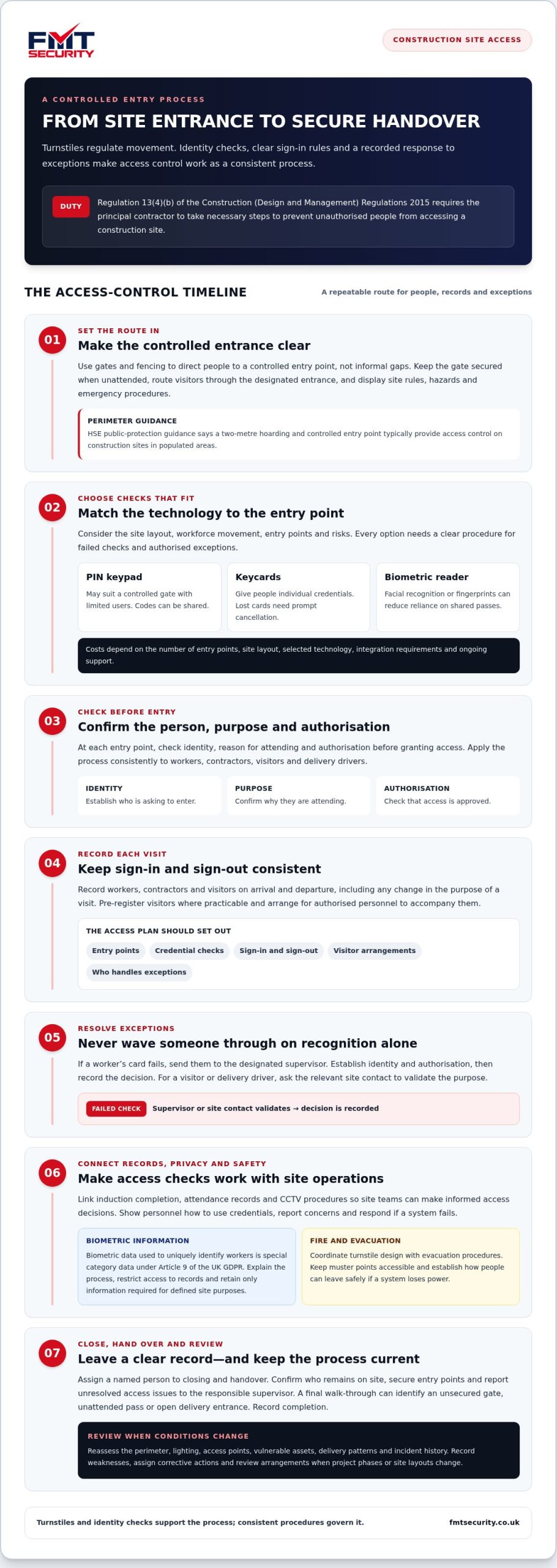
Construction site access control services bring together gate supervision, identity checks, attendance recording and incident reporting. Their purpose is to apply site rules consistently, not simply operate a barrier. A defined process identifies who may enter, what they are there to do and who can authorise exceptions. Arrangements should reflect the project phase, layout, workforce and delivery activity.
At the gate, personnel can check credentials, record arrivals and direct visitors to their authorised site contact. For example, a delivery driver should follow the designated route and site safety instructions before unloading. Gate staff can escalate an unexpected vehicle or unrecognised visitor to site management. Staff also need to know who can approve entry if the expected contact is unavailable.
Physical supervision complements electronic systems. A turnstile or card reader records a credential event, while security personnel can respond if someone tailgates, presents another person’s pass or challenges an instruction. Staff can also observe access conditions, report damage and help separate pedestrian and vehicle movements. Set out these duties in post instructions, including reporting lines and incident records.
The Health and Safety at Work Act 1974 is identified as a key UK regulation relevant to construction-site security and access control, according to the UK legislation register. Under Regulation 13(4)(b) of the Construction (Design and Management) Regulations 2015, the principal contractor must take necessary steps to prevent unauthorised people from accessing a construction site. Operational controls should therefore support the principal contractor’s site arrangements and communicate concerns promptly.
Before deploying controls, review the site-specific risk assessment. Consider perimeter condition, lighting, entry points, vulnerable assets, delivery patterns and incident history. Then match supervision and reporting to the identified risks. A quiet boundary beside stored plant may need different attention from a busy pedestrian entrance. Review controls when the site layout or project activity changes, and record corrective actions after audits or incidents.
Effective service also depends on coordination with site management and contractors. Agree who supplies authorised personnel lists, how changes are communicated and who receives attendance reports. Set a process for lost credentials, failed recognition and disputed access decisions. In an incident, staff should know how to preserve relevant records, notify the responsible manager and follow established emergency procedures.
Measure performance through completed checks, accurate attendance records, reported incidents and resolved deficiencies. Site leaders can review repeated access exceptions to identify unclear instructions or weak points. Regular briefings help personnel understand revised routes and site rules. Treat gate supervision, records and escalation as one operating procedure, and review it whenever project conditions change.
What does construction site access control involve?
Construction site access control brings together people, vehicles, site rules and entry records. It covers who may enter, how their purpose is checked, where they can go and how concerns reach site management. A controlled gate is only one part of the arrangement, which must also account for contractors, visitors, delivery drivers and project layout changes.
Start by mapping each entrance against the site plan. Separate pedestrian and vehicle movements where the layout allows, and direct deliveries through an agreed gate. HSE public-protection guidance says a two-metre hoarding and controlled entry point typically provide access control on construction sites in populated areas. Check the perimeter for gaps, damaged sections and routes that could let people bypass the designated entrance.
Use the same sequence for every arrival. Confirm the person’s identity and reason for attending, check authorisation, then record entry and direct them to the relevant area or contact. Arrange visitor pre-registration and accompaniment by authorised personnel throughout the visit. If a name or purpose does not match the expected arrangements, pause admission and escalate the issue to the site contact.
Vehicle controls need separate attention. Tell delivery firms which entrance and route to use, and coordinate arrival times with site operations. At the gate, confirm the delivery destination and contact before directing the driver onwards. This helps prevent vehicles entering work areas without a clear purpose. Keep pedestrian access separate from vehicle movements where practical, especially during busy deliveries.
Controls must change as the project develops. A new phase may move the gate, alter pedestrian routes or expose stored materials differently. Review access arrangements against the current site plan, delivery schedule and vulnerable assets. Update instructions, signage and authorised access lists together, so workers and contractors receive consistent information. Record who approved each change and tell the gatehouse before it takes effect.
Useful records link an access decision to a person, time and reason. Maintain sign-in and sign-out information for workers, contractors and visitors, then resolve missing or conflicting entries through a supervisor. Record incidents such as attempted unauthorised entry, damaged fencing or a delivery at the wrong entrance. Review reports with site management and assign corrective actions.
Emergency procedures are part of the access process. Gate staff need to know how to report a concern, contact the responsible manager and follow site evacuation instructions. Keep emergency routes and muster points accessible, and communicate changes when the site layout shifts. Access controls must not obstruct safe movement from the site.
Use these checks to assess whether your arrangements suit current site activity. Review your construction site access arrangements and identify where gate procedures, records or supervision need strengthening.
FMT Security: Construction Security
FMT Security provides Construction Security for projects requiring professional manned guarding and disciplined site oversight. Its fully trained, SIA-licensed security officers can support gatehouse procedures, monitor access activity and report concerns to the responsible site team. This service can provide consistent human oversight alongside existing site procedures and systems.
Discuss your site layout, working arrangements and access requirements with FMT Security to identify appropriate support. The company also provides Corporate Security, Industrial Security and Event Security for other commercial environments.
Contact FMT Security to discuss Construction Security for your site, or visit fmtsecurity.co.uk.
Put site access arrangements into operation
Review how your access arrangements work during ordinary site activity, not only at the gate. Consider how staff respond to a changed delivery, an unfamiliar visitor or a mismatch between attendance records and people on site. This operational review can clarify where human oversight is needed alongside turnstiles, facial recognition and connected systems.
A practical construction site access control plan should reflect the site’s procedures, layout and operational risks. FMT Security provides Construction Security, as well as Corporate Security and Industrial Security for other working environments. Its security guard service can support consistent site supervision and the reporting of concerns.
Review your construction site access control arrangements and identify where your team needs additional oversight. Contact FMT Security about site access to discuss the next step.
Clear responsibilities give your team a sound foundation for managing access consistently.
Frequently Asked Questions
Why Does Assessing Security Needs Matter for Construction Sites?
Assessing security needs matters because controls must address the site’s current risks, not an assumed standard layout. A materials compound beside temporary fencing presents different concerns from a staffed pedestrian gate. Reviewing incidents, project changes and vulnerable assets helps managers prioritise controls and identify gaps before they become routine. The assessment also gives supervisors a basis for assigning responsibility and checking whether existing measures remain suitable.
How Often Should Access Control Measures Be Reviewed and Updated?
Review access measures regularly and whenever site conditions change, rather than relying on a calendar date alone. A new project phase, relocated gate, changed delivery route, reported breach or shift in stored assets can alter exposure. Record the review date, findings, responsible person and corrective action. This creates a traceable decision history and helps managers distinguish a completed review from an assumption that existing controls still work.
How Should Employees Be Trained on Access Control Procedures?
Train staff using the actual site procedure and realistic scenarios, not just a policy document. Ask gatehouse personnel to practise handling a lost credential, an unlisted visitor and a delivery at the wrong entrance. Explain who can authorise exceptions and how to record them. Supervisors should revisit instructions after a layout change or incident, then confirm staff understand revised responsibilities before applying them.
How Should You Define Access Levels and Permissions?
Define permissions by role, work area and approved purpose. For example, a delivery driver may need access to a designated unloading area, while a subcontractor may need entry only to zones required for their tasks. Give supervisors authority to approve exceptions, record who approved them and remove access when a worker’s assignment ends. Review permissions against current contractor lists so old credentials are not left active.
What should site teams review when assessing security?
Review the whole site, not only the gate. Inspect perimeter condition and lighting, access points, lock-up routines, vulnerable assets, delivery patterns, incident history, reporting routes and supervision. Consider how these factors interact: poor lighting beside a storage compound may make a fence weakness harder to detect. Compare observations with current controls, assign an owner to each deficiency and record whether corrective work is complete.
What UK laws and regulations apply to construction site access control?
The Construction (Design and Management) Regulations 2015 include Regulation 13(4)(b), requiring the principal contractor to take necessary steps to prevent unauthorised access. The Health and Safety at Work Act 1974 is identified as relevant to site security by the UK legislation register. Turnstile fire-safety design also involves the Regulatory Reform (Fire Safety) Order 2005, according to that register. Biometric identification engages Article 9 of the UK GDPR, which classifies identifying biometric data as special category data.
Who is responsible for controlling access to a construction site in the UK?
The principal contractor must take necessary steps to prevent unauthorised people accessing the site under Regulation 13(4)(b) of the Construction (Design and Management) Regulations 2015. Site managers can set day-to-day procedures, while security personnel apply checks and report concerns. These operational roles support rather than replace the principal contractor’s responsibility. The contractor should make reporting routes and authority for entry exceptions clear to everyone working at the gate.
What are the best access control methods for construction sites?
An effective approach combines physical barriers, identity checks and human oversight. For construction site access control, a staffed gate can manage exceptions, while keycards or swipe cards record individual use and biometric readers support identity checks. PINs may suit a restricted entry point, but shared codes weaken accountability. Choose a combination based on site layout, workforce movement, data handling and emergency exit arrangements, then review it as the project changes.