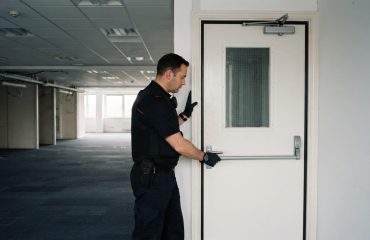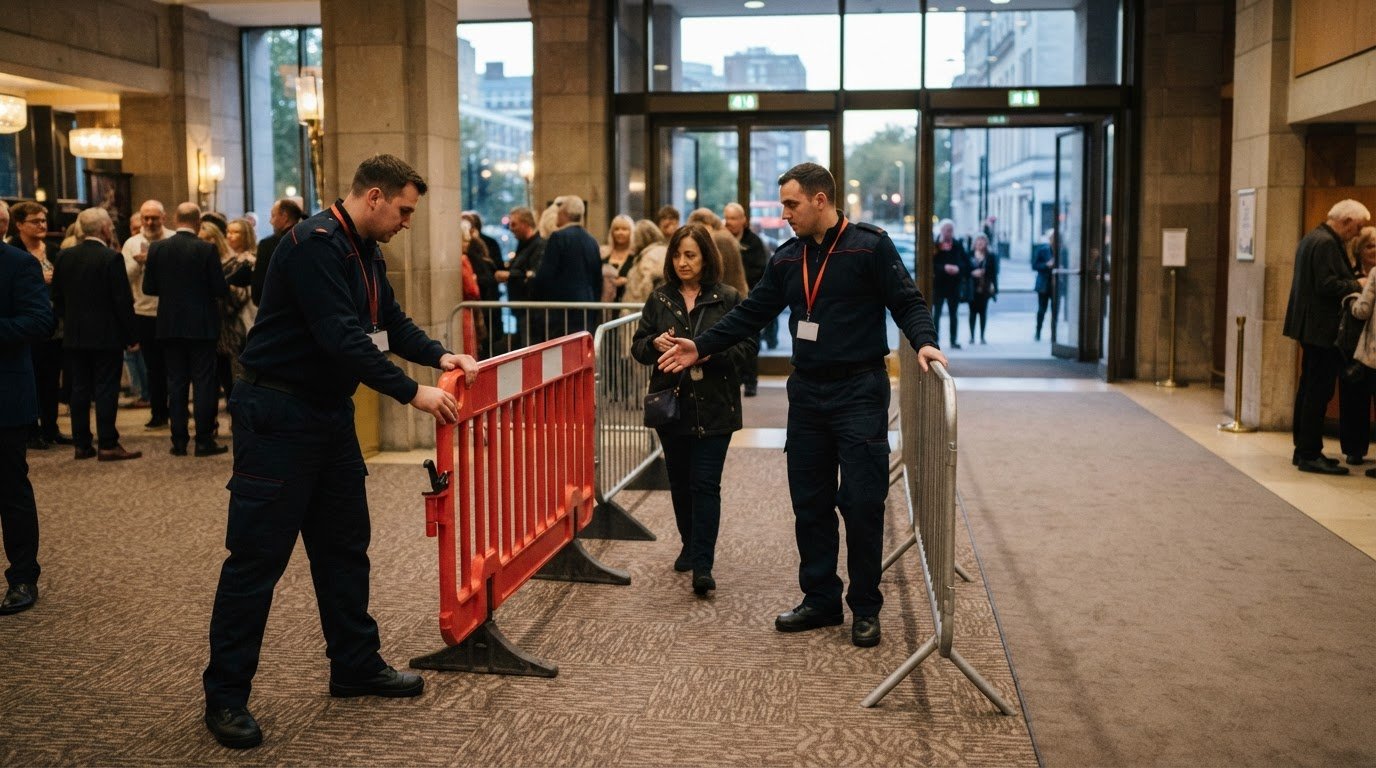
A venue’s capacity is a safety limit, not a target to exceed. Crowd management security brings together staff, barriers and signage to guide movement, reduce overcrowding and respond to changing conditions. Planning should begin well before the event, with arrangements tailored to the venue, expected attendance and event type.
A festival needs different arrangements from a corporate dinner, but both depend on clear roles, active observation and reliable communication. Capacity limits and emergency procedures should be considered alongside how people enter, move through and leave the venue.
This guide explains what crowd management involves, how event capacity relates to a venue’s safety certificate, and which risks a professional assessment should address. It also explains what to consider when selecting a provider, so you can plan appropriate safeguards and understand how event security can support a controlled, well-prepared event.
Key Takeaways
- Match crowd controls to the event, venue layout and expected attendance, rather than relying on a standard plan.
- Agree the operating capacity against the venue’s safety certificate and define who controls entry and can initiate an evacuation.
- Assess movement patterns, pinch points, exits and emergency access so that likely risks inform staffing and response arrangements.
- When selecting a security provider, look for clear roles, communication procedures and a defined approach to managing incidents.
What is Crowd Management?
Crowd management coordinates people, staffing and movement at events, from arrival through departure. Planning begins in advance and adapts to the event’s layout, audience and activities.
Event Types and Scales
Concerts, sporting fixtures, exhibitions and conferences each create different movement patterns. A convention may need controlled registration and clear routes between halls, while a concert needs monitoring around entrances and performance areas. Corporate events also vary: a dinner for two hundred people requires a different deployment from a greenfield festival drawing several thousand attendees. Start by matching staffing, barriers and event security arrangements to the venue and expected crowd behaviour.
Planning Across the Event Lifecycle
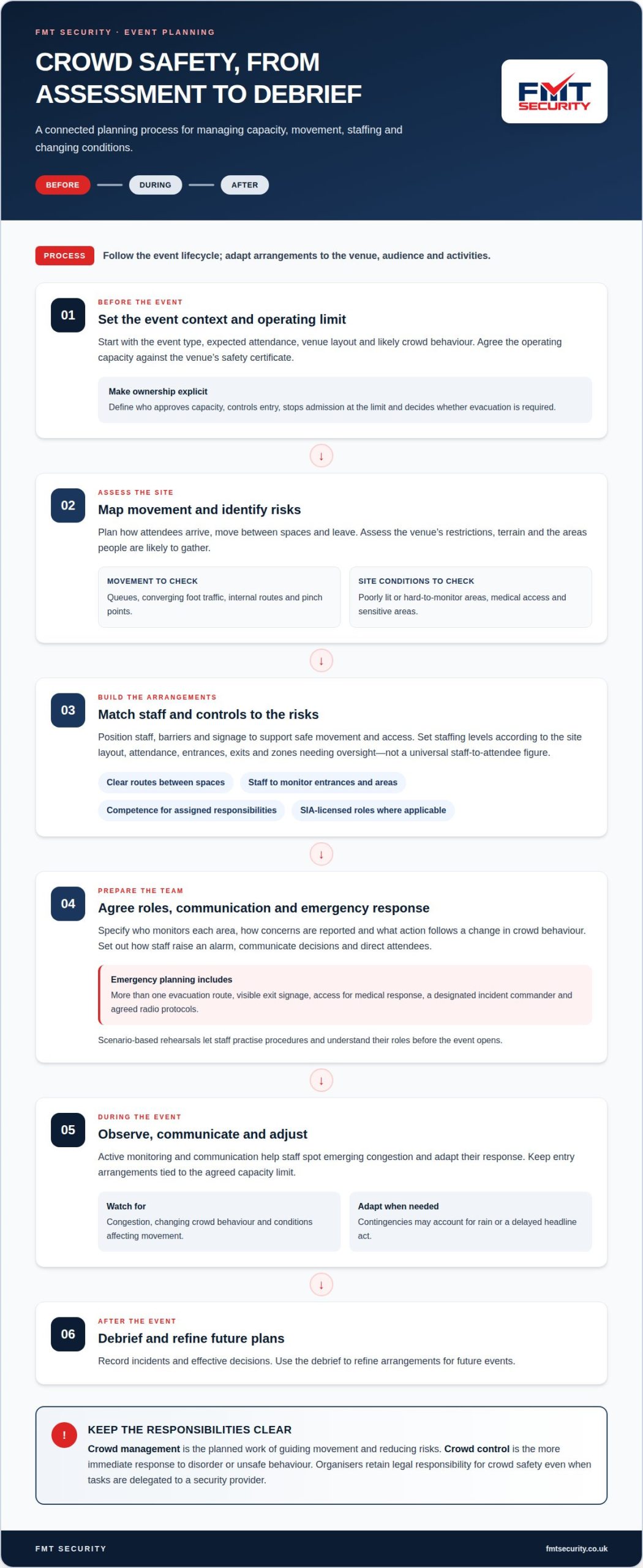
Before an event, planning identifies how attendees arrive, move between spaces and leave. Staff, barriers and signage can then be positioned to support smooth movement, with contingencies for changes such as rain or a delayed headline act. During the event, monitoring and communication help staff spot emerging congestion and adjust their response. Afterward, a debrief records incidents and effective decisions, helping refine arrangements for future events. The UK Government’s HSE event-safety guidance covers preparation, event management, post-event activity and emergency planning.
Management and Control Responsibilities
Crowd management is the planned work of guiding movement and reducing risks. Crowd control is the more immediate response to disorder or unsafe behaviour. The distinction matters at a sports fixture: planned entry routes help manage flow, while staff may need to intervene if a disturbance develops. In the UK, organisers retain legal responsibility for crowd safety even when they delegate tasks to a security provider. The organiser and provider should define their roles and escalation procedures. According to legislation.gov.uk, employers must conduct their undertakings, so far as reasonably practicable, to protect people outside their employment from health or safety risks. Clear procedures help staff act within agreed responsibilities.
Capacity limits and venue safety certificates
Capacity planning connects the venue’s safety certificate with the event layout and expected attendance. The operating limit should guide entry arrangements, staffing and decisions to pause admission.
Venue Layout and Attendee Flow
A venue’s usable capacity depends on more than its total floor area. Organisers need to consider entrances, exits, barriers, internal routes and areas where attendees may gather. For example, a conference with several halls needs clear routes between registration, seating and exhibition spaces. Barriers can guide movement, while staff at entrances help monitor flow and support safe access. These arrangements should match the venue’s certificate and event plan.
Venue-Specific Requirements
Requirements vary with venue type, event size, location and expected crowd movement. An enclosed exhibition hall has different access routes from a greenfield site, where terrain and temporary barriers affect how attendees enter and leave. Capacity planning should take account of the venue and the event. Staffing levels depend on the site layout, attendance, entrances, exits and zones requiring oversight, not a universal staff-to-attendee figure. Organisers should also assign personnel according to their responsibilities and required competence, including SIA-licensed roles where applicable.
Applicable UK Requirements
Concerts, sporting occasions, exhibitions, conferences and corporate hospitality events must abide by strict health and safety legislation. According to the UK Government, HSE event-safety guidance covers planning, event management, post-event activity and incidents or emergencies. The event capacity should be agreed against the venue’s safety certificate, with contracts setting out who approves capacity, stops entry at the limit and decides whether evacuation is required. According to the UK Government, employers must conduct their undertakings, so far as reasonably practicable, to protect people outside their employment from health or safety risks. Event organisers retain legal responsibility for crowd safety when work is delegated.
Before opening, the agreed arrangements should connect the certificate limit to entry monitoring and crowd control procedures. A clear allocation of responsibilities helps staff manage admission safely and respond if conditions change. For event-specific planning, venue security arrangements should reflect the site and event requirements.
Crowd safety planning and risk assessment
A documented assessment connects the event environment, crowd movement and emergency procedures. It helps everyone involved deliver a coordinated response before conditions become unsafe.
Crowd Risk Assessment
Assessment starts with expected crowd size, movement patterns, venue restrictions and site terrain. Identify where queues form, where foot traffic converges, and which areas are poorly lit or difficult to monitor. Consider pinch points, medical access and sensitive areas, too. HSE event-safety guidance covers event preparation, management, post-event activity and emergency planning. The Purple Guide is also relevant to organisers planning event safety.
Safe crowd management depends on matching controls and resources to identified risks. The plan should specify who monitors each area, how concerns are reported, and what action follows a change in crowd behaviour.
Emergency and Evacuation Planning
Emergency procedures should explain how staff raise an alarm, communicate decisions and direct attendees. Plans need to account for more than one evacuation route, visible exit signage and access for medical response. A designated incident commander and agreed radio protocols can help teams coordinate. Scenario-based rehearsals allow staff to practise procedures and understand their roles before the event opens.
Plans should also define escalation points and coordination with emergency services. These arrangements help staff respond consistently if congestion, disorder or another incident affects safe movement.
Planning and Monitoring Crowds
Large-crowd planning maps movement from arrival through departure, including queues and transition areas. Staff monitor assigned zones and communicate changes through clear channels. For example, sudden rain may push an outdoor crowd towards covered spaces, requiring teams to observe changing density and adjust their response. Ongoing monitoring helps identify pressure points early and supports controlled movement through the site.
Communication should connect personnel across zones with those making operational decisions. Clear responsibilities and regular updates help the team act on emerging risks instead of relying on isolated observations.
Monitoring Equipment and Technology
Barriers and signs guide attendees along planned routes, while surveillance systems can support observation across a site. CCTV, drones and AI-based tracking may also be used to monitor crowd density and movement. These tools support situational awareness, but they do not replace staff observation, communication or agreed response procedures.
Equipment should suit the event environment and risks identified in the assessment. The plan should establish how staff share relevant observations and who acts when monitoring indicates a developing concern.
Choosing a crowd management company
When choosing a provider, assess whether its personnel and procedures fit your event. A festival, sporting fixture and corporate gathering create different demands. Arrangements should reflect the venue, attendance, event duration and risks identified during planning. If ticket sales are expected to reach a few hundred people, professional crowd management support may be worth considering.
Look for a defined operating plan, not just a proposed staffing figure. It should assign stewards and security personnel to specific areas, explain how they communicate, and specify who escalates incidents. At a festival, roles might cover arrival routes, queues, performance areas and departure. At a conference, registration, hall transitions and restricted areas may need closer attention. Clear duties help the team coordinate its response.
Ask how the approach is tailored to the site and event schedule. Personnel should understand their zones, reporting lines and procedures for changing conditions. Communication arrangements should connect staff on the ground with the person directing the response. The plan should also identify who controls entry, monitors capacity and coordinates with emergency services if required.
FMT Security provides prices after a free quote is requested. The event duration, venue layout, expected attendance, staffing requirements and assessed operational risks all help shape the proposed arrangements. A plan for a multi-area festival will differ from one for a single-space corporate event, because the required resources and coordination differ.
Before appointing a provider, establish how responsibilities will be recorded and integrated with the event plan. Clear arrangements for reporting, escalation and decision-making support consistent delivery. For tailored event support, discuss your event security requirements.
Staffing should be tailored to the venue, attendance, event duration and assessed risks, with stewards and security personnel assigned to specific areas and duties.
FMT Security
FMT Security provides Event Security for organisers who need professional personnel as part of their event arrangements. Its staff support crowd safety, bag checks and perimeter protection, with duties coordinated alongside the wider event operation. FMT Security also provides Corporate Security, Industrial Security and Construction Security, with manned guarding tailored to different commercial environments.
To discuss event security, share the setting, schedule and requirements for your event. This helps establish how security personnel can fit into the wider plan and support its operational needs.
Contact FMT Security to discuss security for your event.
Put your event plan into action
Effective crowd management security starts by translating the event plan into clear operational arrangements. Bring together the venue details, event schedule and priorities so professional support can be aligned with the setting and agreed responsibilities.
This preparation gives security personnel a practical framework for working alongside organisers and other event staff. It also clarifies how security fits into the wider operation while keeping the event’s specific needs in view. FMT Security provides security services across event, corporate, industrial and construction settings, supporting different operational requirements.
Share your event details and discuss the security arrangements needed for your venue with FMT Security. A focused conversation can help identify a practical next step for planning and delivery.
Contact FMT Security to discuss your event requirements and move forward with a clear plan.
Frequently Asked Questions
What is crowd management security and what does it include?
Crowd management security is the coordinated work of reducing risks and supporting safe movement at an event. It can include security staff, entry management, perimeter protection and procedures for responding to incidents. At public or private functions, FMT Security’s Event Security includes staff for crowd safety, bag checks and perimeter protection. Organisers and security personnel coordinate these duties with the event’s wider operating arrangements.
How can a professional crowd management security provider assess crowd risks and create a crowd management plan, and what information should organisers provide?
A provider assesses the event environment and uses the findings to shape a plan around its requirements. Organisers should provide the venue layout, safety certificate, expected attendance, event schedule, entry arrangements and known operational risks. Details such as staggered arrivals or separate public and staff entrances help inform access arrangements. Sharing existing emergency procedures also clarifies how the security team fits into the event’s command structure.
How do professional security teams manage crowd surges, crush risks and emergencies, and what should organisers expect from them?
Security teams follow agreed procedures, report changing conditions and coordinate their actions with the event’s designated decision-makers. If a surge develops, staff can relay observations, support controlled movement and follow agreed instructions about entry or escalation. Organisers should expect clearly assigned responsibilities and communication channels, including procedures for contacting emergency services. Define the provider’s role in advance so it complements, rather than replaces, the organiser’s overall safety responsibilities.
What crowd safety guidance do the HSE and Purple Guide recommend?
HSE event-safety guidance covers preparation, event management, post-event activities and emergency planning. The Purple Guide is also relevant to organisers planning event safety.
What staffing levels and qualifications are needed for UK event crowd security?
There is no universal staff-to-attendee figure. Staffing should reflect the venue layout, attendance, entrances, exits and areas requiring oversight. Assign personnel according to their responsibilities and competence, including SIA-licensed roles where applicable.