A single guard cannot cover duties taking place simultaneously in different locations, so the right staffing depends on your site’s layout, activity and required cover. Commercial manned guarding contractors in the UK can provide SIA-licensed officers for access control, patrols, visitor management, checks of vulnerable areas and incident response. Effective cover is planned around the risks and responsibilities at each site, not a standard headcount.
It’s understandable to want clear answers on what guarding includes, how many officers a site may need and what makes static cover suitable for commercial or industrial premises. Manned guards carrying out security guarding work covered by Schedule 2 of the Private Security Industry Act 2001 must hold a valid SIA licence, according to the Security Industry Authority. This article explains how to assess guard numbers, what to look for in licensing and provider standards, and how static guarding can support site security.
Key Takeaways
- Estimate guard numbers by mapping site areas and duties that need attention at the same time.
- Plan static cover around access points, vulnerable areas and operating patterns, then consider whether patrols or alarm response should complement it.
- Check that guards hold a valid SIA licence for the security guarding work they perform.
- Factor working-time requirements into rota planning to support consistent, reliable site cover.
How do commercial manned guarding contractors assess how many security guards my site needs?
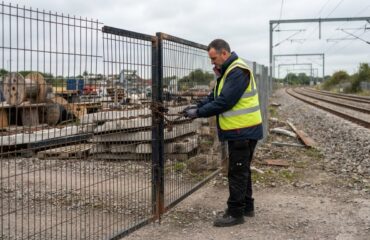
Commercial manned guarding contractors in the UK should assess site layout, operating activity and vulnerable areas before recommending staffing. Construction sites may need coverage around materials storage, vehicle access and changing work zones. Offices have different priorities, including reception, visitor access and restricted rooms. Industrial premises require attention to production areas, loading points and staff movements. These differences shape the assignment and the number of officers needed at any one time.
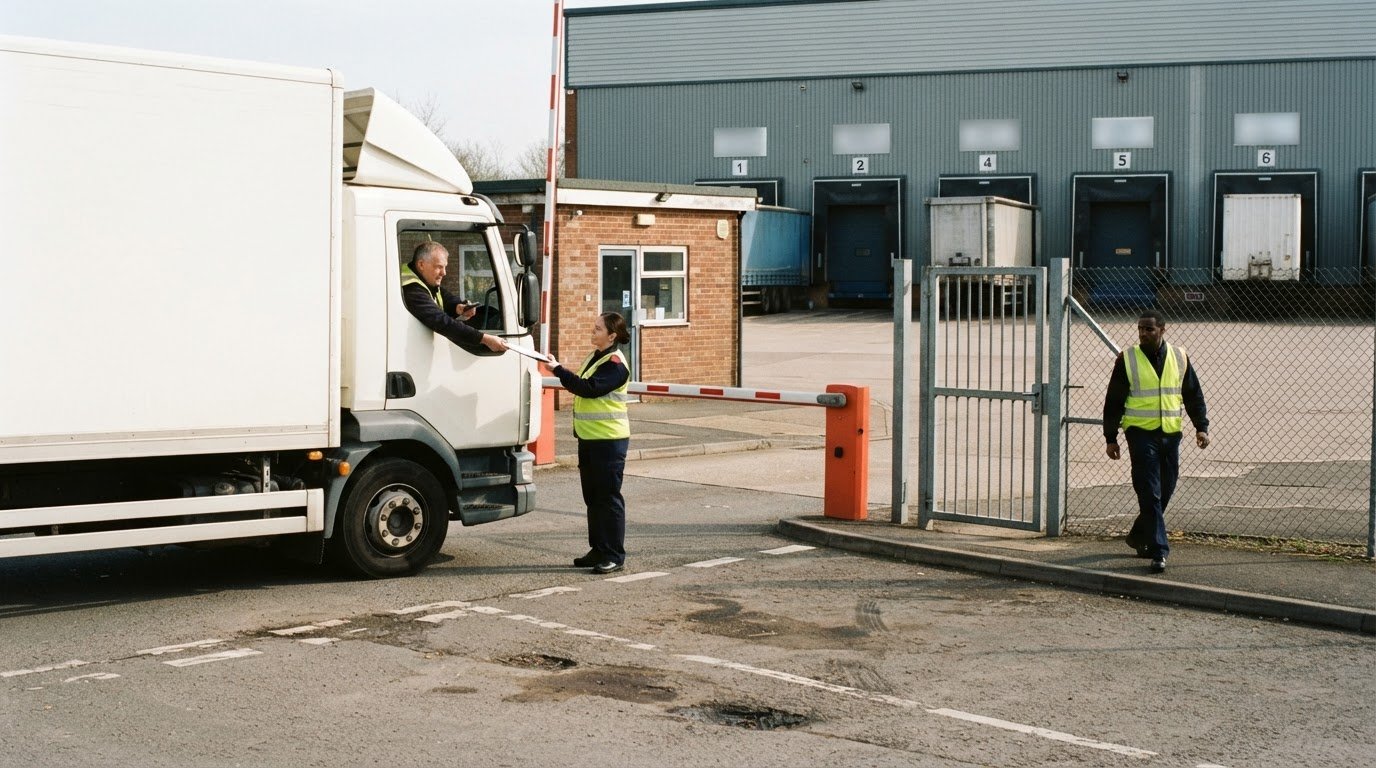
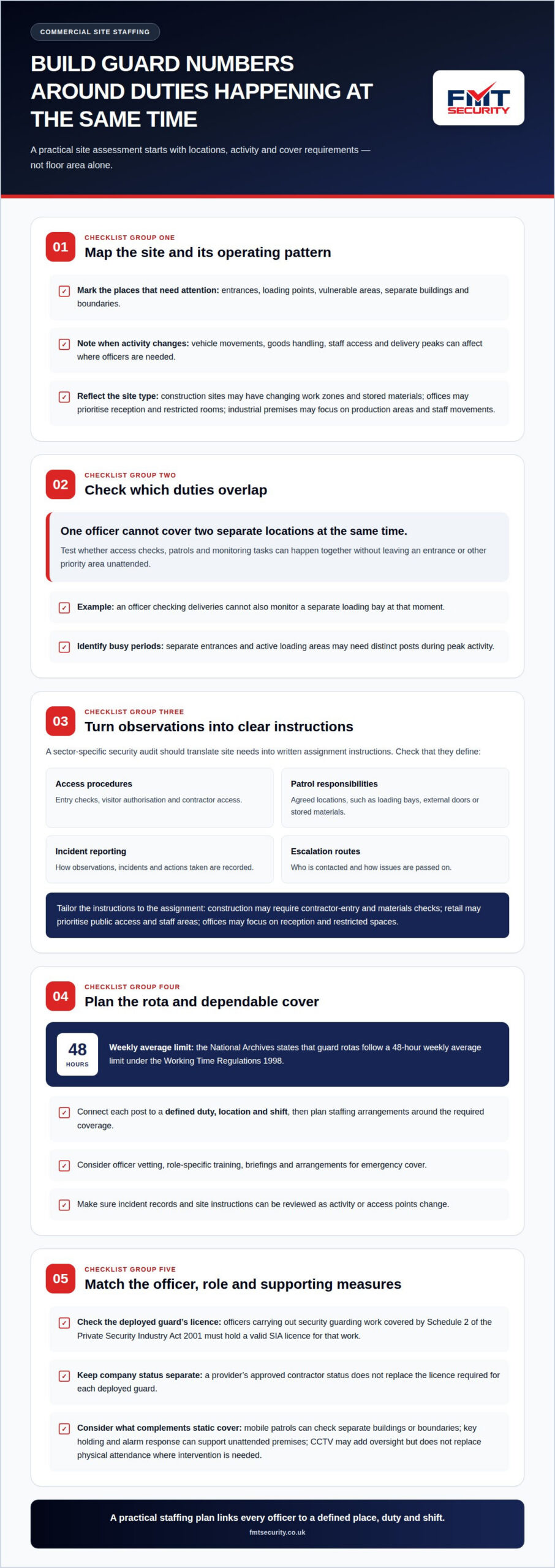
Distribution centres and warehouses need plans that reflect vehicle movements, goods handling and staff access. An assessment identifies where access checks take place and whether patrols can cover other areas without leaving an entrance unattended. For example, an officer checking deliveries cannot also monitor a separate loading bay at the same time. The site layout and periods of peak activity shape officer deployment.
A sector-specific security audit turns those observations into written assignment instructions. These should define access procedures, patrol responsibilities, incident reporting and escalation routes. Construction instructions may address contractor entry and checks around stored materials. Retail premises may prioritise public access and staff areas, whilst an office assignment may focus on reception and restricted spaces. Clear instructions help trained officers apply consistent procedures.
Guard numbers follow the duties that must happen at the same time, rather than the site’s total floor area alone. The National Archives states that guard rotas follow a 48-hour weekly average limit under the Working Time Regulations 1998. Rota planning must account for required coverage and appropriate staffing arrangements. A site with separate entrances and active loading areas may need distinct posts during busy periods.
Commercial manned guarding contractors in the UK should also consider officer vetting, role-specific training and arrangements for emergency cover. Assessment includes how officers are briefed and how incidents are recorded. For a warehouse, the plan should account for delivery peaks; for a construction site, it should reflect changing access points. Recommendations should connect each post to a defined duty, location and shift, giving clients a practical basis for reviewing site cover.
What Is Manned Guarding and Why Do Commercial Sites Require It?
Manned guarding places security officers on site to manage access, patrol designated areas and respond to incidents. Commercial sites can combine a visible static presence with other security measures to address different risks.
Integrated guarding and response services
Static officers provide a consistent presence at key locations, while mobile patrols can check separate buildings or boundaries. Key holding and alarm response can support site security when premises are unattended. CCTV monitoring may add oversight, but it does not replace physical attendance where intervention is needed. Review how each measure fits the site’s operating procedures and response arrangements. Integrated guarding arrangements can be considered alongside those requirements.
Access control and incident reporting
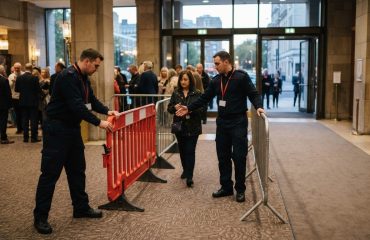
At reception or a vehicle entrance, officers can manage visitor access, follow authorisation procedures and direct contractors to the right area. Patrols provide visible checks of agreed locations, such as loading bays or external doors. Clear reporting records incidents, observations and actions taken, giving site managers information for follow-up. Management reviews can check that assignment instructions and reporting processes still reflect site activity.
Visible patrols can help deter unauthorised access by making a security presence apparent. Routes and timing should reflect site procedures and operational priorities, so critical areas are not left unchecked.
Contracts, service levels and guarding risks
A guarding assignment should define the locations covered, duties, shift arrangements, reporting process, escalation contacts and how changes are agreed. These details establish what the service includes and how performance is reviewed. The site operator and security provider should coordinate health and safety arrangements, including site hazards, safe access, emergency procedures and each party’s responsibilities. Clear communication supports consistent working practices.
Businesses should recognise that guards cannot be in multiple places at once, and a visible presence cannot remove every risk. The service should match site priorities and complement other security measures. Review how incidents are recorded, who receives reports and how management oversight addresses issues. These provisions make service expectations and operational limitations clear.
SIA licensing and approved contractor status
Manned guards deployed at commercial sites in the UK must hold a valid SIA licence for security guarding work covered by Schedule 2 of the Private Security Industry Act 2001, according to the Security Industry Authority. This requirement concerns officers undertaking the relevant work. A company’s approved contractor status is a separate consideration and does not replace the licence required for each deployed guard.
Licensing checks should match the role and location assigned. A reception officer managing visitors, for example, must hold the appropriate licence for their security guarding duties. Assignment instructions should also reflect the actual site, whether an office entrance, construction access point or industrial facility. Clear role definitions help prevent gaps between the work expected and the officer’s authorised activity.
Provider credentials should be considered alongside the arrangements supporting each assignment. A sound deployment process connects officer selection, site-specific instructions and management oversight. Ask how these processes are documented and applied across different locations. Credentials alone do not show whether staffing, reporting procedures or site instructions fit the operational risks.
Officer vetting and training also matter. Screening helps establish an officer’s suitability for the role, while training should prepare them to follow site procedures and respond appropriately to incidents. For example, an officer controlling warehouse access needs instructions covering delivery movements and visitor entry. At a corporate site, the assignment may instead prioritise reception conduct and restricted areas.
Security services should be organised around the client’s operating requirements, with responsibilities clear before deployment. Relevant industry experience can help shape instructions for construction, retail, office and industrial settings. A provider should explain how SIA-licensed officers are briefed, supervised and supported when site requirements change. This gives businesses a clearer basis for assessing proposed cover than relying on a licence or accreditation alone.
Static guarding for commercial and industrial premises
Static guarding places an officer at a defined position on commercial premises. A reception post can manage entry, direct visitors and maintain a visible security presence. At an industrial site, deployment may focus on a vehicle entrance, control point or vulnerable building. The main benefit is consistent attention to a location where access decisions or site activity require oversight.
Construction sites often change as work progresses. Gate locations, delivery routes and areas containing materials may shift, so the static post and its duties should reflect current site arrangements. At an industrial facility, a fixed officer may control access to operational areas or monitor vehicle movements. The assignment works best when the position and responsibilities match the site’s actual risks.
Static guarding differs from mobile patrols, which move between locations to conduct checks. A large premises may need a fixed presence at its main entrance while patrols cover separate buildings or boundaries. These approaches can complement one another, but an officer assigned to reception cannot also be elsewhere at the same time. Deployment should account for this practical limit.
Consider the activity at each post before deciding its scope. Reception duties may centre on visitor access and directing contractors, while a construction entrance may require attention to deliveries and site entry procedures. Industrial posts may focus on vehicle access and controlled areas. Clear responsibilities help officers prioritise observations, follow site procedures and report relevant incidents.
Static guarding is most useful where a specific location needs regular human oversight. It is less suitable as the sole measure if the priority is checking several distant areas at once; mobile coverage may complement a fixed post. For commercial premises, the takeaway is to match each position to a defined operational need, then set duties and reporting expectations accordingly. Discuss static guarding for your premises.
FMT Security: Security guard service
FMT Security provides security guard services for commercial sites where a professional, visible presence supports day-to-day security procedures. Its Construction Security, Corporate Security and Industrial Security services address different operating environments, from building sites to offices and industrial premises.
Consider FMT Security when your site needs guards assigned to defined locations and duties, or when existing arrangements need to reflect changing operational risks. A clear brief on site activity, access points and required cover helps shape an appropriate guarding arrangement. The service can be considered alongside the site assessment and licensing factors outlined above.
For a discussion about security guard services for your premises, contact FMT Security.
Set a clear basis for site cover
Your next step is to turn site priorities into a clear operational brief. Identify the business activity that must continue, the areas where disruption would matter, and how security responsibilities fit existing procedures. When choosing commercial manned guarding contractors in the UK, consider how each provider’s deployment approach aligns with those priorities.
A useful discussion connects officer deployment with day-to-day working patterns, clarifies the information managers need and provides a basis for reviewing arrangements as operations change. FMT Security provides Construction Security, Corporate Security and Industrial Security for different commercial settings. The right service depends on the site’s operating context and guarding requirements.
Share the site’s context and priorities to begin a focused discussion about suitable arrangements. Discuss your site guarding requirements with FMT Security.
Frequently Asked Questions
Are your officers trained to deal with emergencies or confrontations?
FMT Security’s officers are fully vetted & screened, SIA-licensed and trained to meet SIA standards. Qualified Security Officers are selected for each contract. Site procedures should explain how officers report incidents, escalate concerns and communicate with responsible managers. For example, event security instructions can include procedures for supporting an emergency evacuation. Training and instructions guide the response, but cannot guarantee that every confrontation will be prevented.
Can I arrange temporary security cover?
Temporary cover can be discussed as a tailored security requirement. Set out the period, premises, operating hours and duties, such as controlling a construction entrance during a defined work phase. FMT Security uses these details to shape a suitable guarding arrangement. If site activity or access points change during the assignment, include that information in the brief so the proposed duties reflect the temporary conditions.
Can you provide overnight or weekend guarding?
Guarding arrangements are tailored to operational requirements, so specify the overnight or weekend hours and the duties required. For example, an industrial premises may need attention at a vehicle entrance outside its normal operating hours. FMT Security also provides a mobile patrol service operating 24 hours a day, 7 days a week throughout the UK. Mobile patrols and static guarding are distinct arrangements, with different deployment patterns.
How quickly can guarding start?
Deployment timing depends on the site information and requirements, including locations to cover, operating hours and duties. A clear brief helps establish the assignment’s scope and the instructions officers will need. Include the site postcode, required cover and relevant access procedures when requesting a quote. FMT Security does not specify a fixed start time, so do not plan around an assumed commencement date.
I have CCTV, why do I need static guards?
CCTV can help monitor activity, while an on-site officer can interact directly with visitors or people entering restricted areas. A static guard can carry out these on-site duties and report incidents through agreed procedures. For example, a warehouse may use CCTV to observe a loading area while an officer manages access at the entrance. These measures serve different, complementary functions.
What affects manned guarding costs?
Manned guarding requirements depend on the site, including the number and location of posts, operating hours, duties and assignment complexity. A reception post with visitor management has different responsibilities from a construction entrance managing site access. FMT Security provides pricing only after a free quote is requested. Include premises details, operating requirements, site postcode and the type of cover needed to support a relevant quotation.