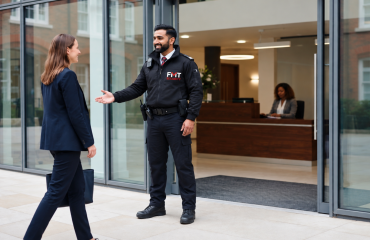
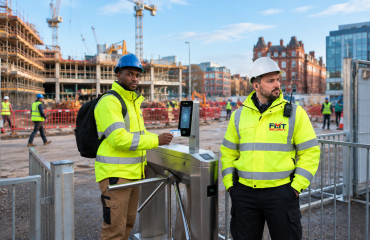
A staffed security post does more than provide a visible deterrent. Static security guards manage access at a fixed location, monitor people entering and leaving, and help protect staff, visitors, property and equipment. In the UK, security guards must hold a Security Industry Authority (SIA) licence.
Controlling an entrance can reduce unauthorised access, but effective site security also depends on clear procedures and consistent attention. Duties should reflect the location’s risks, from checking visitors and supervising deliveries to observing vulnerable areas.
This article explains what static guards do, how access checks and asset protection work, and how different cover periods can meet operational needs. It also outlines the practical factors to consider when deciding what level of on-site security your premises require.
Key Takeaways
- Set clear entry procedures so visitor checks and delivery oversight match the risks at your premises.
- Decide whether a fixed post, mobile patrols or CCTV best addresses each site’s coverage needs.
- Match cover periods to operating hours, temporary exposure and the level of ongoing oversight required.
- For construction sites or other commercial premises, consider how a tailored guarding arrangement can support continuity and asset protection.
Access control and identity verification
At a staffed entrance, static security guards help control who enters and leaves. Their presence supports monitoring and can deter unauthorised access. In the UK, security guards must hold a Security Industry Authority (SIA) licence, whether they work at a corporate reception, an industrial gate or a construction site.
Visitor checks work best when the entry procedure is clear and consistently applied. A guard may ask visitors to show identification, establish who they are meeting and follow the site’s sign-in process. Deliveries can be checked against the intended recipient or designated drop-off point. These steps help distinguish authorised visitors and deliveries from unexpected arrivals, while keeping the entrance controlled.
- Confirm the visitor’s identity and purpose before permitting access.
- Direct deliveries to the agreed receiving area and notify the relevant contact.
- Refer unclear or refused access requests through the site’s established escalation process.
Some premises also use biometric scanners or proximity-based access systems to restrict entry to authorised personnel. A guard can support these controls by monitoring the entrance, responding to access difficulties and identifying attempts to follow someone through a secured door. At a site holding sensitive records or equipment, this combined approach helps maintain oversight without relying on a valid pass as the only sign of authorisation.
Private security guards in the UK are unarmed and have no police powers. They may use reasonable force only when necessary and within the law; a citizen’s arrest is possible only in specific circumstances. During access disputes, the priority is to follow site procedures, avoid escalation and contact the appropriate authorities when required. Clear boundaries help protect visitors, staff and the guard while maintaining control of the premises.
What Is the Role of a Static Security Guard?
A static officer remains at an assigned post, such as a warehouse entrance or reception desk. A mobile officer moves between areas, checking locations that a fixed post cannot observe. Static guarding provides a consistent on-site presence, while mobile patrols extend coverage across a wider site. Both can support security when responsibilities and handovers are clearly defined.
Combining a fixed post with mobile patrols or CCTV can address different site vulnerabilities. For example, an officer may control a vehicle entrance while a patrol checks perimeter gates and less-used buildings. CCTV can show areas beyond the officer’s direct line of sight, and the officer can follow agreed procedures when monitoring identifies activity requiring attention. Each measure has a distinct purpose, rather than replacing the others.
Choose the deployment according to the site’s risks and layout. A retail premises may need a visible officer near its entrance during trading, while a large industrial site may need patrols between separate buildings. A fixed post provides continuous oversight of one location; a mobile patrol can check several points but does not remain at each one. A tailored plan should specify which areas need a direct presence and which need periodic checks.
Key holding and mobile patrols can complement a static post when a site needs alarm response or checks beyond staffed hours. A keyholder can attend after an alarm activation, investigate the trigger and help secure the premises. Patrol instructions should identify access points, priority areas and reporting procedures, keeping the response aligned with the site’s operating requirements.
When choosing a UK security company, define the site’s risks and required duties, then confirm that assigned officers hold valid SIA licences. Review the proposed post instructions, patrol coverage, supervision and incident-reporting arrangements before agreeing the deployment.
Where a site needs a coordinated approach, security coverage planning can help align fixed-post duties with patrol and monitoring requirements.
Full-time, part-time, short-term and long-term cover
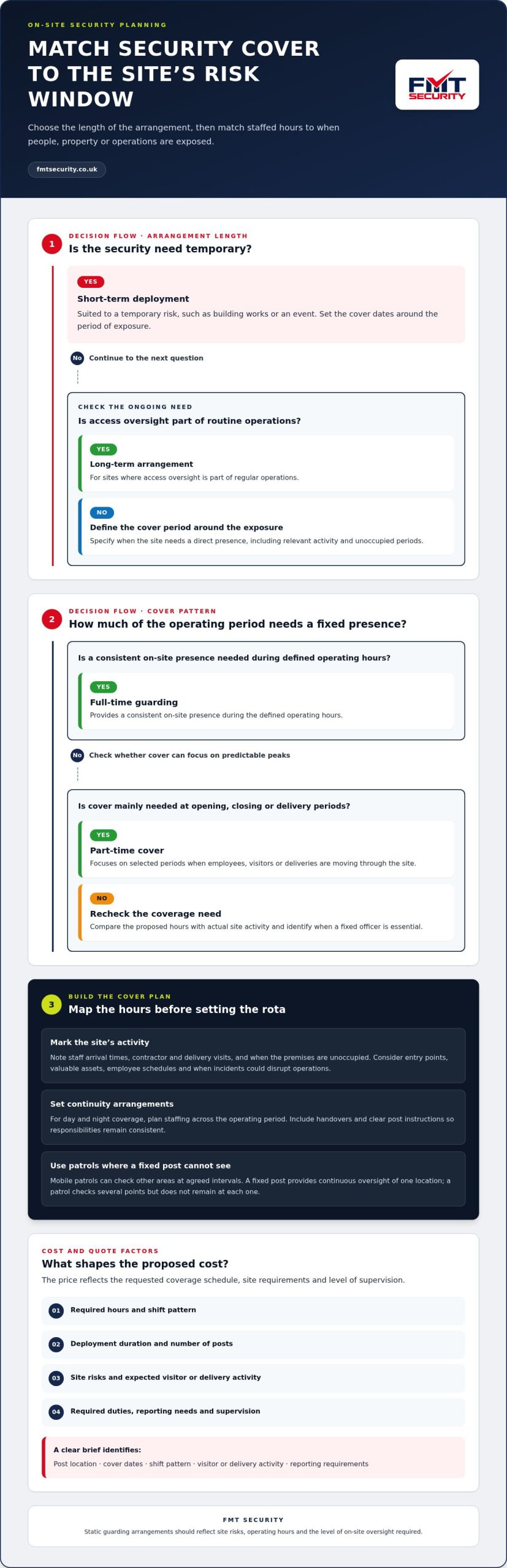
Cover periods should reflect when people, property or operations are exposed to risk. Full-time guarding suits premises needing a consistent on-site presence during defined operating hours. Part-time cover can focus on opening, closing or delivery periods, when employees and visitors are moving through the site. Short-term deployment may address temporary risks, such as building works or an event. Long-term arrangements suit sites where access oversight is part of routine operations.
Businesses use fixed-post guards for different reasons. An office may prioritise reception access during working hours, while a retail premises may need uniformed oversight during trading. Construction sites, industrial facilities and event venues may also require a staffed post suited to their layout and activity. Consider entry points, valuable assets, employee schedules and the times when incidents are most likely to disrupt operations.
Before setting a rota, map the hours when a direct security presence is needed. Identify when staff arrive, when contractors or deliveries attend, and when the premises are unoccupied. Mobile patrols can complement a fixed post by checking other areas at agreed intervals. For day and night coverage, plan staffing across the operating period, including handovers and post instructions that maintain continuity.
Security costs depend on the required hours, deployment duration, number of posts, site risks and duties. The price is provided after a quote request and reflects the coverage schedule, site requirements and level of supervision. A precise brief should state the post location, cover dates, shift pattern, expected visitor or delivery activity and reporting needs. These details help match the arrangement to operational demands, rather than covering periods the site does not require.
Compare the proposed hours with actual site activity and identify when a fixed officer is essential. This clarifies whether continuous, targeted or temporary cover is appropriate before deployment begins.
Protection of people, property, cash and IT assets
A visible officer can deter unwanted activity and provide a point of contact for employees and visitors. At reception, the officer can observe unusual activity, direct people and report concerns through site procedures. This presence supports awareness around equipment, stock and areas containing sensitive information, but does not replace secure storage or sound information-handling practices.
Protection should reflect the assets and risks at each location. A warehouse may need attention to stock movements and vehicle activity, while an office may prioritise access to rooms containing IT equipment. Cash-handling areas need particular care around movement and authorised access. Clear instructions should explain what activity to report, who receives incident notifications and how details are recorded.
Property protection also depends on practical observation. During a patrol, an officer can report a damaged door, an obstructed exit, water entering a building or signs of smoke. In fire or medical emergencies, guards may assist and follow the site’s response procedures; basic first aid may form part of their response. Flooding requires prompt reporting of leaks or rising water, followed by the site’s established safety and escalation steps.
London recorded 55k criminal-damage and arson crimes during 2024-2025. This figure reinforces the value of including damage indicators in site instructions, such as forced doors, broken windows or fresh graffiti. A guard’s role is to observe, report and follow agreed procedures, not to investigate hazards beyond their training or authority. For cash and IT assets, reporting should also protect confidentiality and preserve accurate incident records.
Discuss the site’s people, property and operational risks before setting post instructions. Discuss on-site security requirements to identify where a visible guarding presence can support your protection procedures.
FMT Security: Construction Security
FMT Security provides Construction Security for projects where controlled access and protection of materials are operational priorities. A site-specific guarding arrangement can support oversight of entry points, contractor arrivals and activity around vulnerable areas. Clear post instructions align the officer’s duties with site procedures and changing project requirements.
Consider this service when a construction site needs a visible on-site presence to support access control and asset protection. FMT Security also provides Corporate Security, Industrial Security and Event Security for other commercial environments. The right deployment depends on the premises, operating arrangements and identified security risks.
Discuss guarding requirements for your construction project or commercial site with FMT Security.
Plan your next security step
Before arranging cover, turn operational priorities into a practical brief. Identify the areas requiring oversight, when a security presence matters and what reporting arrangements the site needs. This gives decision-makers a clear basis for defining responsibilities and assessing whether a fixed post suits the premises.
Static security guards are part of a wider risk-management plan, not a substitute for sound site procedures. Specify how officers should respond to concerns, who they should notify and how incidents should be documented. Clear instructions align the security presence with business continuity and the needs of staff, visitors and assets.
FMT Security provides Construction Security, Corporate Security and Industrial Security for organisations requiring guarding in these environments. Discuss your site, its operating requirements and the security priorities a guarding arrangement should address.
Contact FMT Security to discuss your needs and take a considered next step towards a security plan that fits your premises.
Frequently Asked Questions
Are your security guards SIA licensed and vetted?
Yes. FMT Security’s security officers are fully trained, vetted and SIA-licensed. Before deployment, agree the officer’s duties, escalation contacts and reporting arrangements with the site manager. This aligns the assignment with local procedures, whether the post is at a business reception, industrial facility or construction project.
Can I have guards for just nights or weekends?
Yes. Guarding can be planned around the periods when your premises need an on-site officer, including night or weekend shifts. Specify the required hours, handovers, entry duties and incident-reporting contacts. FMT Security provides manned guarding and tailored, contract-specific arrangements, so the brief can focus on the required shift pattern and site responsibilities.
Do security guards have legal powers?
No. UK security guards do not have police powers. They may use reasonable force only when necessary and within the law, and a citizen’s arrest is possible only in limited circumstances. During an incident, guards should follow site procedures, record relevant details and alert the police where appropriate. Their role does not give them general law-enforcement authority.
What do static security guards do in the UK?
Static security guards provide on-site security from a defined post. Duties can include reception oversight, incident recording and observation around an entrance or asset area. At an office, for example, an officer can direct a contractor to the correct host and record an access concern for the site manager to review.
How much does static guarding cost per hour in the UK?
Hourly costs depend on the shift pattern, deployment length, number of posts, site risks and required duties. FMT Security provides pricing after a quote request, based on the arrangement required for the premises. Describe the required cover hours, start date and responsibilities in your enquiry so the quote reflects the actual scope rather than an assumed hourly package.
What qualifications and SIA licence do static security guards need?
Security guards in the UK must hold an SIA licence, and FMT Security’s officers are fully trained, vetted and licensed. Preparation should match the assignment’s responsibilities and site procedures. Before deployment, define the post duties, reporting expectations and escalation contacts so the officer understands how the role fits the premises’ security arrangements.