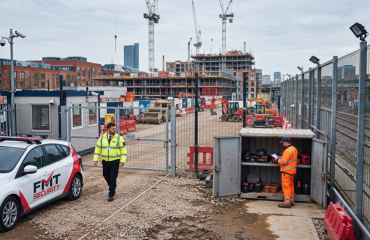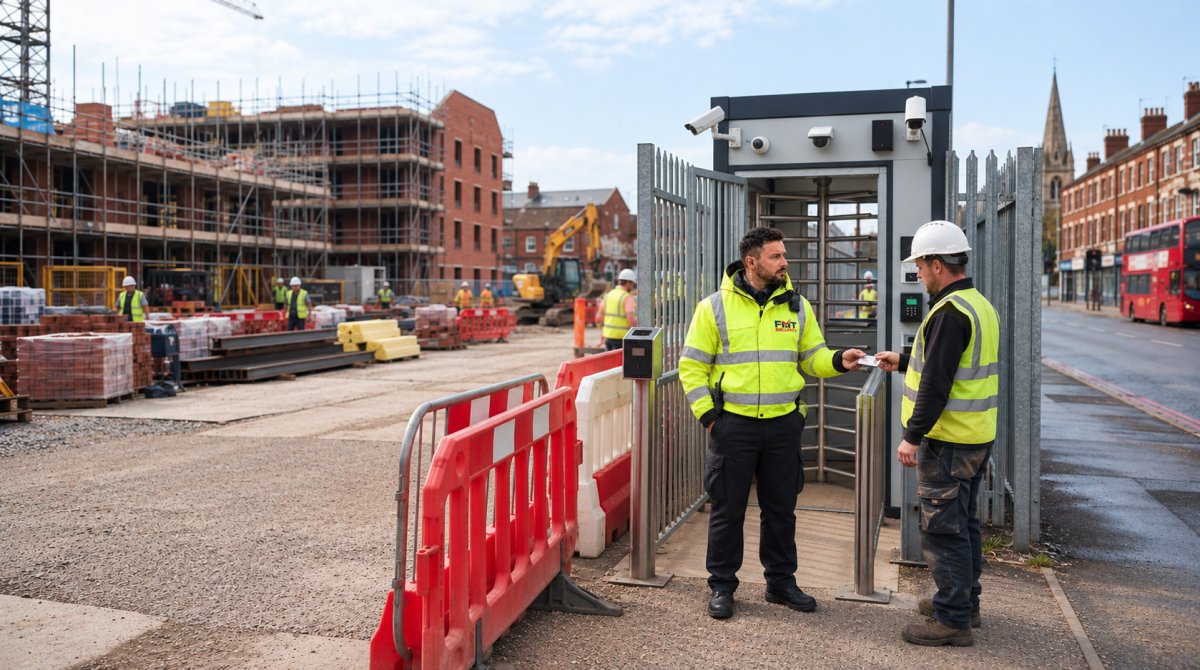
An estimated £1 million is stolen from building and construction sites in the UK each week. Building site security guards provide a visible presence to deter crime and help protect equipment and materials; each individual working in this role must hold a valid SIA licence under the Private Security Industry Act 2001.
Valuable materials left on site can make construction projects vulnerable to theft, which may lead to replacement costs and delays. Building site security guards help protect a project with a visible presence, access control and monitoring tailored to the site’s layout, work phases and operating hours.
This guide explains what construction site guards do, what SIA licensing involves and how security cover can be tailored for short-term projects or continuous site activity. It also outlines how to plan day and night cover, assess the site’s needs and understand the practical factors that shape an effective security arrangement.
Key Takeaways
- Assess how site access, stored materials and changing work stages affect security risks, then shape guarding around those conditions.
- Each individual working as a construction site security guard in the UK must hold a valid SIA licence under the Private Security Industry Act 2001.
- Short-term cover can be planned around project milestones, site opening arrangements and the handover of responsibilities.
- A site-specific risk assessment helps define patrol priorities, access controls and the level of guarding required as conditions change.
- Continuous cover can address risks outside working hours through coordinated day and night shifts and clear site procedures.
What Is a Construction Site Security Guard?
A construction site security guard provides a visible presence, controls access and helps safeguard people, materials and equipment. Building site security guards can also identify changing risks as work areas, delivery points and site boundaries shift.
Theft and Disruption Risks
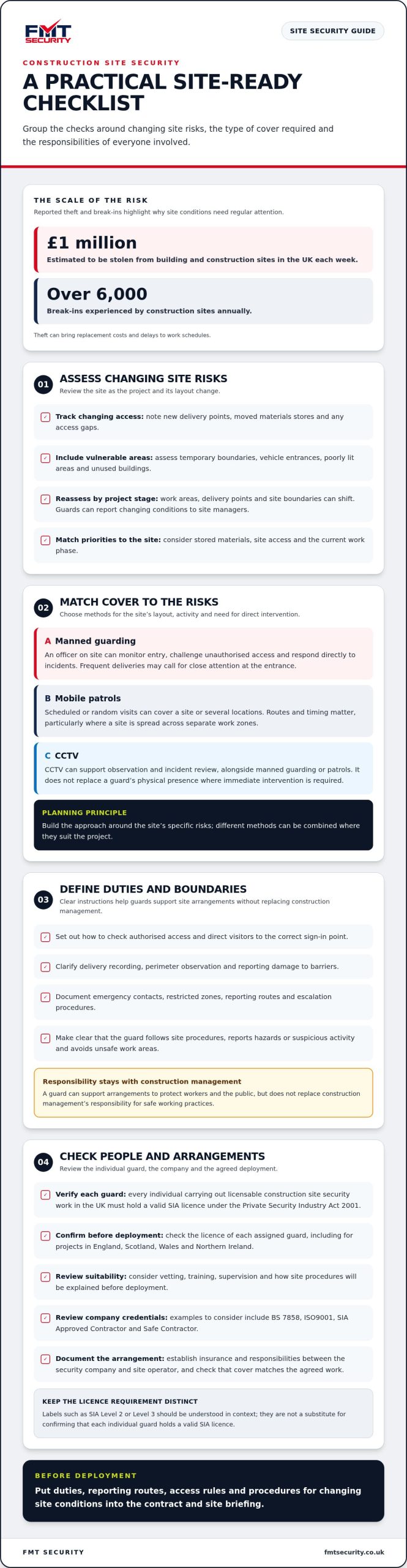
Construction sites can be vulnerable because valuable equipment and materials may remain on site between shifts. An estimated £1 million is stolen from building and construction sites in the UK each week, and construction sites experience over 6,000 break-ins annually. Theft can mean replacement costs and delayed work schedules.
Review risks at each project stage. A new delivery point or relocated materials store, for example, can create an access gap. Include temporary boundaries, vehicle entrances, poorly lit areas and unused buildings in the assessment. Guards can report changing conditions so site managers can respond.
Guarding, Patrol and CCTV Options
Manned guarding places an officer on site to monitor entry, challenge unauthorised access and respond directly to incidents. Mobile patrols cover a site or several locations through scheduled or random visits, so routes and timing matter. CCTV can support observation and incident review, while on-site support may be useful for direct interaction or intervention.
Choose cover by matching each method to the site’s risks. A project with frequent deliveries may need close attention at its entrance, while a spread-out site may benefit from patrols across separate work zones. CCTV can complement either approach, but does not replace a guard’s physical presence where immediate intervention is required.
Guard Duties and Protection Responsibilities
On a UK building site, the party managing the works must maintain arrangements to protect workers and the public. A security guard can support those arrangements by monitoring access, directing visitors to the correct sign-in point and reporting hazards or suspicious activity. The guard does not replace construction management’s responsibility for safe working practices.
Daily duties can include checking authorised access, recording deliveries, observing the perimeter and reporting damage to barriers. During an incident, the guard follows site procedures, communicates relevant details and avoids unsafe work areas. Clear instructions on emergency contacts, restricted zones and escalation routes define the role and reduce confusion.
Security requirements vary by project. A housing development may need attention around public-facing boundaries, while an industrial build can involve plant, loading areas and restricted work zones. During a refurbishment, guards may focus on entrances and vacant sections as contractors move between spaces. Review conditions when construction phases change, then adjust access procedures and patrol priorities.
SIA licensing requirements for security guards
Licensing establishes a baseline for individuals carrying out security work on a construction project. Under the Private Security Industry Act 2001, each individual working as a construction site security guard in the UK must hold a valid SIA licence.
Licensing requirements should be checked for the specific security work being carried out. Site arrangements should still reflect the project’s location, work activities and safety procedures.
Guard Training and Vetting
Licensing is one part of assessing a guard’s suitability for a construction site. Review how personnel are vetted, what training prepares them for site procedures and how their duties will be communicated before deployment. Guards need clear instructions about access points, restricted areas, delivery records and who to notify when they identify a concern.
Address insurance when arranging security cover. Establish which responsibilities sit with the security company and which remain with the site operator, then document the arrangement. Check that the proposed cover aligns with the work and deployment described in the agreement. Clear responsibilities support accountability if an incident affects people, property or the project schedule.
Credentials such as BS 7858, ISO9001, SIA Approved Contractor and Safe Contractor are examples to consider when assessing a security company. Treat them as part of the wider review, alongside insurance, documented procedures and the planned supervision of guards and patrols.
SIA Licensing
The SIA licence requirement applies to each individual performing licensable construction site security work in the UK. Confirm that each assigned guard holds a valid licence before deployment, rather than relying only on a company-level statement. This check applies to projects in England, Scotland, Wales and Northern Ireland.
Security credentials may also refer to SIA Level 2 or Level 3. These labels should be understood in context, and not confused with the requirement for each individual guard to hold a valid SIA licence. Confirm who will be deployed, what their role involves and how licence status is checked and recorded.
To appoint a reputable UK site security company, review its vetting process, staff training, insurance arrangements, relevant credentials and supervision procedures. Then compare these with the site brief: an officer assigned to a delivery entrance, for example, needs clear access-control instructions and an escalation contact. This structured review supports compliance and gives project managers greater peace of mind.
Before work starts, set out responsibilities in the contract and site briefing. Include the guard’s duties, reporting route, access rules and procedures for changing site conditions. These steps help ensure licensed, trained personnel can carry out their assigned role consistently throughout the project.
Short-term security contracts and deployment
Short-term security contracts can match cover to a project’s changing demands, such as a delivery period, exposed works or a temporary closure. Before deployment, define the site area, operating hours, required duties and end date. A written brief helps guards understand the assignment from their first shift.
Set out the contract’s start and end arrangements, shift pattern, handover process and method for requesting changes. A project entering a quieter phase may need fewer staffed access points, while a major delivery may require focused gate control. Agree how changes are authorised, recorded and reflected in the deployment plan.
The cost depends on the length and timing of cover, number of guards, site layout, access points and required duties. Manned guarding at one entrance differs from cover across several work zones and out-of-hours monitoring. A clear brief helps define the scope for a quotation.
Access control should be ready from the first shift. Give guards a current list of authorised staff, contractors and expected deliveries, along with a process for checking identification and recording visitors. If a delivery driver arrives outside the agreed window, for example, direct them to the named site contact rather than admitting them on assumption.
Alongside guards, maintain secure boundaries, controlled gates, suitable lighting and clear procedures for keys and deliveries. CCTV or alarms can support detection and provide information for incident review, while a guard can check access in person. Make sure each measure has a clear purpose and a named site contact responsible for relevant actions.
Contract management should specify how incidents are recorded and escalated. A report should capture the time, location, people involved, observed damage and action taken, such as notifying the site manager about suspected vandalism near a storage area. Set the reporting route before deployment so urgent events reach the right decision-maker without delay.
For any 24-hour control-room or incident-response arrangement, define how the site raises an alert, who receives it and what response follows. Include out-of-hours contacts and instructions for events such as an alarm activation or damaged perimeter. Keep these details current when project personnel or access arrangements change.
Short-term cover works best when deployment details match the site’s actual activity, rather than a generic rota. A practical next step is to plan construction site security cover around the project schedule, access arrangements and reporting requirements.
Construction businesses across the UK experienced a 67% rise in reported crime incidents last year. The overall crime rate stated for construction businesses nationwide is 82 incidents per 1,000.
Tailored security plans and site risk assessments
A site risk assessment turns construction activity into practical security priorities. Walk the site and note access routes, equipment storage, boundary conditions and areas changing between project phases. A newly opened vehicle entrance, for example, may need different monitoring from a completed section with restricted access.
Assess each risk by considering what could be affected, how access occurs and what disruption might follow. A plant store, fuel area and temporary office have different security needs. Record existing safeguards and identify gaps, such as an unchecked delivery entrance or fencing removed during groundworks.
Use the assessment to create an operational plan with clear responsibilities. A useful sequence is:
- Map gates, pedestrian entrances, boundaries and restricted zones.
- Identify valuable equipment, materials and vulnerable property areas.
- Set access procedures for workers, contractors, visitors and deliveries.
- Assign personnel to specific duties, reporting routes and escalation contacts.
Link each action to an identified risk. If contractors use a rear gate during a particular work phase, specify who checks entry and how authorised access is recorded. If equipment is moved overnight, update patrol priorities and inform the relevant site contact. This connects security deployment to actual site activity.
Construction conditions change as structures rise, scaffolding moves and temporary storage areas shift. Review the plan after a significant layout change, a new work phase or an incident. Moving a materials compound, for example, can leave an old access route open unless someone is assigned to secure or monitor it.
Set out how the client and security personnel will communicate. Name the person who approves access changes, receives incident reports and coordinates with site management. Include practical details such as delivery windows, emergency contacts and areas guards must not enter without authorisation. Clear instructions reduce ambiguity during routine shifts and unexpected events.
Risk-led planning also helps determine the type and positioning of cover. A compact refurbishment with one controlled entrance differs from a spread-out development with several work zones. Match staffing and patrol routes to the layout, activity and exposure identified in the assessment, then document why each measure is in place.
Keep the plan usable on site. Give personnel a current site map, access instructions and a process for reporting changed conditions. When a new contractor arrives or a work area becomes restricted, the responsible contact can update procedures and brief affected staff before the change takes effect.
24/7 Site security
Construction sites can remain exposed after the workforce leaves, while valuable equipment and materials stay on site. A 24/7 plan maintains security through working hours, overnight periods, weekends and handovers, when site activity and access patterns differ. Manned guarding creates a visible presence intended to deter crime before it occurs.
Continuous cover needs a defined operating plan, not simply a rota spanning every shift. Set out who takes over, which areas need attention, how incidents are escalated and how site instructions pass between personnel. The incoming guard, for example, should know about an incomplete boundary repair before starting a shift.
Decide whether the whole site needs a constant guard presence or whether cover should focus on higher-risk periods and locations. A project storing plant beside a vehicle entrance may prioritise that area overnight. A site with several active work zones may need patrol routes that adapt as access points or equipment locations change.
Plan each shift around health and safety procedures. Give guards clear boundaries for restricted work areas, safe access routes and instructions for reporting hazards without entering unsafe zones. Site management should identify the appropriate contact for urgent incidents, such as a damaged perimeter or an alarm activation during an unstaffed period.
Continuous security can combine on-site personnel with supporting measures such as controlled gates, lighting, alarms and CCTV. Define the purpose of each measure. An alarm can signal a trigger event, for example, while a guard observes site conditions and follows the agreed reporting procedure.
Reliable handovers are essential to consistent cover. Record incidents, maintenance issues, unusual access and changes to site conditions in a shared log. If a delivery changes the location of valuable materials, the next shift needs that information to adjust monitoring and patrol priorities. Clear records also help managers identify recurring vulnerabilities.
One customer review describes dog handlers remaining on site for approximately 7 weeks, covering day and night shifts. This example illustrates how continuous deployment can span a defined project period; the actual plan should follow the site’s duration, exposure and operational requirements.
Before arranging round-the-clock cover, prepare a site map, shift instructions, contact list and escalation process. Specify how access is controlled outside normal working hours and who can authorise exceptions. These details help guards protect assets without obstructing authorised work or compromising site procedures.
For projects requiring continuous guarding, discuss construction site security cover suited to the site’s operating pattern and identified risks.
FMT Security: Construction Security
FMT Security provides construction security for projects requiring professional manned guarding and site protection. Its guards can support access control, monitor activity and help safeguard equipment and materials, with duties tailored to the site’s layout and operating requirements.
Consider this service when a project has valuable assets on site, changing access arrangements or periods when work areas are unoccupied. A clear brief covering site boundaries, entry procedures, priority areas and incident reporting helps align security with construction activity. FMT Security also provides corporate, industrial and event security.
To discuss construction security for your project, contact FMT Security.
Put the next security decision into action
Assign one project lead to keep the security brief aligned with site activity. That person can coordinate access changes, delivery arrangements and updates when construction phases shift, keeping instructions consistent for everyone involved.
When assessing building site security guards, consider how their duties fit the project’s management structure and who will receive reports. A clearly assigned contact helps security personnel escalate concerns through an established route, avoiding uncertainty during a shift or handover.
FMT Security provides Construction Security, Corporate Security and Industrial Security. Businesses can discuss guarding requirements for construction and other commercial sites with a provider whose services match those needs.
Bring your site priorities, operating arrangements and reporting requirements into the discussion, so the next steps reflect the work taking place. Contact FMT Security about site cover and move towards a more organised security plan for your project.
Frequently Asked Questions
Does an SIA licence apply to the security company or to the individual guard?
The SIA licence applies to the individual guard, not simply to the company supplying security. Make the licence check part of the deployment process and match each officer’s identity to the person assigned to the shift. Company credentials and insurance are separate considerations. Recording individual checks alongside the site’s staffing information provides a clear audit trail if assignments change.
How can a client verify that patrols on their construction site are actually happening?
Agree a patrol schedule and require a record at each checkpoint, noting the time, location and observations. A guard can document a damaged fence or open storage area with a written entry and, where procedures permit, a photograph. Managers should compare completed records with planned routes and follow up on missed checkpoints or unexplained gaps. This creates evidence for operational review rather than relying on verbal assurances.
What SIA licence must a UK construction site security guard hold?
Each individual working as a construction site security guard in the UK must hold a valid SIA licence under the Private Security Industry Act 2001. The practical check is to confirm the assigned guard’s licence and identity before they begin duties. Do not treat a security company’s credentials as a substitute for the individual requirement. Record the check with the deployment details so any replacement officer is assessed separately.
What are the risks of theft, vandalism and trespassing on construction sites?
Theft can remove tools, machinery or materials needed for scheduled work, creating replacement needs and disrupting contractors’ plans. Vandalism may damage temporary barriers, stored supplies or completed work, leaving defects to address before the next stage. Trespass can expose visitors to active work areas and create additional safety concerns. Managers can reduce uncertainty by recording incidents, noting affected locations and checking whether access arrangements or site conditions contributed.
How can site managers assess security needs and arrange guard cover?
Start by mapping entrances, boundaries, storage areas and active work zones, then identify where access or valuable equipment needs closer attention. Set out working patterns, expected deliveries, reporting contacts and areas guards must avoid. Use the brief to define duties, deployment periods and handovers. Review the plan when access, contractor activity or material locations change, and arrange cover around those requirements.