
An office entrance can become a weak point when access procedures are unclear. Office security guards help manage entry by checking visitors, following agreed procedures and maintaining a visible security presence. Effective arrangements also depend on clear escalation steps and a risk assessment suited to the building and its use.
Organisations need to protect people, premises and daily operations without creating unnecessary disruption. A well-planned approach gives staff and visitors a consistent experience while helping prevent unauthorised access and identify concerns promptly.
This article explains how access control and visitor management work in practice, what SIA-licensed officers contribute, and how a tailored risk assessment helps determine the level of cover. It also outlines the operational factors to consider when arranging office security, so you can make a measured decision based on your building’s vulnerabilities and procedures.
Key Takeaways
- Set clear entry procedures for staff, contractors and visitors, including how arrivals are recorded and unusual situations escalated.
- Match manned guarding arrangements to the premises, daily operations and the risks that could disrupt business continuity.
- Understand the licensing considerations for security work, including the Private Security Industry Act 2001.
- Use a tailored risk assessment to identify priority vulnerabilities and shape practical security measures for the site.
Access control and visitor management
Office entry procedures should distinguish authorised access from unverified arrivals. Clear routines help protect staff, visitors and business operations.
Visitor access management
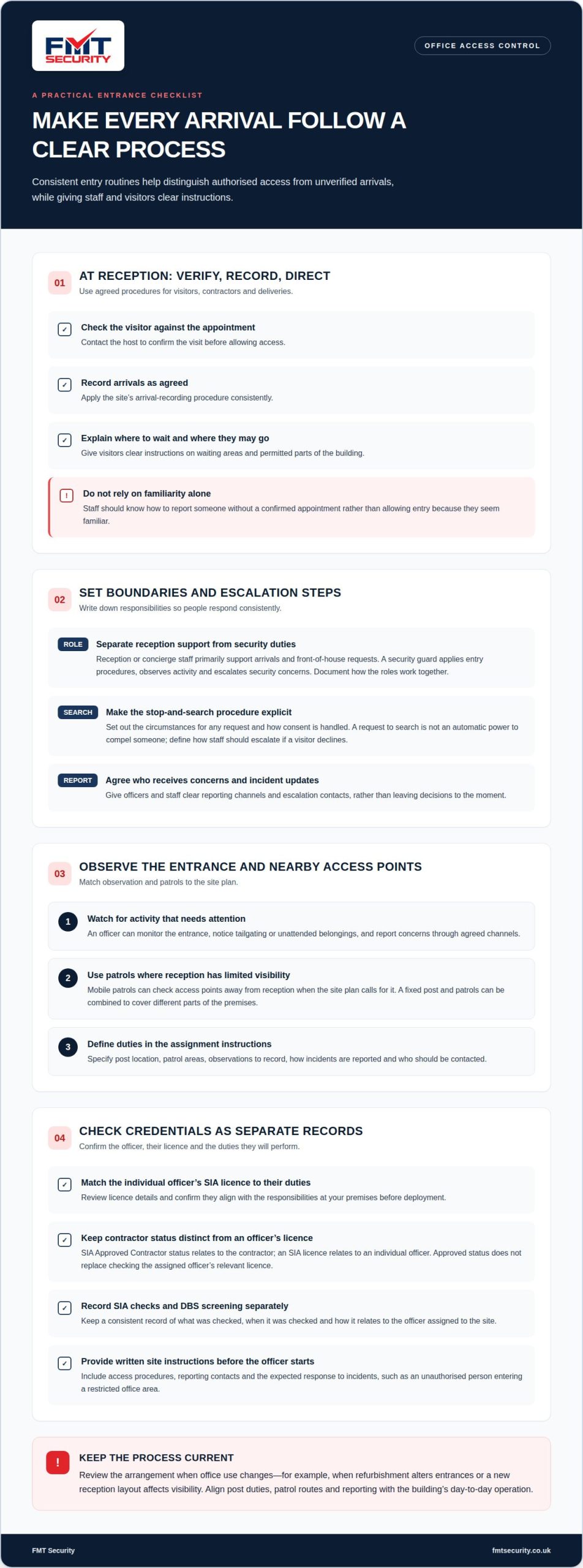
At reception, office security guards can check visitors against appointments, contact their hosts and record arrivals according to agreed procedures. Visitors should receive clear instructions on where to wait and which areas they may enter.
Review how the process handles contractors, deliveries and unexpected visitors. For example, staff should know how to report someone without a confirmed appointment rather than allowing entry based on familiarity alone.
Guard duties and front-of-house roles
A receptionist or concierge primarily supports arrivals and front-of-house requests. A security guard adds a protective role by applying entry procedures, observing activity and escalating security concerns. Document duties so security complements, rather than obscures, reception responsibilities.
For stop and search, set out the site procedure, the circumstances for any request and how consent is handled. Guards should not treat a request to search as an automatic power to compel someone. Clear escalation arrangements help staff respond consistently if a visitor declines.
Surveillance adds another layer of observation. A trained officer can monitor the entrance, notice tailgating or unattended belongings, and report concerns through agreed channels. A mobile patrol may also check access points away from reception, where the site plan calls for it.
SIA Approved Contractor status relates to the contractor, while an SIA licence relates to an individual officer. Consider them separately when reviewing security credentials. Approved status does not replace checking that assigned officers hold the relevant licence for their duties.
Manned guarding for commercial premises
Manned guarding places a trained officer on site to deter unauthorised access and respond to operational concerns. For office security guards, the post and duties should reflect how staff, visitors and property use the premises.
Staff protection through manned guarding
Protecting staff involves more than controlling the entrance. An officer can monitor shared areas, identify behaviour that needs attention and follow agreed escalation procedures. For example, staff working late can report an unfamiliar person near their work area, allowing the officer to assess the situation and respond under the site protocol.
Consider where employees may need assistance, including reception, car parks and isolated corridors. The deployment plan should define patrol areas, reporting arrangements and who receives incident updates.
Hiring an office security guard
To hire office security guards in the UK, define the site’s risks, required duties and coverage pattern, then arrange a service that matches those needs. Specify the post location, expected incident response and how performance will be reported.
Before deployment, agree site instructions, escalation contacts and handover procedures. Include building access arrangements and nearby public-facing areas in the deployment brief.
Manned guarding can combine a fixed reception post with mobile patrols elsewhere on the premises. Office security guards at the entrance provide a visible deterrent, while patrols can check spaces that reception cannot observe directly. The right balance depends on the building layout, operating hours and how staff move through the site.
Set clear duties in the assignment instructions. These might include recording patrol observations, reporting property damage and contacting a named manager when an incident occurs. A defined response process helps staff understand what happens after a concern is raised, rather than leaving decisions to the moment.
Review the arrangement when office use changes, such as a refurbishment that alters entrances or a new reception layout. A planned security approach for commercial premises can align post duties, patrol routes and reporting with the building’s day-to-day operation.
SIA-licensed security guards and officers
An SIA licence is an important credential when appointing officers for professional security duties. Check that licence details and assigned responsibilities align before deployment.
SIA-licensed office security guards
For office security guards, review the officer’s licence details and confirm they match the duties at your premises. A reception post and mobile patrols, for example, may involve different responsibilities, so define each task clearly in the deployment brief.
Ask how officers receive site instructions and report concerns. An office may need a clear route for escalating incidents from its lobby to the duty manager, rather than relying on informal handovers.
SIA licensing and DBS checks
Keep SIA licence checks and DBS screening as distinct parts of recruitment and deployment records. Record what was checked, when it was checked and how it relates to the officer assigned to the site.
Use a consistent process for each officer, including a review before duties begin and whenever assignments change. This supports accountable decisions across a security team without treating one credential as a substitute for other checks.
The Private Security Industry Act 2001 is the legislation cited in connection with offences involving working unlicensed, according to The National Archives. This makes licence status an important consideration when arranging guarding work in the UK.
Before an officer starts, match their identity to the records, review their licence details and provide written site instructions. Include access procedures, reporting contacts and the expected response to incidents, such as an unauthorised person entering a restricted office area.
Then assess how the officer will work within the wider security operation at your premises. A fixed post may suit a single entrance, while mobile patrols can cover internal areas or separate access points. Specify who supervises the assignment and how observations reach the responsible manager.
These steps help you assess whether licensed officers are prepared for the actual role, rather than relying on general claims of experience. They also give managers a practical basis for reviewing deployment and maintaining consistent professional standards.
Risk assessments and tailored security plans
A site assessment connects vulnerabilities with practical security measures. It should consider people, assets, building layout and daily operations.
Guard numbers and shift planning
There is no single number of guards suited to every office. Assess entrance locations, building layout, operating hours, visitor activity and tasks requiring continuous attention. A single staffed entrance, for example, creates different demands from a building with several access points and separate floors.
Plan shifts around when coverage is needed, including handovers and gaps between operating patterns. Specify who takes responsibility during each handover, how incidents are recorded and how managers receive updates. A written schedule helps align staffing with the security plan without assuming one post can monitor every area.
Risks and limitations of office guards
Guards can deter and report concerns, but they cannot eliminate every risk or replace sound building procedures. A reception post, for example, may not provide direct oversight of a rear entrance. Identify such limitations in the assessment and assign suitable monitoring, patrol or escalation arrangements.
UK office security planning should account for health and safety, data protection and employment requirements. Set out how incident records are handled, what information officers may access and how their duties fit workplace procedures. This gives managers a practical framework for protecting staff while respecting privacy and defined responsibilities.
A security company should use the assessment to prioritise vulnerabilities rather than apply identical measures to every premises. Consider corporate security requirements such as access patterns, sensitive assets, public-facing areas and periods of reduced occupancy. Record each risk, its potential effect and the response assigned to it.
Review the plan after a significant change, such as a renovation that creates a new entrance or a change in how staff use the building. Compare incident reports with the current deployment, then update duties where the evidence shows a gap. This keeps security measures relevant to actual site conditions.
Set out your office’s layout, operating pattern and priority risks to develop a tailored guarding plan with FMT Security’s corporate security team.
FMT Security: Construction Security
FMT Security provides Construction Security for building sites and Corporate Security for office environments. If your office needs a dedicated guarding arrangement, Corporate Security is the relevant service to discuss. It supports businesses seeking a professional security presence shaped around their premises, operational requirements and identified risks.
For organisations managing both offices and construction activity, priorities may differ between occupied workplaces and active building sites. FMT Security also provides Construction Security, with arrangements suited to site requirements. A clear outline of access points, working patterns and principal concerns helps establish the right focus.
Contact FMT Security to discuss your office security requirements and the next practical step.
Make your next security decision with confidence
Security arrangements should stay aligned with the way your organisation operates. As teams, premises and working patterns change, review who owns each procedure and how concerns reach the responsible manager. This helps keep the role of office security guards clear within your wider operational plan.
FMT Security offers Construction Security, Corporate Security and Industrial Security. If you are assessing office guarding or reviewing how security should support changing business requirements, discuss your priorities and the procedures you need officers to follow with FMT Security.
Contact FMT Security to discuss your requirements and plan a security arrangement suited to your premises. A clear starting point can support a more disciplined approach to protecting people and business operations.
Frequently Asked Questions
What qualifications and SIA licence do office security guards need in the UK?
Security officers should hold an SIA licence appropriate to the licensable duties they perform and receive training suited to their assigned post. Requirements depend on the role, so don’t assume a general security qualification covers every task. Before deployment, compare the officer’s identity and licence details, then confirm responsibilities such as reception cover, patrols or CCTV monitoring in written instructions.
What should I check when choosing an office security company?
Check that the company can define the assignment, provide suitable officers and explain how it manages day-to-day accountability. Ask how site instructions are recorded, who receives incident reports and how changes to the building or operating pattern are reflected in the deployment. For example, a new entrance may require revised post instructions and a clear handover, not just verbal updates.
Can office security guards monitor CCTV and control access under UK law?
Yes, guards can monitor CCTV and manage access when these tasks are assigned to them and authorised by the organisation. Set clear instructions on which cameras they monitor, which areas they may access and how they should report incidents. Handle CCTV footage and visitor information under the organisation’s data-protection procedures, limiting access to the duties officers have been assigned.