
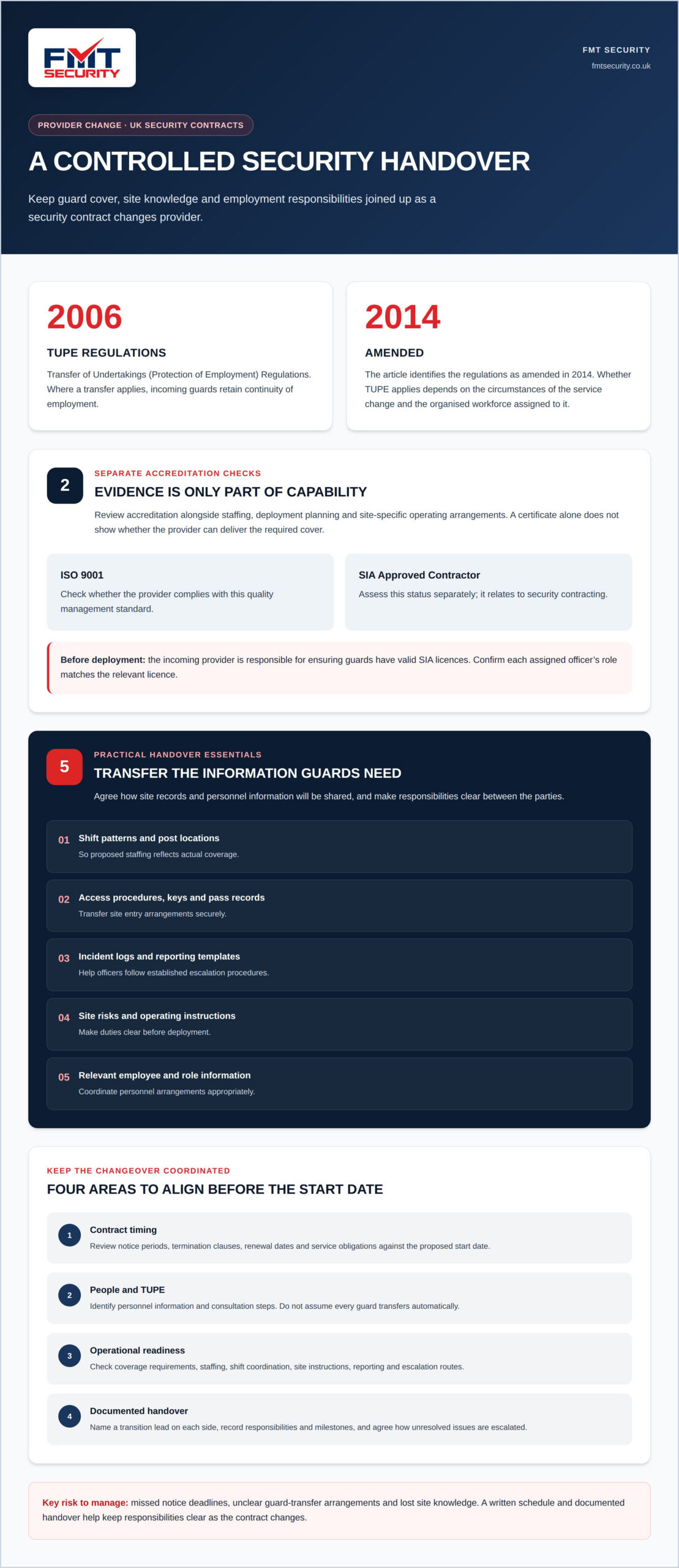
A change of security contractor is only successful when guard cover, site knowledge and employment responsibilities are managed together. When switching security guard companies, the key legal consideration is TUPE: the Transfer of Undertakings (Protection of Employment) Regulations 2006, as amended in 2014, according to the UK Government. Where a transfer applies, incoming guards retain continuity of employment.
That makes a provider change more than a simple handover. Contract notice terms, employee information, communication with affected guards and the secure transfer of site records all need coordinated management to support continuity and an orderly transition.
This guide explains how to assess a prospective provider’s operational capability, plan communication between the parties and manage the handover of personnel and site information. It also explains how TUPE may affect incoming guards, including continuity of employment and the careful handling of existing terms. The aim is a controlled changeover that maintains security provision as responsibilities move to the new contractor.
Key Takeaways
- Review contract notice periods and termination terms before setting a changeover date, so the transition is planned around your existing agreement.
- Assess a prospective provider’s accreditation, staffing capability and site-specific operating arrangements, not just its proposed service description.
- Agree clear communication and handover procedures, including how guards, site records, keys and access passes will be transferred.
- Understand how TUPE may affect incoming guards’ employment terms and continuity, and ensure employee information is handled as part of the transition.
What should clients expect from a professional provider when switching security guard companies in the UK?
Switching security guard companies should start with a careful review of the existing contract, not a rushed changeover. A prospective provider can map notice requirements, termination clauses, renewal dates and service obligations against the proposed start date. This helps identify contractual conflicts before they affect security cover.
Ask for a transition plan that identifies which guards are assigned to the contract and how their roles will be assessed. Where TUPE applies, affected employees may transfer to the incoming provider. According to UK Government, TUPE is the Transfer of Undertakings (Protection of Employment) Regulations 2006, as amended in 2014. The UK Transfer of Undertakings (Protection of Employment) Regulations were amended in 2014, according to UK Government.
TUPE may apply when a contract changes provider and the relevant legal conditions are met. Whether it applies depends on the circumstances of the service change and the organised workforce assigned to it. The provider should identify the personnel information and consultation steps needed for the transition, rather than assume that every guard transfers automatically.
Before appointing a replacement provider, assess its ability to meet the site’s coverage requirements, reporting arrangements and operating procedures. The new contract should set out responsibilities, service standards, escalation routes and the start date. For example, an office contract may need clear post instructions and incident-reporting channels.
Notice periods and renewal dates determine when a new provider can take over. Align the outgoing contract’s expiry or termination with recruitment, induction and site familiarisation, and record each milestone in the transition plan.
The work involved in changing providers depends on the required coverage, site risks, staffing arrangements and transition needs, including any employment-related obligations. A provider can help reduce gaps in cover by coordinating the start date, guard allocation, site instructions and shifts with the outgoing contractor.
Key risks include missed notice deadlines, unclear guard-transfer arrangements and lost site knowledge. Manage them with a written schedule of responsibilities, a documented handover and an agreed process for escalating unresolved issues.
Verifying provider accreditations and operational capability
Assess accreditation evidence alongside deployment planning. A certificate alone does not show whether a provider can staff your posts, follow site instructions and maintain reporting standards during a transfer. Review relevant accreditation evidence, named management responsibility and an operational plan tailored to the site.
For quality management, check whether the provider complies with ISO 9001. For security contracting, assess whether it has SIA Approved Contractor status. Treat these as separate checks: one concerns quality management, while the other relates to security contracting. Record the evidence and its relevance to the services being proposed.
Operational capability is demonstrated through practical detail. Review the proposed staffing structure, shift coverage, site-specific instructions, supervision arrangements and incident-reporting process. For example, a commercial office plan should explain how officers receive post instructions and report access concerns. A clear escalation route shows who manages an issue and how it reaches the responsible person.
Check SIA licences before deployment. The incoming provider is responsible for ensuring guards have valid SIA licences before they are deployed. Include licence status in the personnel transition process, and confirm each assigned officer’s role matches the relevant licence. This prevents the handover plan from relying on unverified staffing assumptions.
Treat HCIS references carefully during a UK contract transition. If the site’s governing documents or contract refer to HCIS requirements, identify the relevant obligations, records and responsibilities in the handover plan. Keep this separate from UK accreditation checks, and do not assume an HCIS reference applies to every UK site. The site documentation should clarify its relevance.
Use a written assessment that records accreditation evidence, staffing arrangements, licence checks and any site-specific compliance requirements. This creates a clear basis for reviewing static guard provision against the site’s operational needs, without treating a certificate as a substitute for deployment capability.
Management and communication
A named transition lead on each side keeps decisions and responsibilities clear. The incoming provider needs the contract start date, site contact details, post instructions, coverage requirements and escalation routes. These details shape the transition plan and direct questions to the person responsible.
For an effective handover, the incoming provider also needs practical site information, including:
- Current shift patterns and post locations, so proposed staffing reflects actual coverage.
- Access procedures, key and pass records, so site entry arrangements transfer securely.
- Incident logs and reporting templates, so officers can follow established escalation procedures.
- Site-specific risks and operational instructions, so guards understand their duties before deployment.
- Relevant employee and role information, so personnel arrangements can be coordinated appropriately.
Agree communication channels before the changeover. The contract should define measurable service standards, including response times and reporting protocols. It should also specify who receives incident reports, handles service concerns and escalates unresolved issues. Clear ownership reduces the risk of missed messages during the transfer.
Plan an on-site overlap between outgoing and incoming guards for 2-4 hours. This gives officers time to pass on local procedures, access details and location-specific knowledge. For example, an outgoing guard can show the incoming officer where deliveries are recorded and how visitors are directed.
Keep a controlled handover record. Transfer keys, passes, documents and confidential data securely, and record receipt with the responsible representatives. A written schedule can show what has been handed over, what remains outstanding and who will resolve each gap.
Before the start date, transition leads should confirm that incoming staff have the post instructions, contact lists and reporting routes they need. A brief operational review can test a scenario, such as reporting an access breach, and resolve any ambiguity before normal duties begin.
Terms and continuity of employment for incoming guards
Where TUPE applies, transferring guards retain continuity of employment with the incoming provider. This affects employment rights, so the transfer requires accurate personnel information and careful handling of existing terms.
For example, a guard with 4 years’ service retains that service for redundancy and unfair dismissal purposes. The incoming provider should therefore understand each transferring employee’s service history before making decisions about employment or staffing.
Employee liability information is central to the transfer. The outgoing provider must give it to the incoming provider at least 28 days before a TUPE transfer. Failure to provide this information can result in a minimum award of £500 per employee to the incoming provider, according to the UK Government.
Operationally, providers are advised to be able to produce a clear record of each guard’s pay, leave entitlement and HR history within 48 hours of notice. This helps the incoming provider assess staffing arrangements and prepare for the transfer using consistent employee records.
Plan the consultation process as well. UK TUPE law sets no minimum period for informing and consulting affected employees before a transfer. The parties should organise communication around the transfer timetable, explain what is changing and provide relevant information to employees in a timely, orderly way.
Take particular care with existing terms. Changes connected to a transfer are generally void unless there is an economic, technical or organisational reason entailing changes in the workforce. The incoming provider should distinguish transfer-related changes from other proposed adjustments and document the reason for any change.
During due diligence, establish which guards are assigned to the contract and review their roles, service records and employment terms. Keep employee information secure and limit access to those managing the transfer. A structured record helps resolve discrepancies before they disrupt staffing or payroll.
For a transition involving transferring guards, discuss employment continuity planning as part of the contract handover.
FMT Security: Static Guards
FMT Security provides Static Guards for organisations changing their on-site security arrangements. A structured service can help maintain a consistent guarding presence while site instructions, staffing arrangements and communication responsibilities are established.
For construction sites and corporate premises, the right arrangements depend on the site, operating requirements and security risks. FMT Security provides Construction Security, Corporate Security and security guard services, tailored to the environment and required duties.
Consider FMT Security when planning guarding for a contract transition or arranging cover at a site. Details about the premises, required duties and handover arrangements help shape the operational plan.
To discuss your security requirements, contact FMT Security.
Set the next contract up for sustained performance
Switching security guard companies is an opportunity to establish a stronger operational foundation, not just replace the current arrangement. Use the transition to define effective security provision in practice, including clear accountability, consistent communication and duties suited to the site. These expectations give the new working relationship a practical basis for review and ongoing management.
FMT Security provides Construction Security, Corporate Security and Industrial Security for organisations with different premises and operational needs. Setting out the environment and required duties helps shape a service suited to the contract’s security requirements.
Move the transition towards a clear, professionally managed plan. Contact FMT Security to discuss your security requirements and the next steps for your site.
Frequently Asked Questions
What Is TUPE?
TUPE is the Transfer of Undertakings (Protection of Employment) Regulations 2006, according to the UK Government. The regulations were amended in 2014, also according to the UK Government. They can protect employees’ rights when a relevant business or service transfers. For a security contract change, the key issue is whether the circumstances meet the legal conditions, not simply whether the contractor’s name changes.
How can a professional security provider support a switch between security guard companies in the UK?
A provider can coordinate the operational transition, clarify responsibilities and align the new service with the site’s requirements. For example, it can map post duties to coverage needs, organise the transfer of site instructions and establish who receives incident reports. A clear plan identifies outstanding actions and responsible contacts, helping you manage the change while maintaining focus on daily security operations.
What notice period is required to terminate a UK security contract?
The notice period depends on the wording of the existing contract; there is no single period that can be applied to every agreement. Review the termination clause alongside renewal dates, required notice format and any conditions for early termination. For example, a contract that renews automatically may require notice before its renewal date. Record the applicable deadline before agreeing a replacement start date.
Does TUPE apply when changing security companies in the UK?
TUPE may apply when a security contract moves to a new provider, but a change of contractor does not automatically mean that it applies. The circumstances of the service change and the employees assigned to the work matter. Review whether the relevant legal conditions are met and identify potentially affected staff. This helps the parties plan employment responsibilities alongside operational arrangements.
What happens to security guards’ jobs and terms under TUPE?
Where TUPE applies, transferring guards generally move to the incoming provider with continuity of employment preserved. Handle their existing terms carefully: transfer-related changes are generally void unless an economic, technical or organisational reason entails changes in the workforce. For example, assess a proposed change to working arrangements in relation to the transfer and its underlying rationale before implementing it.
How can clients compare UK security companies, SIA licences and accreditations?
Compare each provider’s proposed staffing, supervision, reporting arrangements and ability to meet the site’s operating requirements. Assess whether the provider complies with ISO 9001 and has SIA Approved Contractor status. Separately, ensure the guards assigned to the contract hold valid SIA licences before deployment. A provider’s accreditation does not replace individual licence checks or a practical review of how the service will operate.