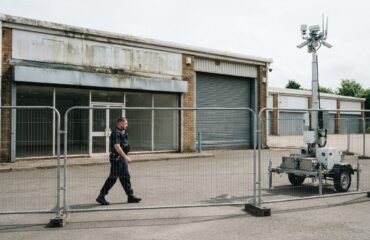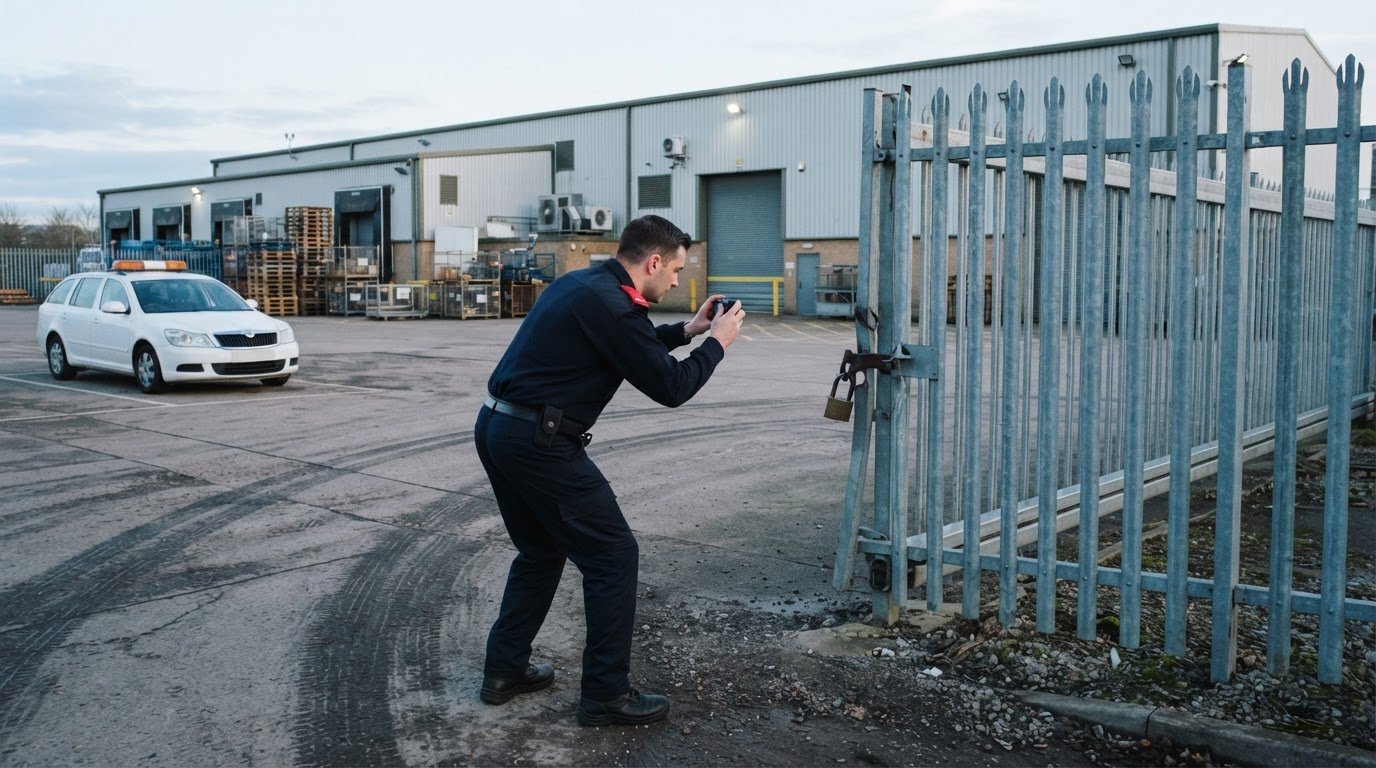
A static guard is not always the most practical way to oversee an entire site. Mobile security patrols provide a visible deterrent, allow officers to inspect changing site conditions and create a record of their findings. Coverage can move between priority areas instead of remaining at one post.
This flexibility can suit premises where risks vary by location or time, but patrols are not a like-for-like substitute when continuous on-site presence is essential. Reports, including photographs or video, can help businesses understand site conditions and identify issues that need attention.
This article explains how patrols can deter risks, what clear reporting and risk assessment involve, and how scheduled, random or responsive visits differ. It also outlines when mobile coverage may be a practical alternative to static security, and how site layout, vulnerable areas and required checks can guide the choice for your operation.
Key Takeaways
- Use mobile coverage to direct checks towards priority areas when continuous guarding at a fixed post is not essential.
- Clear incident reports and visual records can help you track site conditions and identify recurring vulnerabilities.
- Choose scheduled, random or combined visits according to the risks, site layout and checks required.
- FMT Security provides mobile patrols for construction, corporate and industrial settings where flexible site oversight is needed.
Why Choose Mobile Security Patrols?
Mobile security patrols provide a moving presence across premises rather than continuous cover at one post. Their value depends on site risks, required checks and whether incidents call for an immediate on-site response.
Patrols Compared with On-Site and Static Guarding
A static guard remains at a fixed location, while patrol officers check assigned areas. This can suit a business park where entrances, external windows and perimeter sections need attention at different times. Static guarding is more appropriate when one location requires continuous presence. Compare each option with the risks that the post or patrol route needs to address.
A reliable cost comparison requires a defined scope. Compare quotations against visit frequency, patrol duration, site size, staffing, and alarm-response or key-holding requirements. A scheduled route covering several buildings differs from a dedicated guard stationed at one entrance. The deciding factor is the level and continuity of presence required, not the service label alone.
Choosing a Reliable Patrol Provider
Choose a provider by documenting the premises, priority areas, visit schedule, reporting expectations and escalation procedure. Then assess whether its proposed patrol plan addresses those requirements, including how officers record missed access, damage or suspicious activity. A written scope makes service delivery easier to review and helps distinguish routine checks from alarm response. For keyholding, the keyholder must be able to reach the premises within 20 minutes to resolve alarm issues.
Confirm that deployed officers are suitably trained and that their qualifications match their assigned duties. The agreement should specify the required credentials and responsibilities.
A service contract or service-level agreement should define patrol areas, scheduled visits, tasks, reporting, alarm escalation, key-holding arrangements and how changes are agreed. Clear terms support accountability and help ensure the service meets the agreed requirements.
Patrols do not provide continuous presence between visits, and a mobile officer cannot attend two locations at once. Police may ignore future alarms if a keyholder fails to attend on more than three occasions, so define alarm attendance and escalation clearly.
Coverage depends on the provider’s operating area and travel logistics. Suitable sites can include offices, industrial premises, building sites and business parks, with patrol routes shaped around access points and exposed areas.
Patrol reporting, photographs and risk assessments
Patrol records show what officers checked, observed and escalated during each visit. Consistent entries help managers compare site conditions and review recurring concerns.
GPS-Confirmed Visits and Timestamps
Where GPS confirmation is part of the process, location data can record an officer’s attendance at an assigned checkpoint. A timestamp records the visit time, while checkpoint scans link attendance to specific areas. For example, a report can distinguish an inspected loading bay from a perimeter route still awaiting checks. These records support proof of service, but do not establish that every risk was resolved.
Patrol software can collect and analyse past incident data to inform future planning. For example, a manager reviewing repeated reports of damaged fencing can prioritise that boundary in later risk assessments. Reports submitted from mobile devices can include photographs or video of a forced gate, damaged vehicle or suspicious activity. Where real-time reporting is used, observations can be logged during the visit. Clear descriptions should separate observed facts from assumptions and record the officer’s actions and escalation.
Photographs, Risk Assessments and Incidents
Photographs and video provide visual context for a written account. A trained officer can record a broken window or obstruction alongside its location and the checks completed nearby. Risk assessments can then use logged incidents to identify repeated vulnerabilities rather than treat each event in isolation. If criminal activity is suspected, the report should describe what was observed and refer it through the agreed procedure.
Useful proof-of-service records cover attendance, findings, actions and unresolved concerns. A consistent format makes reports easier to compare across visits and locations, including vehicle areas, entrances or storage spaces. Businesses defining these requirements can review the scope of mobile patrol coverage before deployment. The value lies not in a photograph alone, but in a clear record that supports decisions and follow-up.
Regular, random, hybrid and ad hoc patrols
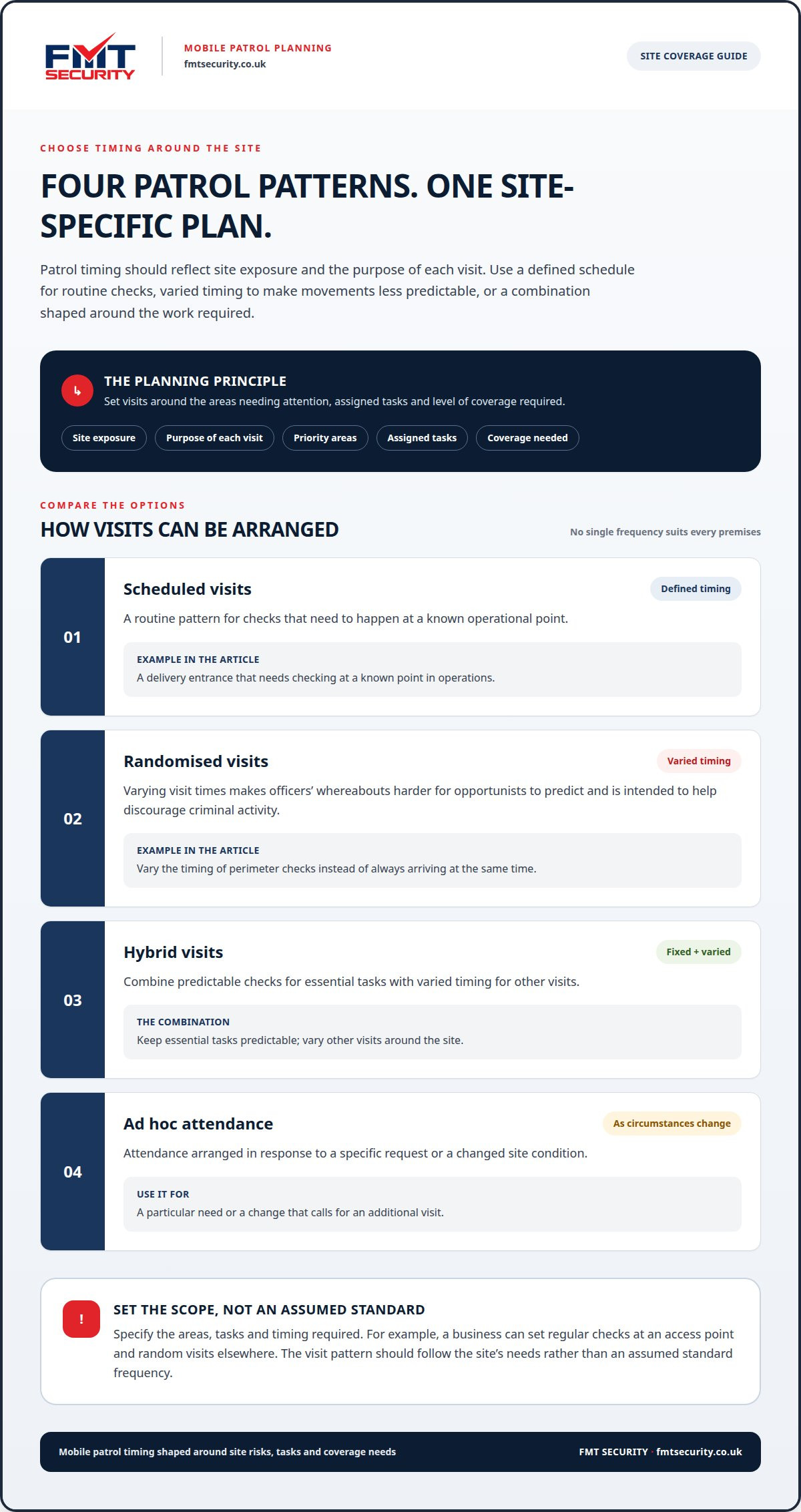
Patrol timing should reflect the site’s exposure and the purpose of each visit. A defined schedule provides routine checks, while varied timing makes officer movements less predictable.
Scheduled and Randomised Visits
Visits can be scheduled or random, with the client specifying areas, tasks and timing. A scheduled visit may suit a delivery entrance that needs checking at a known operational point. Random visits can vary the timing of perimeter checks. A hybrid plan combines both, keeping essential tasks predictable while varying other visits. Ad hoc attendance addresses a specific request or changed site condition.
There is no single visit frequency for every premises. Set the schedule around the areas requiring attention, assigned tasks and level of coverage needed. For example, a business can specify regular checks at an access point and random visits elsewhere. This defines the service without relying on an assumed standard frequency.
Random Patrols and Crime Deterrence
Random patrols are intended to make officers’ whereabouts harder for opportunists to predict, helping discourage criminal activity on the property. If patrols always arrive at the same time, an observer may learn the pattern. Varying visits can disrupt that predictability, while cameras may provide a separate view between patrols. Neither approach should be treated as a substitute for the other.
Hybrid arrangements can pair a fixed visit window for a critical task with less predictable checks of other areas. For instance, officers might attend for a specified access check, then vary visits around vehicles or a secondary boundary. Ad hoc visits can also address a reported concern or operational change. The plan should identify who can request attendance and which areas officers must prioritise.
To set an effective pattern, list the site’s priority areas, required tasks and known periods of activity. Assign scheduled visits where timing matters and random visits where uncertainty supports deterrence. Review the arrangement when site use or exposure changes, so patrol timing continues to serve its operational purpose.
Mobile patrols as an alternative to static security
Static guarding places an officer at a fixed post, providing a continuous visible presence there. Mobile patrols move between assigned areas, which can suit sites where risks are spread across separate buildings, entrances or external boundaries. The distinction is operational: choose fixed coverage when one location needs constant attendance, and mobile visits when checks across several areas are the priority.
During a patrol, officers can inspect perimeter security, doors, windows and lighting, and note suspicious activity or vulnerabilities. At a business park, for example, a route can cover several buildings and their external areas. Officers may patrol on foot, by bike or by car, according to the areas they need to cover. These visits provide active checks, but not continuous presence between visits.
Mobile coverage can be arranged for property checks during the day or at night. It may also support alarm response, with officers attending trigger events to investigate and secure facilities. The response plan should specify which locations need attention, what officers are expected to do and how findings are reported. This links patrol activity to site risks instead of treating each visit as a general drive-through.
For a larger site, divide the premises into assigned areas and prioritise exposed access points, outbuildings and less visible exterior spaces. Patrol officers can check those areas, secure doors and windows where required, and report suspicious activity. Licensed officers provide a visible security presence while moving across the site; static guarding is a stronger fit when an entrance needs uninterrupted attendance. The practical choice depends on whether the priority is continuous attendance or flexible coverage across multiple locations.
Define the required areas, checks, visit pattern and alarm escalation process before selecting an approach. Discuss mobile patrol coverage for premises that need coordinated checks across multiple areas.
FMT Security: Mobile Patrol
FMT Security provides a dedicated Mobile Patrol Service for businesses that need planned checks across premises rather than continuous guarding at one post. It can suit sites where risks extend across several areas or changing conditions call for flexible coverage. The service can be tailored to the premises, priority locations and tasks officers are expected to perform.
Construction Security, Corporate Security and Industrial Security can also address distinct operating environments where site access, assets and vulnerabilities differ. A defined patrol plan helps align visits with those operational requirements and clarify what officers should observe and report. Where one entrance needs uninterrupted attendance, static guarding may remain more appropriate; mobile coverage suits checks across dispersed areas.
To discuss a patrol plan for your premises, contact FMT Security.
Set the Next Step for Your Site
Effective security planning begins with a clear view of operational priorities. Consider which areas need regular oversight, where fixed attendance remains essential and what information decision-makers need from each visit. This assessment can help determine whether mobile security patrols fit alongside existing arrangements or should form part of a broader site plan.
FMT Security provides Construction Security, Corporate Security and Industrial Security for commercial environments with different site requirements. A discussion about your premises can focus on the coverage needed, priority locations and tasks officers should perform. This provides a practical basis for aligning patrol arrangements with day-to-day operations and relevant risks.
Discuss your patrol requirements with FMT Security and take a considered step towards a security plan suited to your site.
Frequently Asked Questions
Can you respond to alarms as part of the patrol service?
Yes. FMT Security provides key holding and immediate alarm response to investigate trigger events and secure client facilities. This allows alarm events to be handled through an arranged response rather than relying solely on an employee to attend. Clear site access arrangements and current contact details help officers follow agreed instructions and escalate concerns appropriately.
How often do patrols take place?
Patrol frequency is set according to the premises, priority areas and required tasks. A site with several separate buildings may need a different pattern from a single commercial unit with one principal access point. The schedule can also account for changing operational activity, such as deliveries or periods when machinery and materials are unattended, so visits focus on relevant exposure.
What happens during a Mobile Patrol visit?
During a visit, officers carry out the checks agreed for the site and report relevant observations. For example, they may follow access instructions, inspect a designated area and record an exception such as a damaged barrier or unexpected activity. The agreed procedure determines how findings are escalated, who receives the report and whether further action is required.
What do mobile security patrols include?
The service can include scheduled or random patrol units assigned to inspect properties and perimeter checkpoints. Its scope depends on the required duties and site arrangements. Key holding and alarm response can also be arranged where needed. A commercial premises might prioritise access checks, while an industrial site may require attention to separate checkpoints.
How does mobile patrol cover work in the UK?
FMT Security provides mobile patrol coverage throughout the UK, with units operating 24 hours a day, 7 days a week. Its security officers are fully trained and licensed to meet SIA standards. A business agrees the premises and required duties, then patrol officers attend according to the arranged coverage and carry out the assigned work.
How much do mobile security patrols cost in the UK?
The cost depends on the individual site’s requirements and is provided after a quote request. Factors include the premises’ layout, areas to be covered, visit frequency and duties required during each visit. Key-holding or alarm-response requirements can also affect the scope. This information helps shape a service arrangement around operational needs.